Clinical Research Phases: Understanding Phase 1, Phase 2, Phase 3, and Phase 4 Trials

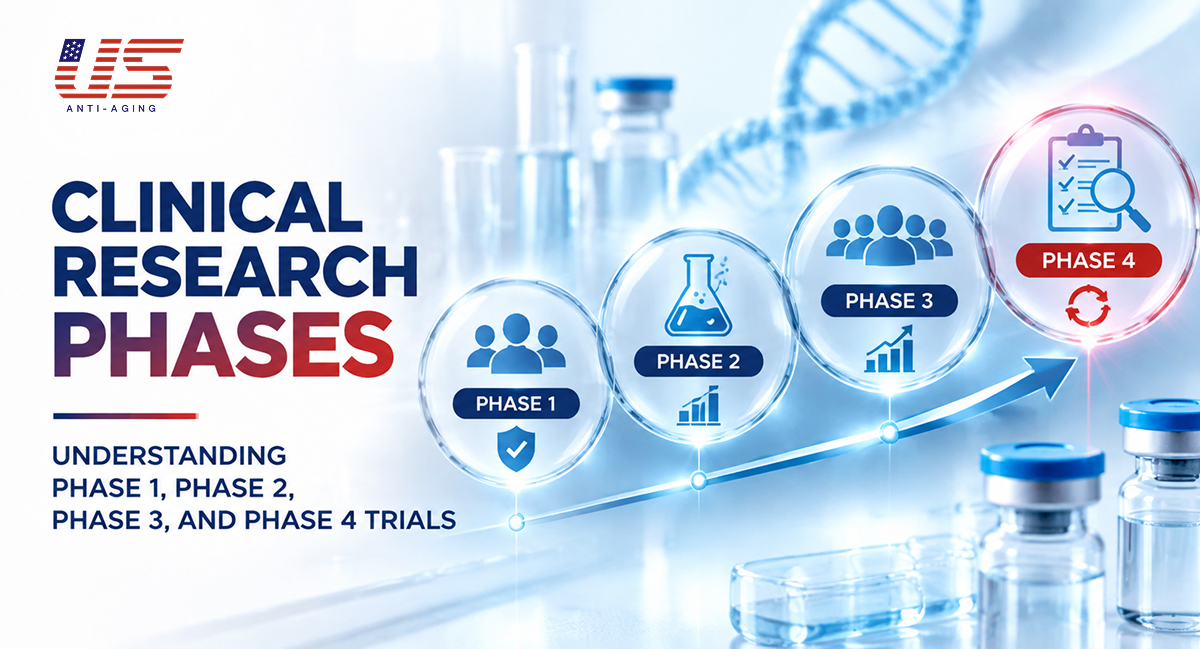


Clinical research phases are stages of human drug development that help scientists evaluate investigational treatments for safety, effectiveness, and appropriate use. Phase 1 primarily examines safety and dosage, Phase 2 explores preliminary efficacy, Phase 3 provides larger-scale evidence of benefits and risks, and Phase 4 investigates approved treatments after they reach the market.
Each stage addresses different scientific questions and builds on previous evidence. However, successful completion of an early trial does not guarantee regulatory approval or clinical effectiveness.
For laboratories exploring the science behind experimental compounds, US Anti-Aging offers research materials intended strictly for laboratory investigation.
This guide explains how clinical trials progress, what researchers measure, and why each phase matters when evaluating scientific evidence.
What Are Clinical Research Phases and Why Are They Important?
Clinical research phases provide a structured framework for evaluating investigational drugs in human participants. Each phase addresses specific questions about safety, biological activity, effectiveness, and treatment-related risks.
In the United States, the Food and Drug Administration (FDA) oversees drug development through regulatory requirements designed to protect participants and support reliable evidence.
How Clinical Development Progresses
Before human testing, researchers typically examine chemical characteristics, biological activity, and safety-related findings from appropriate nonclinical investigations.
Sponsors then submit an Investigational New Drug (IND) application when required before beginning clinical investigations in the United States.
Once authorized to proceed, clinical trials follow protocols that define participants, study procedures, outcomes, and safety monitoring.
The FDA describes clinical development as a progression from relatively small early-stage studies toward larger investigations designed to evaluate treatment benefits and risks (FDA, Clinical Research).
Comparison of the Four Clinical Trial Phases
| Phase | Primary objective | Typical participants | Main evidence generated |
|---|---|---|---|
| Phase 1 | Initial safety, tolerability, and dosage | 20–100 | Safety and pharmacokinetic data |
| Phase 2 | Preliminary efficacy and continued safety | Up to several hundred | Early effectiveness signals and adverse events |
| Phase 3 | Confirm effectiveness and characterize risks | 300–3,000 | Comparative clinical evidence |
| Phase 4 | Evaluate approved products after marketing | Varies; sometimes thousands | Longer-term safety and real-world information |
Participant numbers represent general FDA examples, not universal requirements. Actual designs vary according to the disease, intervention, and research objectives.
What Happens During Phase 1 Clinical Trials?
Phase 1 trials generally represent the first substantial evaluation of an investigational drug in humans.
Researchers primarily investigate safety, tolerability, pharmacokinetics, and dosing characteristics. Although early biological responses may also be measured, Phase 1 studies usually cannot establish clinical effectiveness.
Safety and Dose Evaluation
Many Phase 1 investigations involve healthy volunteers. However, studies involving certain conditions, including advanced cancers, may enroll patients instead.
Researchers may examine:
- Adverse events: Unfavorable medical occurrences during the trial.
- Tolerability: How participants respond to the investigational intervention.
- Pharmacokinetics: How the body absorbs, distributes, metabolizes, and eliminates a compound.
- Pharmacodynamics: Measurable biological responses associated with exposure.
- Dose escalation: How selected outcomes change across carefully monitored dose levels.
These measurements help researchers identify potential safety concerns before designing larger studies.
Why Early Human Data Matter
Preclinical models provide valuable information, but they cannot perfectly predict human responses.
Therefore, Phase 1 trials help characterize how an investigational compound behaves in participants under controlled conditions.
Researchers also assess whether the available findings support further clinical investigation.
Importantly, acceptable safety findings in a small group do not rule out uncommon or delayed adverse effects.
How Do Phase 2 Clinical Trials Evaluate Preliminary Efficacy and Safety?
Phase 2 studies typically involve participants with the condition that researchers intend to investigate.
Unlike Phase 1, these trials place greater emphasis on whether an intervention produces meaningful evidence of activity or preliminary effectiveness.
However, researchers continue evaluating adverse events and other safety outcomes.
Exploring Preliminary Effectiveness
Phase 2 investigators select predefined endpoints that reflect the study’s scientific objectives.
For example, researchers may examine disease-related biomarkers, clinical measurements, or other validated indicators of response.
Some trials also compare different experimental regimens or evaluate dose-response relationships.
Consequently, Phase 2 findings help determine whether larger studies are scientifically justified.
How Researchers Design Phase 2 Studies
Phase 2 designs may include randomized comparisons, multiple treatment groups, or staged enrollment.
In certain research settings, investigators use two-stage designs that allow early termination when preliminary activity appears insufficient.
A foundational study introduced statistical approaches for minimizing expected sample size while controlling specified error rates in Phase 2 research (Simon, 1989).
These methods help researchers make better-informed decisions about further development.
Why Phase 2 Results Remain Preliminary
An encouraging Phase 2 result does not necessarily predict success in Phase 3.
Smaller participant groups may not represent broader populations. Additionally, preliminary endpoints may not reliably predict long-term clinical outcomes.
Therefore, researchers must consider statistical uncertainty, study limitations, and the clinical relevance of measured changes.
What Is the Purpose of Phase 3 Clinical Trials?
Phase 3 trials investigate whether an experimental treatment demonstrates sufficient effectiveness and an acceptable safety profile in a defined population.
These studies generally involve more participants and may compare the investigational intervention with an established treatment or an appropriate control.
Their findings often contribute substantially to regulatory applications.
Confirming Clinical Effectiveness
Researchers establish primary and secondary outcomes before beginning the study.
A primary endpoint addresses the central research question, while secondary endpoints provide additional information about treatment responses.
Many Phase 3 studies use randomized allocation to reduce systematic differences between groups.
Additionally, blinding may help limit bias when participants or researchers assess outcomes.
Transparent reporting standards emphasize the importance of clearly describing randomization, participant flow, outcomes, and statistical methods (Schulz et al., 2010).
Evaluating Safety in Larger Populations
Larger trials can reveal adverse events that smaller studies may not detect.
Researchers also examine treatment discontinuation, clinically significant laboratory changes, and other safety-related outcomes.
Nevertheless, even large trials may lack sufficient duration or participants to identify very rare complications.
Therefore, clinical safety evaluation continues beyond Phase 3.
From Phase 3 Evidence to Regulatory Review
After completing relevant investigations, sponsors may submit a marketing application to the FDA.
Regulators assess evidence concerning effectiveness, safety, manufacturing quality, and the proposed product labeling.
However, completing Phase 3 does not automatically result in approval.
The evidence must support the proposed use under applicable regulatory standards.
How Does Phase 4 Research Monitor Treatments After Approval?
Phase 4 studies occur after a drug receives marketing approval.
Their purpose is to investigate additional questions about safety, effectiveness, optimal use, or treatment-related outcomes under broader conditions.
Unlike earlier phases, Phase 4 research concerns products that have already passed the relevant approval process.
Understanding Post-Marketing Research
Once an approved treatment reaches wider populations, researchers can investigate outcomes that earlier trials could not fully characterize.
For example, studies may examine longer-term exposure, different patient populations, or uncommon adverse reactions.
Researchers may use randomized clinical trials, observational studies, or patient registries, depending on the scientific question.
However, not every post-marketing safety investigation qualifies as a formal Phase 4 clinical trial.
Why Continued Safety Monitoring Is Necessary
Preapproval trials involve defined eligibility criteria and limited observation periods.
Consequently, certain populations or long-term outcomes may receive less extensive evaluation before approval.
Post-marketing surveillance helps identify potential safety signals as more people use an approved product.
Nevertheless, researchers must distinguish statistical associations from established causal relationships.
How Phase 4 Evidence Supports Ongoing Evaluation
Post-approval findings can contribute to updated safety warnings, labeling changes, additional research requirements, or other regulatory actions.
The FDA’s clinical development framework includes Phase 4 research within post-marketing safety monitoring (FDA, Clinical Research).
Therefore, regulatory approval marks an important milestone rather than the end of scientific evaluation.
To gain a deeper understanding of scientific methods, preclinical investigations, and clinical evidence, explore our comprehensive guide, Peptide Research: Scientific Methods, Preclinical Studies, and Clinical Evidence.

FAQs About Clinical Research Phases
1. What are the four main clinical research phases?
The four main phases are Phase 1, Phase 2, Phase 3, and Phase 4.
They primarily investigate initial safety, preliminary effectiveness, confirmatory clinical evidence, and post-approval outcomes, respectively.
2. What is the difference between Phase 1 and Phase 2 clinical trials?
Phase 1 primarily investigates safety, tolerability, and pharmacokinetics.
Phase 2 expands the investigation to preliminary effectiveness while continuing to monitor safety.
3. Does completing Phase 3 mean a treatment is FDA-approved?
No. Phase 3 results often support a regulatory application, but the FDA must evaluate the complete evidence and relevant manufacturing information before granting approval.
4. Why are Phase 4 trials important?
Phase 4 studies provide additional information after approval, including longer-term safety and treatment outcomes.
They can help identify questions that earlier clinical studies could not fully address.
5. Do all experimental compounds complete every clinical phase?
No. Some candidates stop development because of safety concerns, insufficient effectiveness, or other scientific and operational limitations.
Additionally, certain development programs use combined or adaptive phases rather than following a strictly separate sequence.
Conclusion: Understanding the Role of Clinical Research Phases
Understanding clinical research phases helps researchers distinguish preliminary findings from stronger evidence supporting medical applications.
Phase 1 establishes initial human safety information, Phase 2 explores potential effectiveness, Phase 3 generates larger-scale confirmatory evidence, and Phase 4 supports continued investigation after approval.
However, each phase has limitations, and no individual study can establish every aspect of a treatment’s safety or effectiveness.
Researchers investigating the underlying science can also explore laboratory-focused resources at US Anti-Aging.
Disclaimer: All compounds and information presented in this article are intended strictly for scientific research and educational purposes. These products are not approved for medical use and are not intended for human or veterinary use, diagnosis, treatment, or prevention of any disease.