Peptide Research: Scientific Methods, Preclinical Studies, and Clinical Evidence

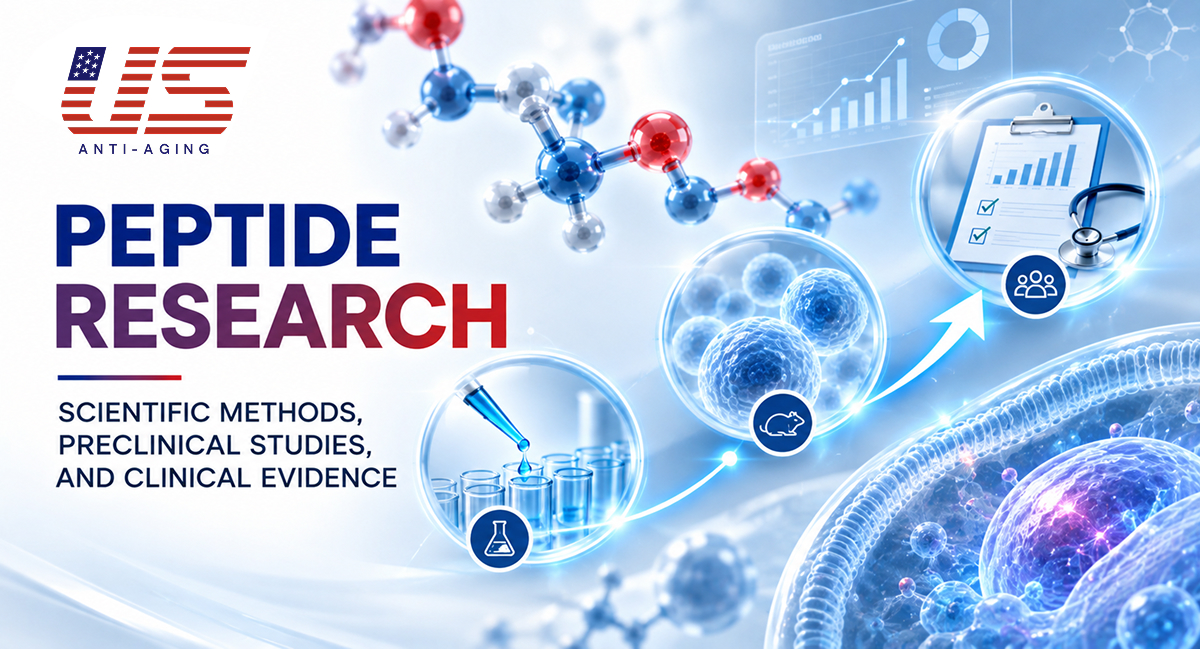


Peptide research is the scientific investigation of peptide molecules, their biological properties, molecular interactions, and potential applications. Scientists use analytical chemistry, laboratory experiments, preclinical models, and human clinical trials to examine how peptides behave and whether specific compounds demonstrate measurable biological activity.
However, different research stages produce different types of evidence. Laboratory findings may reveal molecular mechanisms, while carefully designed clinical trials investigate safety and effectiveness in humans.
For laboratories exploring peptide science, US Anti-Aging offers research compounds intended for controlled scientific investigation.
This guide examines research methodologies, evidence evaluation, clinical development, and the scientific challenges involved in studying peptide compounds.
What Is Peptide Research and What Does It Aim to Investigate?
Peptide research examines molecules composed of amino acid residues connected through peptide bonds. Researchers study naturally occurring peptides, synthetic sequences, and chemically modified compounds to understand their properties and biological interactions.
Scientific investigations cover molecular characterization, receptor activity, stability, metabolism, and potential applications across different research fields.
Major Objectives of Peptide Research
Researchers investigate several scientific questions:
- Molecular identity: What are the compound’s sequence, mass, and chemical characteristics?
- Biological activity: Does the peptide produce measurable effects in experimental models?
- Mechanisms of action: Which molecular targets participate in observed responses?
- Stability: How does the compound behave under different experimental conditions?
- Safety: What potential adverse effects emerge during appropriate testing?
- Clinical relevance: Can suitable evidence support further investigation in humans?
Importantly, identifying biological activity does not automatically establish therapeutic value.
Scientific reviews describe peptide development as a multidisciplinary field involving molecular discovery, structural optimization, analytical evaluation, and clinical investigation (Fosgerau & Hoffmann, 2015).
Why Research Objectives Matter
A clearly defined scientific question determines which experimental methods are appropriate.
For example, researchers investigating receptor binding may use biochemical assays. Meanwhile, scientists examining systemic distribution require models that account for biological transport and metabolism.
Consequently, research quality depends on matching experimental design to the intended scientific objective.
How Do Scientists Design and Conduct Peptide Research Studies?
A reliable peptide research study begins with a testable hypothesis and a carefully defined experimental plan.
Researchers select suitable models, measurement techniques, and controls before collecting data. Additionally, they establish procedures for documenting experimental conditions and evaluating results.
Key Stages of Experimental Design
A typical investigation includes five stages:
- Research question: Define the biological or chemical property under investigation.
- Experimental model: Select an appropriate biochemical, cellular, or organism-based system.
- Analytical methods: Identify techniques that measure the intended endpoints.
- Controls and replication: Establish comparisons that help distinguish experimental effects from background variation.
- Data interpretation: Evaluate findings using appropriate statistical and scientific methods.
These steps support reproducibility and help researchers identify possible sources of error.
Analytical Characterization Before Biological Testing
Scientists often begin by examining compound identity and sample quality.
High-performance liquid chromatography (HPLC) can separate chemical components, while mass spectrometry supports molecular identification.
However, analytical purity does not prove biological activity, safety, or clinical effectiveness.
Researchers must interpret each measurement according to what the technique actually establishes.
Why Reproducibility Is Essential
Experimental reproducibility allows independent investigators to evaluate whether findings remain consistent under comparable conditions.
Therefore, researchers should document sample characteristics, experimental controls, statistical methods, and relevant procedures.
Furthermore, transparent reporting helps distinguish robust observations from findings that require additional validation.
What Types of Evidence Are Generated in Preclinical Peptide Research?
Preclinical investigations generate evidence before researchers establish whether a candidate is appropriate for clinical development.
These studies commonly involve biochemical assays, cultured cells, computational models, and, when scientifically justified, animal experiments.
However, not every peptide investigated in a laboratory enters a formal drug-development program.
In Vitro Evidence and Molecular Mechanisms
In vitro studies examine biological processes outside intact living organisms.
For example, researchers may measure receptor interactions, enzyme activity, or changes in cellular signaling following exposure to a peptide.
These experiments help establish mechanistic hypotheses under controlled conditions.
Nevertheless, isolated systems cannot fully reproduce circulation, metabolism, and interactions between multiple organs.
In Vivo Evidence and Biological Complexity
In vivo investigations examine responses within living organisms.
These models can provide information about compound distribution, metabolism, physiological regulation, and organism-level responses.
However, differences between species can limit the relevance of findings to humans.
Consequently, researchers must consider experimental validity and the limitations of each model.
International reporting recommendations emphasize transparent experimental design, statistical analysis, and appropriate reporting of animal studies (Percie du Sert et al., 2020).
Comparing Different Levels of Scientific Evidence
| Research stage | Primary objective | Evidence generated | Main limitation |
|---|---|---|---|
| Analytical characterization | Examine chemical identity and quality | Molecular mass, composition, purity | Does not establish biological activity |
| Biochemical assays | Investigate molecular interactions | Enzyme activity, receptor binding | Limited biological complexity |
| Cell-based studies | Examine cellular responses | Signaling and gene expression changes | Cannot reproduce whole-body physiology |
| Animal studies | Investigate integrated biological effects | Physiological and safety-related observations | Species differences |
| Human clinical trials | Evaluate defined outcomes in participants | Human safety and efficacy evidence | Applicability depends on trial quality and population |
Importantly, evidence from one stage cannot automatically replace evidence from another.
Instead, researchers integrate findings to determine whether additional investigations are scientifically justified.
How Are Peptides Evaluated in Human Clinical Trials?
Human clinical trials investigate defined scientific questions involving safety, biological responses, and potential clinical effectiveness.
However, only appropriately authorized and evaluated investigational products should enter human studies.
The existence of laboratory research material does not establish its suitability for clinical administration.
Understanding Clinical Trial Phases
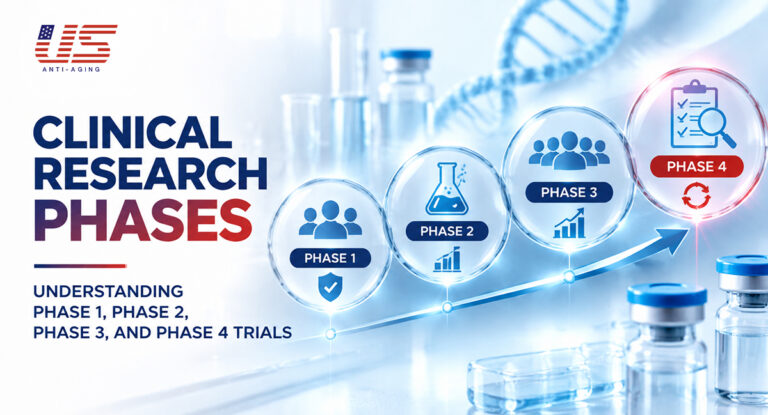
Clinical development generally progresses through several stages.
Phase 1: Researchers primarily investigate safety, tolerability, and pharmacokinetic characteristics, often in relatively small participant groups.
Phase 2: Studies examine preliminary effectiveness in a defined population while continuing safety evaluation.
Phase 3: Larger trials investigate effectiveness and safety, frequently comparing an intervention with an appropriate control or existing treatment.
Phase 4: Following regulatory approval, researchers may conduct additional studies to investigate longer-term safety and real-world use.
The FDA explains that each clinical phase addresses different research questions and contributes evidence toward regulatory evaluation (FDA, 2025).
How Researchers Evaluate Clinical Evidence
Researchers examine several characteristics when interpreting trial results:
- Study design: Whether the investigation appropriately addresses its hypothesis.
- Control groups: Whether comparisons support reliable interpretation.
- Participant selection: Whether the population represents the intended research question.
- Outcome measures: Whether endpoints are clinically meaningful and appropriately measured.
- Statistical analysis: Whether findings account for uncertainty and potential bias.
Furthermore, researchers evaluate adverse events, withdrawals, and differences between participant groups.
Modern Good Clinical Practice guidance emphasizes participant protection, reliable data, and quality-focused trial design (FDA, 2025).
Why Clinical Trials Do Not Guarantee Approval
Even promising compounds may fail to demonstrate adequate effectiveness or acceptable safety.
Additionally, regulatory review considers manufacturing quality, consistency, and the overall evidence supporting a specific proposed use.
Therefore, clinical investigation should never be confused with regulatory approval.
What Are the Main Challenges and Limitations of Current Peptide Research?
Despite advances in analytical techniques and experimental models, peptide research continues to face substantial scientific challenges.
These challenges involve molecular stability, biological complexity, reproducibility, and the interpretation of evidence.
Molecular Stability and Biological Availability
Some peptides undergo rapid degradation through enzymatic processes.
Additionally, their molecular properties may limit distribution across certain biological barriers or affect exposure at specific targets.
Consequently, researchers investigate stability, pharmacokinetics, and structural modifications when evaluating candidate molecules.
Scientific literature identifies stability, delivery, and molecular optimization as important considerations in peptide development (Lau & Dunn, 2018).
Translating Laboratory Findings Into Clinical Evidence
A positive laboratory result does not guarantee a comparable response in humans.
Cell cultures lack many physiological interactions, while animal models may differ from human biology in metabolism and receptor characteristics.
Furthermore, experimental concentrations may not correspond to achievable or appropriate human exposures.
Therefore, researchers need carefully designed studies before drawing broader conclusions.
Research Quality and Interpretation
Scientific findings can vary because of differences in sample quality, experimental methods, model selection, and statistical analysis.
Moreover, small studies may produce uncertain estimates, while inadequate controls can introduce bias.
For this reason, researchers should examine independent replication, study limitations, and the consistency of available evidence.
High-quality investigations distinguish established observations from preliminary hypotheses rather than presenting all findings as equally conclusive.
FAQs About Peptide Research
1. What is peptide research?
Peptide research investigates the chemical properties, biological mechanisms, and potential applications of peptide molecules.
Scientists use analytical methods, laboratory models, and appropriately designed clinical studies to examine different aspects of peptide behavior.
2. What is the difference between preclinical and clinical peptide research?
Preclinical studies investigate molecular properties and biological responses using laboratory or nonhuman models.
Clinical studies involve human participants and evaluate defined questions about safety, effectiveness, or other clinical outcomes.
3. Can laboratory peptide studies prove medical benefits?
No. Laboratory studies can reveal molecular interactions and potential biological mechanisms, but they cannot independently establish clinical benefits.
Medical claims require appropriate human evidence and regulatory evaluation.
4. Why do some peptides fail during clinical development?
Potential reasons include inadequate effectiveness, safety concerns, unfavorable pharmacokinetics, or manufacturing challenges.
Additionally, biological responses observed in early research may not translate into meaningful clinical outcomes.
5. Are all research peptides approved for human use?
No. Research-use-only compounds do not become approved medicines simply because scientists investigate them.
Regulatory approval applies to specific evaluated products and intended uses, not to every material containing a particular peptide sequence.
Conclusion: Understanding Scientific Evidence in Peptide Research
Peptide research depends on a systematic process of molecular characterization, experimental investigation, and careful evidence evaluation.
Preclinical studies help scientists examine biological mechanisms and generate hypotheses. Meanwhile, appropriately designed clinical trials provide human evidence relevant to safety and effectiveness.
However, meaningful scientific conclusions require reproducible findings, suitable experimental models, and transparent interpretation of limitations.
For laboratories exploring peptide chemistry and molecular biology, US Anti-Aging offers research compounds intended for controlled scientific investigation.
Disclaimer: All compounds and information presented in this article are intended strictly for scientific research and educational purposes. These products are not approved for medical use and are not intended for human or veterinary use, diagnosis, treatment, or prevention of any disease.