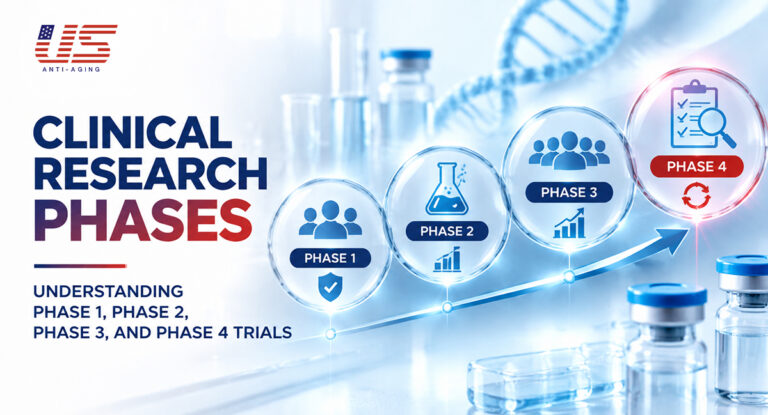
Peptide Clinical Trials: Study Designs, Research Outcomes, and Current Evidence

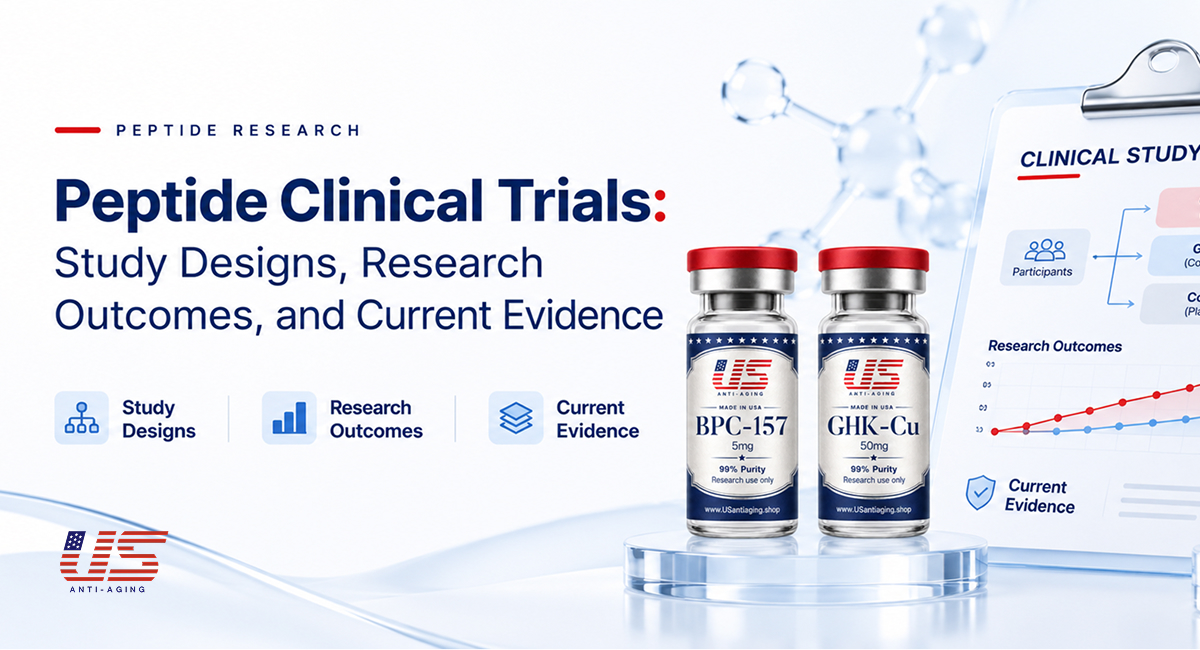


Peptide clinical trials investigate the safety, biological activity, and potential effectiveness of peptide-based compounds in human participants. Researchers use controlled study designs to measure outcomes, identify adverse events, and determine whether specific compounds provide meaningful clinical evidence.
These investigations span different clinical research phases, from early safety assessments to larger confirmatory trials. However, not every experimental peptide progresses through clinical development, and promising findings do not automatically establish medical benefits.
For laboratories exploring peptide science, US Anti-Aging provides research-focused compounds intended for scientific investigation.
This article examines peptide trial designs, published human research, clinical endpoints, and the limitations researchers must consider when interpreting available evidence.
What Are Peptide Clinical Trials and What Do Researchers Investigate?
Peptide clinical trials are human studies designed to evaluate compounds containing amino acid sequences with specific biological properties.
Researchers investigate different characteristics depending on the compound, intended application, and stage of clinical development.
These studies follow established clinical research phases, but their scientific objectives extend beyond simply determining whether a peptide produces a measurable response.
Major Objectives of Peptide Clinical Research
Clinical investigators commonly examine:
- Safety and tolerability: Identifying adverse events and potential risks.
- Pharmacokinetics: Measuring absorption, distribution, metabolism, and elimination.
- Pharmacodynamics: Evaluating biological responses associated with exposure.
- Clinical efficacy: Determining whether an intervention produces meaningful outcomes.
- Dose-response relationships: Examining how responses vary across studied exposure levels.
Importantly, these outcomes require different experimental methods.
For example, identifying receptor activity in a laboratory does not establish clinical effectiveness in humans.
How Peptide Trials Differ From Laboratory Research
Human investigations must account for physiological complexity, participant variability, and clinical safety.
Furthermore, researchers must follow applicable ethical and regulatory requirements, including informed consent and appropriate institutional review.
Scientific reviews describe peptide therapeutics as a diverse research field involving molecular optimization, biological evaluation, and clinical development (Lau & Dunn, 2018).
Which Types of Peptide-Based Compounds Have Been Studied in Human Trials?
Human research has investigated multiple peptide classes, including metabolic hormones, growth hormone-related analogs, and compounds targeting specific signaling systems.
However, these categories differ substantially in clinical maturity. Some peptides form part of approved medicines, while others remain investigational.
GLP-1 Receptor Agonists and Metabolic Research
Glucagon-like peptide-1 (GLP-1) receptor agonists represent an extensively studied category of peptide-based therapies.
Researchers investigate their effects on metabolic regulation through controlled clinical studies.
For example, the STEP 1 trial examined semaglutide in adults with overweight or obesity. The randomized study reported a mean body-weight change of -14.9% with semaglutide compared with -2.4% with placebo over 68 weeks, alongside gastrointestinal adverse events (Wilding et al., 2021).
These findings concern a specific pharmaceutical formulation, study population, and clinical protocol.
They should not be generalized to unrelated research compounds.
Growth Hormone-Releasing Hormone Analogs
Researchers have also investigated peptide analogs associated with growth hormone signaling.
Tesamorelin, for example, has undergone randomized human trials involving adults with HIV-associated abdominal fat accumulation.
A pooled analysis of two Phase 3 studies examined changes in visceral adipose tissue and additional safety-related outcomes (Falutz et al., 2010).
However, findings for one peptide and indication do not establish comparable effects for other growth hormone-related compounds.
Investigational Multi-Receptor Peptides
Scientists have investigated experimental peptides designed to interact with multiple hormonal receptors.
For example, a Phase 2 study evaluated retatrutide, a compound targeting GIP, GLP-1, and glucagon receptors, in adults with obesity.
The trial reported dose-dependent weight changes and gastrointestinal adverse events, supporting further investigation rather than establishing unrestricted clinical use (Jastreboff et al., 2023).
Regulatory status must always be evaluated separately from published trial findings.
How Are Safety and Efficacy Measured in Peptide Clinical Trials?
Researchers evaluate safety and efficacy using predefined endpoints appropriate to the investigational compound.
Clinical research phases influence the questions investigators prioritize, while study protocols specify how they collect and analyze data.
Common Clinical Trial Measurements
| Research area | Typical measurements | Scientific purpose |
|---|---|---|
| Safety | Adverse events, laboratory abnormalities | Identify potential risks |
| Pharmacokinetics | Drug concentration, exposure, clearance | Characterize compound behavior |
| Pharmacodynamics | Biomarkers and physiological responses | Investigate biological activity |
| Efficacy | Disease-specific clinical endpoints | Evaluate potential clinical benefits |
| Tolerability | Discontinuation and treatment-related symptoms | Assess participant responses |
| Long-term follow-up | Delayed outcomes and adverse events | Investigate durability and safety |
Why Study Design Matters
Randomized controlled trials help reduce systematic differences between comparison groups.
Additionally, blinding can limit certain forms of measurement and interpretation bias.
Researchers should distinguish primary endpoints from secondary or exploratory findings because these outcomes may have different statistical significance and evidentiary strength.
Updated CONSORT guidance emphasizes transparent reporting of trial design, participant flow, outcomes, and analytical methods (Hopewell et al., 2025).
Understanding Safety Evidence
A trial that reports acceptable tolerability does not establish the absence of risk.
Small studies may miss uncommon adverse events, while short observation periods cannot fully characterize delayed effects.
Therefore, safety evaluation requires consideration of participant characteristics, exposure duration, and the completeness of adverse-event reporting.
What Can Published Clinical Trial Results Tell Us About Peptide Research?
Published peptide clinical trials provide evidence about specific interventions under defined experimental conditions.
However, their findings must be interpreted according to participant selection, outcome measures, and study limitations.
Interpreting Clinical Outcomes
Consider a trial reporting a statistically significant change in a biomarker.
That finding may indicate measurable biological activity, but it does not necessarily demonstrate improvement in a clinically meaningful outcome.
Researchers should therefore examine effect size, confidence intervals, comparison groups, and the relevance of the selected endpoint.
For example, the SURMOUNT-1 trial evaluated tirzepatide in adults with obesity and reported differences in body-weight outcomes across randomized treatment groups
Nevertheless, those results apply to the studied intervention and population rather than every peptide that influences metabolic signaling.
Distinguishing Strong and Preliminary Evidence
A useful interpretation considers three questions:
- Was the study appropriately controlled? Randomization and suitable comparisons can strengthen causal interpretation.
- Were the outcomes clinically meaningful? Biomarker changes and patient-relevant outcomes should not be treated as equivalent.
- Were the findings independently supported? Replication and consistent evidence strengthen confidence.
Furthermore, publication does not automatically indicate regulatory approval.
Researchers should evaluate trial registration, published protocols, and relevant regulatory information alongside reported results.

What Are the Limitations of Current Human Clinical Evidence for Investigational Peptides?
Despite advances in clinical development, many investigational peptides lack sufficient evidence to support medical applications.
Importantly, evidence from approved peptide medicines cannot establish safety or effectiveness for chemically different compounds.
Limited Human Data
Some investigational peptides have only small early-stage studies, while others have no published controlled human trials.
Consequently, researchers may lack reliable information about long-term safety, clinically meaningful outcomes, or responses across different populations.
Furthermore, favorable laboratory findings cannot replace human clinical evidence.
Challenges in Translating Research Findings
Several factors limit the interpretation of early clinical results:
- Small participant groups: May produce imprecise estimates.
- Short follow-up periods: May overlook delayed adverse events.
- Population restrictions: Can limit applicability to other groups.
- Exploratory endpoints: May not reflect meaningful clinical benefits.
- Formulation differences: Can affect exposure and product characteristics.
- Incomplete reporting: May obscure important limitations.
These concerns become particularly important when interpreting research involving compounds with limited clinical investigation.
Why Regulatory Status Matters
An investigational peptide and an FDA-approved peptide medicine are not interchangeable.
Approval depends on evidence supporting a specific product, formulation, indication, and manufacturing process.
Therefore, research-use-only materials should not be presented as clinically validated alternatives to approved medicines.
To gain a deeper understanding of scientific methods, preclinical investigations, and clinical evidence, explore our comprehensive guide, Peptide Research: Scientific Methods, Preclinical Studies, and Clinical Evidence.
FAQs About Peptide Clinical Trials
1. What are peptide clinical trials?
Peptide clinical trials are human investigations that examine the safety, biological activity, and potential effectiveness of peptide-based compounds.
Researchers use predefined protocols, endpoints, and monitoring procedures to evaluate outcomes.
2. Have any peptide-based medicines completed clinical trials?
Yes. Several peptide-based medicines have undergone extensive clinical testing and received regulatory approval for specific indications.
However, approval of one peptide does not establish the safety or effectiveness of unrelated compounds.
3. Are all peptides studied in human clinical trials?
No. Many peptides remain limited to laboratory or preclinical investigation.
Human testing requires appropriate scientific justification, ethical oversight, and applicable regulatory authorization.
4. What do Phase 1 and Phase 2 peptide trials investigate?
Phase 1 studies primarily evaluate initial safety, tolerability, and pharmacokinetics.
Phase 2 studies investigate preliminary effectiveness while continuing safety evaluation.
5. Can clinical trial findings establish that a research peptide is safe?
Not automatically. Clinical evidence must apply to the specific compound, formulation, population, and intended use.
Additionally, limited studies may not identify rare or long-term adverse effects.
Conclusion: Understanding Clinical Evidence in Peptide Research
Peptide clinical trials provide valuable information about human biological responses, treatment-related risks, and potential clinical effectiveness.
However, the strength of available evidence varies considerably between compounds. While some peptide-based medicines have undergone extensive evaluation, many investigational peptides remain supported by limited human data.
Consequently, researchers must distinguish preliminary findings from established clinical evidence and consider the limitations of individual studies.
Laboratories investigating peptide chemistry and molecular mechanisms can also explore research-focused materials through US Anti-Aging
Disclaimer: All compounds and information presented in this article are intended strictly for scientific research and educational purposes. These products are not approved for medical use and are not intended for human or veterinary use, diagnosis, treatment, or prevention of any disease.