Peptide Pharmacokinetics: Absorption, Distribution, Metabolism, and Elimination

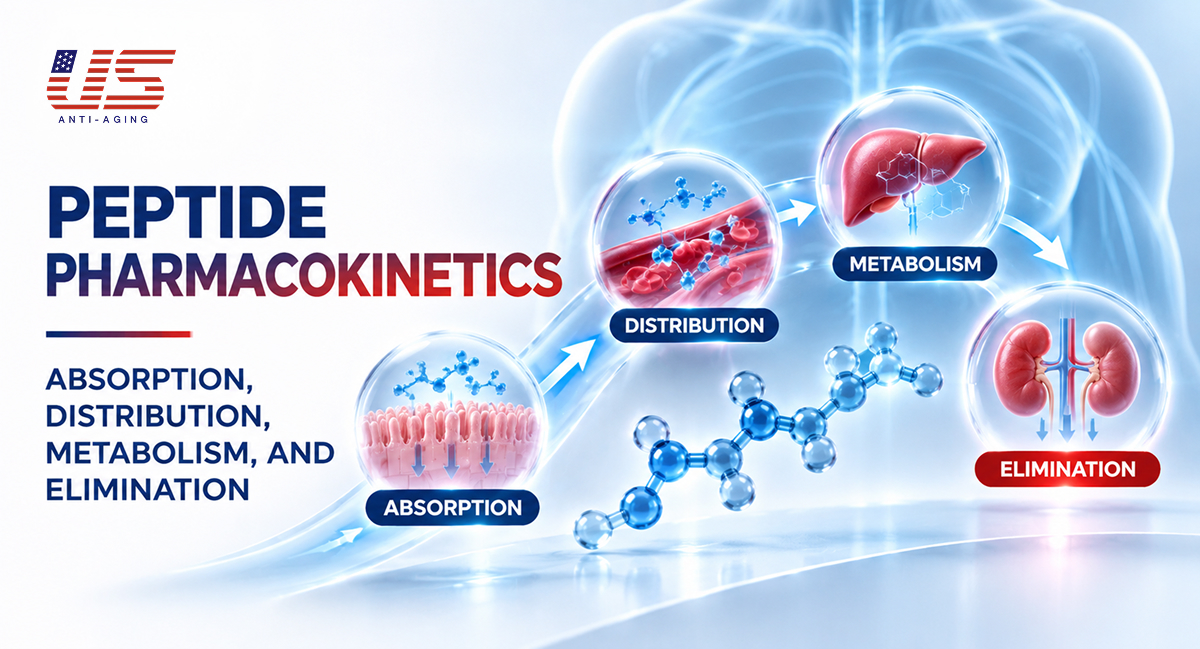


Peptide pharmacokinetics describes how peptide molecules are absorbed, distributed, metabolized, and eliminated within biological systems. These four processes, collectively known as ADME, determine how much of a peptide reaches systemic circulation, where it travels, and how long it remains detectable.
Unlike many small molecules, peptides often face challenges involving enzymatic degradation, membrane permeability, and rapid clearance. However, their pharmacokinetic behavior varies according to molecular structure, chemical modifications, and experimental conditions.
For laboratories investigating peptide behavior, US Anti-Aging provides research compounds intended for scientific investigation.
This guide examines peptide absorption, tissue distribution, metabolic stability, half-life, and the analytical methods researchers use to measure pharmacokinetic properties.
What Is Peptide Pharmacokinetics and Why Does It Matter in Research?
Peptide pharmacokinetics examines the movement and transformation of peptides over time within biological systems.
Researchers use pharmacokinetic measurements to understand how molecular characteristics influence systemic exposure, tissue distribution, and elimination.
These properties are particularly important because peptide molecules may undergo rapid degradation or encounter biological barriers that restrict their movement.
Understanding the Four ADME Processes
Pharmacokinetic investigations generally examine four interconnected processes:
- Absorption: Movement from an administration site into systemic circulation.
- Distribution: Movement between blood, tissues, and other biological compartments.
- Metabolism: Chemical transformation through enzymes and other biological processes.
- Elimination: Removal of the parent peptide through metabolism, excretion, or both.
Together, these processes help researchers characterize changes in peptide concentration over time.
A comprehensive review explains that therapeutic peptides often exhibit pharmacokinetic characteristics distinct from conventional small-molecule compounds, including susceptibility to proteolysis and renal filtration (Diao & Meibohm, 2013).
Pharmacokinetics vs. Pharmacodynamics
Although closely related, pharmacokinetics and pharmacodynamics address different scientific questions.
Pharmacokinetics investigates what happens to a compound within a biological system. In contrast, pharmacodynamics examines how the compound influences biological targets and measurable responses.
For example, researchers might measure plasma peptide concentrations while separately evaluating changes in receptor-associated biomarkers.
Consequently, pharmacokinetic data alone cannot establish biological effectiveness or clinical benefit.
How Are Peptide Absorption and Bioavailability Investigated?
Absorption determines how an administered peptide enters systemic circulation.
However, the extent and rate of absorption depend on molecular characteristics, the administration route, formulation, and biological barriers.
What Determines Peptide Bioavailability?
Bioavailability describes the fraction of an administered dose that reaches systemic circulation as unchanged parent compound.
For intravenous administration, absolute bioavailability is defined as 100% because the administered compound directly enters systemic circulation.
For other routes, researchers may calculate absolute bioavailability by comparing dose-normalized systemic exposure with intravenous reference data.
Important factors affecting peptide absorption include:
- Molecular size and electrical charge.
- Membrane permeability.
- Enzymatic stability.
- Formulation characteristics.
- Local physiological conditions.
- Administration route.
Importantly, absorption and bioavailability are not interchangeable. A molecule may cross a biological barrier but undergo degradation before reaching systemic circulation intact.
Why Oral Peptide Absorption Is Challenging
Many peptides have limited oral bioavailability because digestive enzymes can break peptide bonds, while intestinal membranes restrict the passage of certain molecules.
Furthermore, gastrointestinal pH and local physiological conditions influence molecular stability.
Research examining intestinal transport identifies enzymatic degradation and low epithelial permeability as major barriers to oral peptide absorption (Lundquist & Artursson, 2016).
However, these challenges do not mean every peptide has identical absorption characteristics.
Some approved pharmaceutical formulations use specialized technologies to address specific delivery barriers.
Laboratory Methods for Absorption Research
Researchers may investigate absorption using epithelial cell models, permeability assays, and pharmacokinetic sampling.
For example, cell-based experiments can examine molecular transport across selected biological barriers.
Nevertheless, in vitro permeability findings cannot independently establish systemic bioavailability within living organisms.
How Are Peptides Distributed Across Biological Compartments?
Following entry into systemic circulation, peptide molecules may distribute between blood plasma, extracellular fluid, and selected tissues.
Distribution depends on molecular size, protein binding, tissue permeability, and interactions with biological structures.
What Influences Peptide Distribution?
Several factors affect how peptides move through biological compartments.
Molecular size influences diffusion and movement across certain biological barriers. Meanwhile, plasma protein binding can alter the amount of unbound peptide available for distribution and elimination.
Additionally, tissue blood flow and local permeability may influence how quickly a peptide reaches different compartments.
The distribution of many conventional peptide therapeutics primarily involves plasma and extracellular fluid, although chemically modified molecules may behave differently (Diao & Meibohm, 2013).
Understanding Volume of Distribution
Volume of distribution, commonly abbreviated as Vd, is a pharmacokinetic parameter describing the apparent relationship between the amount of a compound in the body and its plasma concentration.
It does not represent a literal anatomical compartment.
A relatively low volume of distribution may indicate that a compound remains largely within plasma or extracellular spaces. Conversely, a higher value can reflect more extensive distribution or binding outside plasma.
However, researchers must interpret Vd alongside protein binding, clearance, and experimental conditions.
Why Tissue Distribution Matters
A measurable plasma concentration does not necessarily indicate that the same concentration exists in every tissue.
Furthermore, the presence of a compound within a tissue does not independently establish receptor engagement or biological activity.
Therefore, researchers may combine plasma measurements with tissue analysis and molecular imaging when scientifically appropriate.
How Do Enzymatic Degradation and Metabolism Affect Peptide Stability?
Metabolism plays a major role in peptide pharmacokinetics because many peptide molecules are susceptible to enzymatic cleavage.
Proteases and peptidases can break peptide bonds, producing smaller fragments or individual amino acids.
However, the rate and location of degradation vary between compounds.
Major Mechanisms of Peptide Degradation
Researchers commonly investigate:
- Endopeptidase activity: Enzymes cleave peptide bonds within a molecular chain.
- Exopeptidase activity: Enzymes remove amino acid residues from peptide termini.
- Chemical degradation: Oxidation, deamidation, and other reactions may alter molecular integrity.
- Renal processing: Filtration and subsequent enzymatic breakdown may contribute to clearance.
These processes can change the concentration of the intact peptide and generate metabolites with different characteristics.
An industry review examines metabolism and excretion methods for therapeutic peptides, including analytical strategies and the challenges of characterizing peptide metabolites (He et al., 2023).
How Molecular Modifications Influence Stability
Chemical modifications may change how enzymes recognize and process peptide molecules.
For example, researchers investigate amino acid substitutions, terminal modifications, cyclization, and conjugation with larger molecular groups.
Some strategies can reduce enzymatic susceptibility or alter renal filtration.
However, improved stability does not automatically establish greater safety or clinical effectiveness.
Moreover, changes to molecular structure may influence receptor interactions and other biological properties.
How Do Researchers Measure Peptide Half-Life, Clearance, and Exposure?
Researchers quantify peptide pharmacokinetics by collecting concentration measurements over time and analyzing their relationships.
These measurements help characterize exposure, elimination, and differences between experimental conditions.
Major Pharmacokinetic Parameters
| Parameter | Meaning | Research significance |
|---|---|---|
| Cmax | Maximum observed concentration | Describes peak exposure |
| Tmax | Time to reach Cmax | Helps characterize absorption timing |
| AUC | Area under the concentration-time curve | Measures total systemic exposure |
| t½ | Elimination half-life | Describes the time required for concentration to decrease by half during the relevant phase |
| CL | Clearance | Describes the apparent volume of biological fluid cleared of compound per unit time |
| Vd | Volume of distribution | Relates the amount of compound to plasma concentration |
| F | Bioavailability | Describes the fraction of a dose reaching systemic circulation unchanged |
Understanding Half-Life and Clearance
Elimination half-life describes how quickly peptide concentrations decline during the terminal elimination phase.
For simple first-order, one-compartment behavior, researchers may express the relationship as:
t½ = 0.693 × Vd / CL
However, this simplified relationship does not fully describe every multicompartment or nonlinear pharmacokinetic system.
Clearance represents the efficiency of irreversible elimination relative to concentration, not the percentage of a dose removed during a fixed period.
Recent research examining peptide therapeutics further illustrates how molecular size, protein binding, and biological elimination mechanisms influence pharmacokinetic parameters (Nordell et al., 2026).
Analytical Techniques for Peptide Pharmacokinetics
Scientists commonly use liquid chromatography–mass spectrometry (LC-MS/MS) to quantify peptide concentrations in biological samples.
Additionally, immunoassays may support selected investigations when researchers establish adequate specificity and validation.
A typical analysis involves collecting samples at predefined time points, quantifying the intact parent compound, and constructing concentration-time profiles.
However, researchers must distinguish intact peptides from degradation fragments because some analytical methods may detect related molecular species.
Interpreting Pharmacokinetic Evidence
A longer half-life does not necessarily mean a compound produces stronger biological responses.
Similarly, higher systemic exposure does not independently establish a favorable safety profile.
Therefore, researchers interpret pharmacokinetic findings alongside pharmacodynamic measurements, experimental design, and appropriate safety data.
To gain a deeper understanding of scientific methods, preclinical investigations, and clinical evidence, explore our comprehensive guide, Peptide Research: Scientific Methods, Preclinical Studies, and Clinical Evidence.
FAQs About Peptide Pharmacokinetics
1. What is peptide pharmacokinetics?
Peptide pharmacokinetics examines how peptide molecules enter, move through, undergo transformation within, and leave biological systems.
Researchers evaluate absorption, distribution, metabolism, elimination, and concentration changes over time.
2. Why do some peptides have short half-lives?
Many peptides undergo enzymatic degradation or renal filtration.
However, molecular structure, protein binding, and chemical modifications can substantially influence elimination half-life.
3. What is the difference between peptide half-life and stability?
Half-life describes the decline in peptide concentration within a defined pharmacokinetic system.
Stability describes resistance to chemical or enzymatic changes under specified conditions.
Although related, these measurements are not interchangeable.
4. How do researchers measure peptide bioavailability?
Researchers compare systemic exposure after nonintravenous administration with exposure following an intravenous reference dose, accounting for administered doses.
This comparison helps estimate the fraction of unchanged compound reaching systemic circulation.
5. Does a longer peptide half-life indicate greater effectiveness?
Not necessarily. Half-life describes a pharmacokinetic characteristic rather than clinical effectiveness.
Researchers need additional pharmacodynamic and clinical evidence to evaluate biological outcomes.
Conclusion: Understanding Peptide Pharmacokinetics in Scientific Research
Understanding peptide pharmacokinetics requires examining how absorption, distribution, metabolism, and elimination influence molecular exposure over time.
These processes vary according to peptide structure, enzymatic susceptibility, biological barriers, and experimental conditions. Consequently, reliable pharmacokinetic interpretation requires validated analytical methods and appropriate biological models.
Furthermore, measurements such as half-life, clearance, and bioavailability provide important information about compound behavior but cannot independently establish clinical benefits.
Laboratories investigating molecular behavior can also explore research-focused compounds through US Anti-Aging.
Disclaimer: All compounds and information presented in this article are intended strictly for scientific research and educational purposes. These products are not approved for medical use and are not intended for human or veterinary use, diagnosis, treatment, or prevention of any disease.