Peptide Structure: Amino Acid Sequences, Peptide Bonds, and Molecular Organization

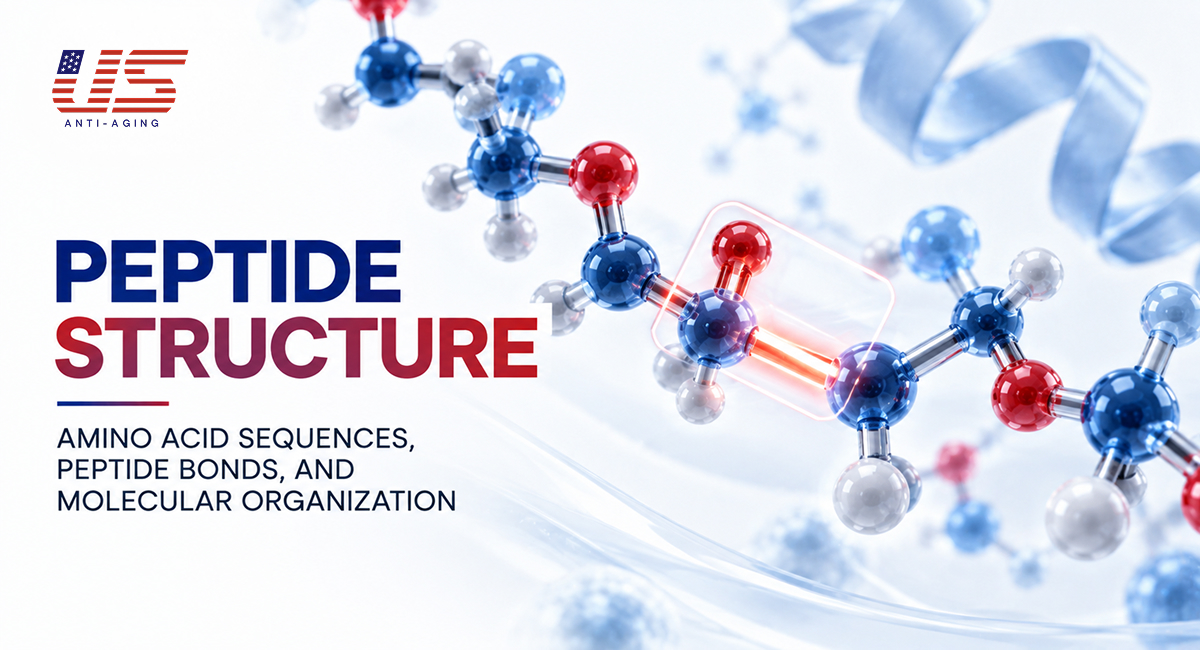


Peptide structure describes how amino acids connect through peptide bonds and organize into molecular shapes. Each peptide contains a specific amino acid sequence that influences its chemical properties, flexibility, stability, and three-dimensional configuration. These structural features determine how the molecule behaves under different biological and laboratory conditions.
Scientists examine peptide architecture to understand molecular folding, chemical interactions, and structural differences between compounds. For laboratories studying peptide chemistry, US Anti-Aging offers research compounds intended for scientific investigation.
This guide explores the molecular organization of peptides, the chemistry of peptide bonds, different structural levels, and the analytical methods researchers use to characterize these molecules.
What Is the Molecular Structure of a Peptide?
A peptide is a molecule formed when two or more amino acids connect through covalent peptide bonds. Each amino acid contributes to a repeating molecular backbone, while its distinctive side chain influences the overall chemical properties.
The fundamental structure of a peptide contains three important components: the amino acid backbone, peptide bonds, and side chains known as R groups.
The Basic Components of a Peptide Molecule
Most conventional amino acids contain an amino group, a carboxyl group, a hydrogen atom, and a variable side chain attached to a central alpha carbon.
When amino acids connect, they form a repeating backbone containing nitrogen, carbon, and oxygen atoms.
The major structural components include:
- Amino terminus (N-terminus): The end of a peptide chain with a free or chemically modified amino group.
- Carboxyl terminus (C-terminus): The opposite end, containing a free or modified carboxyl group.
- Peptide backbone: The repeating sequence of atoms connecting amino acid residues.
- Side chains: Chemical groups that influence charge, polarity, flexibility, and molecular interactions.
Together, these components create a molecular framework capable of adopting different conformations.
Why Peptide Architecture Matters
Amino acid chains do not necessarily remain fully extended. Instead, interactions between backbone atoms, side chains, and surrounding molecules influence their spatial organization.
For example, hydrogen bonding can stabilize certain conformations, while electrostatic interactions can favor or discourage specific molecular arrangements.
Research into peptide conformation demonstrates that amino acid composition and spatial organization contribute significantly to molecular properties (Bierzyński, 2001).
Consequently, researchers examine both molecular composition and three-dimensional arrangement when characterizing peptides.
How Do Amino Acids Form Peptide Bonds and Peptide Chains?
Understanding peptide bond formation is essential for explaining how individual amino acids become connected molecular structures.
A peptide bond is an amide linkage between the carboxyl carbon of one amino acid and the amino nitrogen of another.
The formal reaction involves the removal of the elements of water, producing a covalent connection between amino acid residues.
The Chemistry of Peptide Bond Formation
Peptide bond formation can be described through three basic stages:
- Functional group interaction: The carboxyl group of one amino acid reacts with the amino group of another.
- Amide bond formation: A covalent carbon–nitrogen linkage connects the two residues.
- Chain extension: Additional amino acids join the growing molecular chain.
Although the overall chemistry represents a condensation reaction, biological peptide synthesis involves ribosomes and activated amino acid intermediates. Laboratory chemical synthesis instead uses coupling reagents and protective-group strategies.
Why Peptide Bonds Have Limited Rotation
A peptide bond differs from an ordinary single carbon–nitrogen bond because electron delocalization gives it partial double-bond character.
Consequently, the atoms surrounding the amide linkage generally occupy an approximately planar arrangement.
This restricted rotation influences the conformations available to the peptide backbone.
However, neighboring backbone bonds retain rotational flexibility, allowing the chain to adopt different molecular shapes.
How Peptide Chains Are Classified
Researchers frequently describe peptide molecules according to the number and arrangement of amino acid residues.
| Peptide category | Structural description | Main characteristic |
|---|---|---|
| Dipeptide | Two amino acid residues | One peptide bond |
| Tripeptide | Three amino acid residues | Two peptide bonds |
| Oligopeptide | Relatively short peptide chain | Limited number of residues |
| Polypeptide | Longer chain of amino acids | Greater potential structural complexity |
| Cyclic peptide | Chain containing a covalently closed ring | Restricted backbone flexibility |
These classifications describe molecular organization rather than establishing strict universal boundaries between peptides and proteins.
Additionally, chain length alone does not determine whether a peptide adopts a stable three-dimensional conformation.
What Are the Different Levels of Peptide Structure?
Scientists commonly describe peptide structure through four organizational levels: primary, secondary, tertiary, and quaternary.
Although these terms originated in protein structural biology, they also help researchers describe peptides when the corresponding structural features exist.
Importantly, short peptides do not necessarily exhibit every structural level.
Primary Structure: Amino Acid Sequence
Primary structure refers to the linear order of amino acid residues within a peptide.
Scientists typically represent sequences using one-letter or three-letter amino acid codes, written from the N-terminus toward the C-terminus.
Even a single amino acid substitution can change molecular charge, flexibility, or chemical reactivity.
Therefore, sequence confirmation represents a fundamental step in peptide characterization.
Secondary Structure: Local Molecular Folding
Secondary structure describes recurring arrangements of the peptide backbone.
Common examples include:
- Alpha helices: Spiral-like configurations stabilized by backbone hydrogen bonds.
- Beta sheets: Structures formed through hydrogen bonding between aligned peptide segments.
- Beta turns: Compact configurations that redirect the peptide backbone.
- Disordered conformations: Flexible arrangements without a persistent regular secondary structure.
However, secondary structures can vary according to solvent conditions, amino acid composition, and molecular environment.
Scientific studies of peptide spectroscopy demonstrate how researchers identify structural motifs and investigate conformational behavior (Keiderling, 2020).
Tertiary and Quaternary Structure
Tertiary structure describes the overall three-dimensional organization of a single peptide or polypeptide chain. It may involve interactions between distant amino acid residues, including hydrogen bonds, hydrophobic contacts, and disulfide bridges.
Quaternary structure describes the organization of multiple associated chains into a larger molecular assembly.
Nevertheless, many short peptides remain flexible and do not form stable tertiary or quaternary structures.
This distinction is important because researchers should not assume that every peptide possesses the same structural complexity as a folded protein.
How Do Amino Acid Sequences Influence Peptide Shape and Stability?
The amino acid sequence provides the chemical foundation for peptide structure, but molecular conformation also depends on environmental conditions.
Different residues introduce variations in electrical charge, hydrophobicity, steric constraints, and hydrogen-bonding capacity.
As a result, even closely related sequences may display different structural behavior.
How Individual Amino Acids Influence Folding
Certain amino acids have distinctive structural characteristics.
For example, glycine offers considerable backbone flexibility because its side chain consists of a hydrogen atom. In contrast, proline restricts backbone geometry through its cyclic structure.
Meanwhile, cysteine residues can form disulfide bonds under suitable oxidative conditions, potentially stabilizing specific conformations.
These characteristics influence how peptide chains organize in solution.
Environmental Factors Affecting Structural Stability
Researchers also examine how surrounding conditions influence peptide conformation.
Important factors include:
- Temperature: Can alter molecular motion and the stability of structural interactions.
- pH: Influences ionization states and electrostatic interactions.
- Solvent composition: Changes hydrogen bonding and hydrophobic interactions.
- Ionic strength: Affects interactions between charged molecular groups.
- Concentration: May influence aggregation and intermolecular association.
Consequently, the same peptide may adopt different conformations under different experimental conditions.
Studies of peptide conformational analysis emphasize that flexible molecules can occupy multiple structures rather than one permanent arrangement (Bierzyński, 2001).
Why Structural Stability Matters in Research
Stable molecular characteristics support reproducible laboratory analysis. However, structural stability does not necessarily mean a peptide maintains one rigid conformation.
Instead, some peptides exist as dynamic ensembles of interconverting molecular shapes.
Researchers therefore examine both average structural properties and conformational variability when interpreting experimental results.
How Do Scientists Analyze and Characterize Peptide Structure?
Researchers use analytical chemistry, spectroscopy, and computational techniques to investigate peptide structure.
Because no single method provides every structural detail, scientists often combine complementary approaches.
Common Peptide Characterization Methods
| Analytical method | Information provided | Important limitation |
|---|---|---|
| Mass spectrometry (MS) | Molecular mass and sequence-related information | Does not independently establish complete 3D structure |
| HPLC | Separation and sample purity assessment | Does not directly determine molecular folding |
| Nuclear magnetic resonance (NMR) | Atomic environments and conformational information | Can require substantial sample preparation |
| Circular dichroism (CD) | Secondary structural characteristics | Usually provides ensemble-level information |
| X-ray crystallography | Atomic structural information in suitable crystals | Requires crystals of sufficient quality |
| Molecular dynamics | Computational models of molecular movement | Results depend on model assumptions |
Spectroscopic Analysis of Peptide Conformation
Circular dichroism spectroscopy helps researchers investigate secondary structural characteristics by measuring differences in the absorption of circularly polarized light.
Meanwhile, NMR spectroscopy provides information about local molecular environments and spatial relationships between atoms.
A comprehensive review by Kuril and colleagues discusses the use of circular dichroism for investigating secondary and tertiary structural characteristics in peptides and proteins (Kuril et al., 2025).
Why Multiple Analytical Techniques Are Necessary
A mass spectrum may support molecular identity, but it cannot independently confirm a specific folded conformation.
Similarly, chromatographic purity does not establish biological activity or structural stability under every experimental condition.
Therefore, combining analytical methods allows scientists to develop a more reliable molecular characterization.
For laboratories investigating peptide chemistry and molecular organization, US Anti-Aging provides research-focused compounds for scientific study.
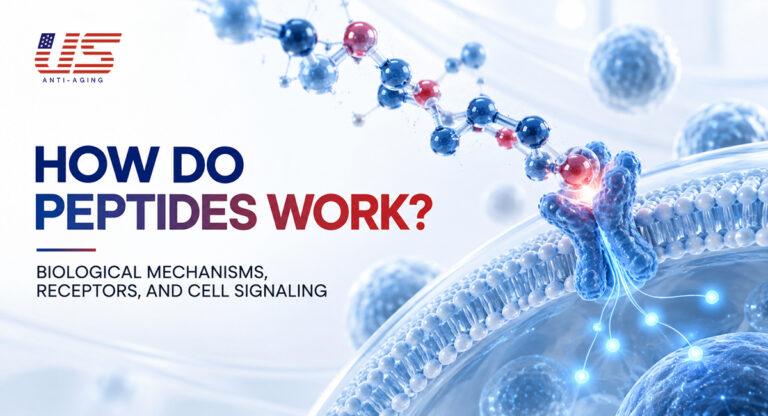
To better understand how peptide structure influences biological activity, explore our comprehensive guide, How Do Peptides Work?, covering receptor interactions, cellular signaling pathways, and the molecular mechanisms involved in peptide research.
FAQs About Peptide Structure
1. What is the basic structure of a peptide?
A peptide consists of amino acid residues connected through covalent peptide bonds. Its molecular backbone contains repeating nitrogen and carbon atoms, while amino acid side chains determine many of its chemical properties.
2. What is the difference between peptide structure and protein structure?
Peptides generally contain shorter amino acid chains, while proteins often consist of longer chains with more complex folding patterns.
However, the distinction is not absolute, and some peptides exhibit well-defined three-dimensional structures.
3. What holds peptide structures together?
Peptide bonds connect amino acids through covalent interactions. Meanwhile, hydrogen bonds, hydrophobic interactions, electrostatic forces, and sometimes disulfide bridges help stabilize particular molecular conformations.
4. Can the same peptide have different molecular shapes?
Yes. Many peptides adopt multiple conformations depending on temperature, solvent composition, pH, and other environmental conditions.
Consequently, researchers often investigate conformational ensembles rather than assuming one permanent structure.
5. How do scientists determine peptide structure?
Researchers combine techniques such as mass spectrometry, NMR spectroscopy, circular dichroism, and X-ray crystallography.
Each method provides different structural information, making complementary analysis important for reliable characterization.
Conclusion: Understanding Peptide Structure in Molecular Research
Understanding peptide structure requires examining amino acid sequences, covalent peptide bonds, backbone flexibility, and three-dimensional molecular organization. Together, these characteristics influence the chemical properties and structural behavior of peptide molecules.
Furthermore, analytical techniques such as mass spectrometry, NMR spectroscopy, and circular dichroism allow researchers to investigate molecular identity and conformational characteristics. However, comprehensive characterization requires appropriate experimental controls and complementary analytical evidence.
For laboratories exploring peptide chemistry and structural biology, US Anti-Aging offers research compounds intended for scientific investigation.
Disclaimer: All compounds and information presented in this article are intended strictly for scientific research and educational purposes. These products are not approved for medical use and are not intended for human or veterinary use, diagnosis, treatment, or prevention of any disease.