How Do Peptides Work? Biological Mechanisms, Receptors, and Cell Signaling

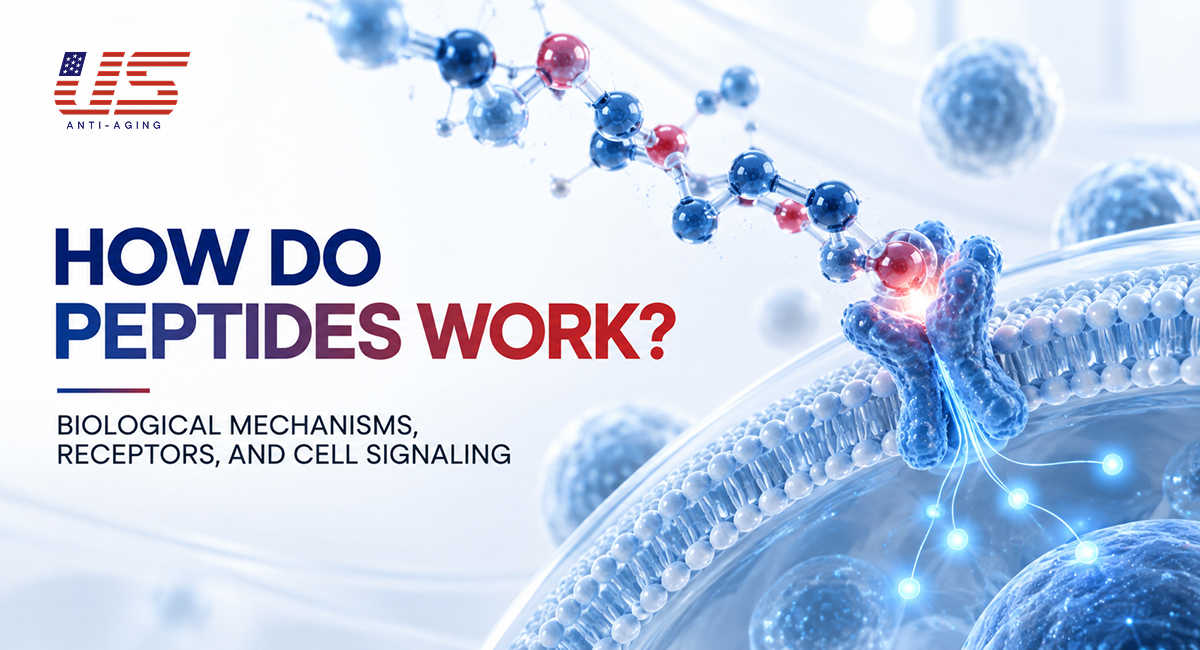


How do peptides work? Peptides function as biological messengers, signaling molecules, and regulatory components that influence how cells communicate and respond to their environment. Many peptides interact with specific receptors, triggering intracellular signaling pathways that regulate processes such as metabolism, cellular growth, and gene expression. However, their biological effects depend on molecular structure, receptor compatibility, and experimental conditions.
Scientists study these mechanisms to understand how peptide sequences influence cellular behavior and molecular communication. For researchers exploring peptide biology, US Anti-Aging provides access to research compounds intended for laboratory investigation.
This guide explains peptide mechanisms, receptor interactions, signaling pathways, and the experimental techniques scientists use to investigate their biological activity.
What Are Peptides and How Do They Function in Biological Systems?
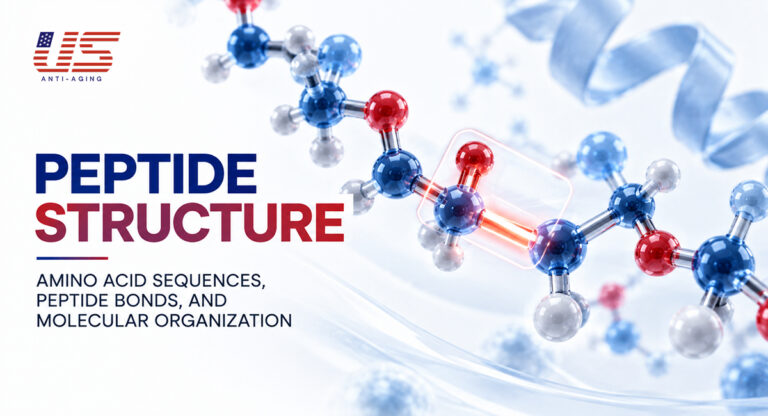
Peptides are molecules composed of amino acids connected through peptide bonds. Although definitions vary, researchers generally distinguish shorter peptide chains from larger proteins based on their length and structural complexity.
Unlike molecules that primarily provide structural support, many biologically active peptides participate in cellular communication. They can act as hormones, neurotransmitters, or local signaling molecules, depending on their sequence and biological context.
How Peptides Communicate With Cells
Peptide communication often begins when a signaling molecule reaches a compatible cellular receptor. This interaction allows cells to recognize specific molecular information and initiate an appropriate response.
For example, peptide hormones participate in endocrine communication, while neuropeptides help regulate signaling within nervous system networks.
Research on peptide signaling demonstrates that these molecules participate in diverse physiological processes through highly specific molecular interactions (Fosgerau & Hoffmann, 2015).
Major Biological Functions of Peptides
Researchers commonly investigate peptides in several functional categories:
- Hormonal signaling: Coordinating biological processes through endocrine communication.
- Neural communication: Modulating neurotransmission and neuronal activity.
- Cellular regulation: Influencing intracellular responses and gene expression.
- Immune signaling: Participating in communication between immune cells.
- Metabolic regulation: Contributing to pathways associated with energy balance and nutrient processing.
Importantly, these functions vary considerably between peptide families. Therefore, scientists evaluate individual compounds rather than assuming all peptides produce similar biological effects.
How Do Peptides Interact With Receptors and Target Cells?
Understanding receptor interactions is essential when investigating how do peptides work at the molecular level.
Many signaling peptides act by binding to receptors located on cellular membranes. However, receptor recognition depends on molecular compatibility rather than simple physical contact.
Peptide–Receptor Binding Mechanisms
Receptors contain specialized binding regions that recognize particular molecular structures. When a compatible peptide approaches, interactions involving hydrogen bonds, electrostatic forces, and hydrophobic contacts may stabilize the molecular complex.
Consequently, receptor binding can alter protein conformation and initiate intracellular signaling.
G protein-coupled receptors (GPCRs) represent one important receptor family involved in peptide-mediated communication. Research has established their central role in translating extracellular signals into intracellular responses (Rosenbaum et al., 2009).
Why Receptor Specificity Matters
Not every peptide interacts with every receptor. Instead, biological activity depends on several molecular characteristics:
- Amino acid sequence and three-dimensional conformation.
- Receptor binding-site compatibility.
- Molecular charge and chemical properties.
- Receptor expression in specific cell populations.
- Peptide concentration and environmental conditions.
Furthermore, receptor binding does not automatically establish biological effectiveness. Researchers must determine whether an interaction activates, inhibits, or otherwise modifies receptor signaling.
What Happens When Peptides Activate Cellular Signaling Pathways?
To understand how do peptides work inside biological systems, researchers examine the events that occur after receptor activation.
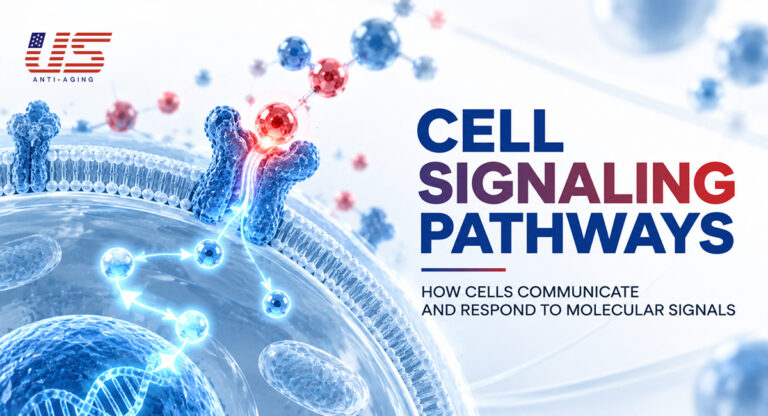
Once a peptide binds to a compatible receptor, the interaction may initiate a sequence of biochemical reactions. These reactions transmit information from the cellular membrane toward intracellular proteins and regulatory systems.
Major Cellular Signaling Pathways
Several signaling networks appear frequently in peptide-related research.
| Signaling pathway | Primary biological role | Research relevance |
|---|---|---|
| cAMP/PKA | Regulates intracellular messenger activity | Hormonal and metabolic signaling |
| MAPK/ERK | Coordinates cellular responses | Cell growth and differentiation |
| PI3K/AKT | Regulates cellular signaling and metabolism | Cell survival and metabolic regulation |
| JAK/STAT | Transmits signals toward the nucleus | Gene expression and immune signaling |
| Calcium signaling | Controls calcium-dependent responses | Secretion and cellular communication |
These pathways do not operate independently. Instead, cells integrate signals from multiple receptors and regulatory proteins.
Research into intracellular communication has demonstrated how signaling networks coordinate cellular decisions through interconnected molecular pathways (Lemmon et al., 2016).
From Receptor Activation to Cellular Response
A simplified signaling sequence includes four stages:
- Recognition: A peptide interacts with a compatible receptor.
- Activation: Receptor activity changes following molecular binding.
- Signal transmission: Intracellular proteins relay or amplify the signal.
- Cellular response: The cell modifies enzyme activity, gene expression, or another biological process.
Nevertheless, different peptides may produce different responses even when they interact with related receptor families.
Additionally, cellular context matters. Receptor abundance, regulatory proteins, and competing signals can substantially influence experimental outcomes.
How Does Molecular Structure Influence Peptide Activity?
Molecular structure plays a central role in explaining how do peptides work across different experimental systems.
Each peptide contains a particular amino acid sequence that influences its chemical properties and three-dimensional organization. Even small structural modifications can change receptor recognition, molecular stability, or biological activity.
Amino Acid Sequence and Biological Recognition
Amino acids differ in size, charge, polarity, and chemical functionality. Consequently, their arrangement influences how a peptide interacts with surrounding molecules.
For example, replacing one amino acid may alter receptor affinity or change the flexibility of a peptide chain.
However, structural similarity does not guarantee identical biological activity. Researchers must experimentally verify whether modified sequences preserve their original molecular functions.
Stability and Molecular Degradation
Peptides may undergo degradation through enzymatic activity, chemical reactions, or unfavorable storage conditions.
Therefore, laboratory investigations often examine:
- Proteolytic stability: Resistance to degradation by enzymes.
- Chemical stability: Susceptibility to oxidation, hydrolysis, or other reactions.
- Structural integrity: Preservation of the intended molecular configuration.
- Solubility: Behavior under defined experimental conditions.
- Aggregation: Formation of molecular assemblies that may affect analytical results.
Scientific literature identifies stability, permeability, and molecular properties as important considerations in peptide development and research (Lau & Dunn, 2018).
These characteristics also help explain why researchers cannot predict peptide activity from amino acid sequence alone.
How Do Researchers Investigate Peptide Mechanisms in Laboratory Models?
Researchers investigating how do peptides work rely on complementary analytical and experimental techniques.
Rather than examining a single biological endpoint, scientists typically combine molecular characterization, receptor studies, and cellular assays to develop a more complete understanding of peptide behavior.
Common Laboratory Research Methods
1. Receptor-binding assays
These experiments measure interactions between peptides and selected receptor targets. Researchers may evaluate binding affinity, competition, and molecular recognition.
2. Cell-based signaling assays
Scientists use cultured cells to investigate changes in intracellular signaling following peptide exposure. Depending on the experimental design, measurements may include second-messenger production, protein phosphorylation, or reporter-gene activity.
3. Molecular characterization
Analytical methods such as high-performance liquid chromatography (HPLC) and mass spectrometry help characterize peptide samples. However, chemical identity and purity do not independently establish biological activity.
4. Gene expression analysis
Researchers use techniques such as quantitative PCR and RNA sequencing to examine transcriptional changes associated with experimental conditions.
5. Structural biology
Methods including nuclear magnetic resonance spectroscopy, X-ray crystallography, and cryo-electron microscopy can provide information about molecular conformation and receptor interactions.
Why Experimental Models Matter
Laboratory models allow researchers to isolate specific biological mechanisms under controlled conditions. However, results from isolated cells or biochemical assays may not accurately predict outcomes in complex organisms.
For this reason, researchers distinguish molecular observations from evidence of clinical effectiveness.
Experimental reproducibility, appropriate controls, and independent validation remain essential when interpreting peptide-related findings.
Scientists can explore research compounds and laboratory-focused resources through US Anti-Aging, while evaluating individual materials according to their intended research applications.
FAQs About How Peptides Work
1. How do peptides work in the body?
Peptides can function as signaling molecules that interact with cellular receptors and influence biological processes. Depending on the peptide, these interactions may regulate hormonal communication, metabolism, neural signaling, or cellular responses.
However, biological effects depend on the peptide’s molecular structure and the receptors present in specific tissues.
2. Do all peptides activate the same receptors?
No. Different peptides recognize different molecular targets, and some peptides interact with multiple receptor types.
Additionally, receptor binding does not always produce activation. Certain peptides may inhibit receptor activity or modify signaling responses.
3. How quickly do peptides activate cellular signaling?
Some receptor-mediated signaling events begin within seconds or minutes under laboratory conditions. However, downstream processes such as changes in gene expression may require considerably longer.
The timing depends on the peptide, receptor system, and experimental environment.
4. What determines whether a peptide is biologically active?
Biological activity depends on molecular structure, receptor compatibility, concentration, stability, and cellular conditions.
Therefore, scientists use controlled experiments to determine whether a peptide produces measurable biological responses.
5. Can laboratory peptide research establish medical benefits?
No. Laboratory findings alone cannot establish clinical safety or therapeutic effectiveness.
Although experimental models provide valuable mechanistic information, medical claims require appropriate clinical evidence and regulatory evaluation.
Understanding Peptide Mechanisms Through Scientific Research
Understanding how do peptides work requires examining receptor recognition, intracellular signaling, molecular structure, and experimental evidence together.
While many peptides participate in essential biological communication, their mechanisms differ substantially. Consequently, reliable conclusions require compound-specific research, validated analytical methods, and careful interpretation of experimental findings.
For laboratories investigating peptide mechanisms and molecular biology, US Anti-Aging offers research-focused compounds for scientific exploration.
Disclaimer: All compounds and information presented in this article are intended strictly for scientific research and educational purposes. These products are not approved for medical use and are not intended for human or veterinary use, diagnosis, treatment, or prevention of any disease.