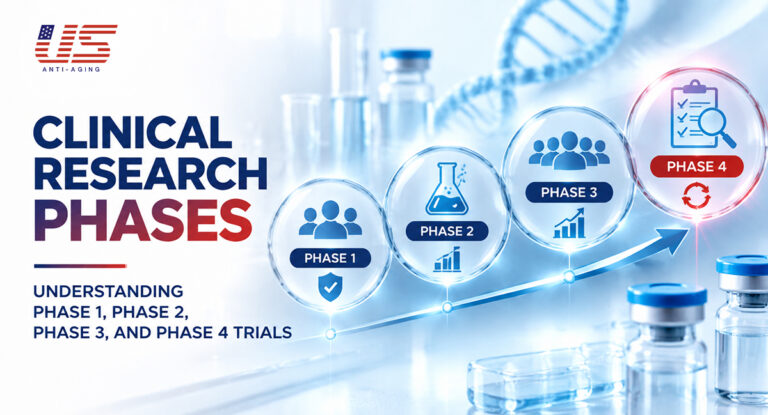
Preclinical Studies: Research Methods, Experimental Models, and Evidence Limitations




Preclinical studies are scientific investigations conducted before human clinical trials to evaluate biological activity, potential toxicity, and the behavior of experimental compounds. Researchers use laboratory assays, cell cultures, computational models, and animal studies when appropriate to identify potential risks and establish whether further investigation is justified.
These studies provide essential evidence during drug development. However, promising laboratory findings do not guarantee safety or effectiveness in humans because experimental models cannot fully reproduce human physiology.
For laboratories exploring molecular mechanisms and peptide science, US Anti-Aging offers research compounds intended for controlled scientific investigation.
This article explains preclinical research methods, experimental models, safety assessment, data interpretation, and the limitations of translating findings into human clinical evidence.
What Are Preclinical Studies and Why Are They Conducted?
Preclinical studies investigate the properties and potential biological effects of experimental compounds before they enter human clinical testing.
Their primary purpose is to identify relevant biological mechanisms, characterize potential hazards, and determine whether sufficient evidence supports further development.
In the United States, the FDA evaluates appropriate nonclinical pharmacology and toxicology information when reviewing Investigational New Drug (IND) applications.
Major Objectives of Preclinical Research
Researchers design preclinical investigations to answer several questions:
- Biological activity: Does the compound produce measurable effects in experimental models?
- Mechanism of action: Which molecular targets or pathways contribute to observed responses?
- Toxicity: What adverse biological effects occur under defined conditions?
- Pharmacokinetics: How does the compound move through and leave biological systems?
- Molecular stability: Does the substance maintain its expected characteristics?
- Translational relevance: Do findings justify additional research?
Importantly, the evidence required depends on the compound, intended application, and proposed clinical investigation.
The Role of Preclinical Evidence in Drug Development
Early experimental findings help researchers select appropriate candidates for further investigation.
However, identifying molecular activity alone does not establish that a compound is suitable for human testing.
In addition, regulatory submissions require relevant safety information and adequate manufacturing documentation.
The FDA describes preclinical evaluation as an essential step for identifying potential toxicity before initial human investigations.
What Types of Experimental Models Are Used in Preclinical Research?
Researchers use several experimental models because no single system captures every aspect of biological activity.
Each model provides different information about molecular interactions, cellular responses, and organism-level processes.
In Vitro and Cell-Based Models
In vitro experiments investigate biological processes outside intact living organisms.
Scientists commonly use cultured cells, isolated enzymes, and biochemical assays to examine specific mechanisms.
For example, a cell-based experiment may measure changes in receptor signaling after exposure to an experimental peptide.
However, isolated cells cannot fully reproduce interactions between organs, circulation, and metabolic systems.
In Vivo and Animal Models
In vivo studies examine biological responses within living organisms.
When scientifically justified, researchers use animal models to investigate tissue distribution, metabolism, physiological regulation, and potential adverse effects.
Nevertheless, experimental outcomes depend on species characteristics and model selection.
Animal studies also require appropriate ethical oversight, welfare safeguards, and adherence to applicable research standards.
Transparent reporting is particularly important. The ARRIVE 2.0 guidelines recommend essential information about study design, sample sizes, statistical methods, and experimental procedures (Percie du Sert et al., 2020).
Emerging Alternative Research Models
Modern experimental approaches increasingly include organoids, organ-on-chip systems, and computational modeling.
These methods can reproduce selected biological characteristics and support mechanism-focused investigations.
However, researchers must validate each model for its intended purpose before relying on its predictions.
How Do Researchers Evaluate Biological Activity and Safety Before Human Trials?
Preclinical studies examine both intended biological effects and potential harmful responses.
Researchers therefore combine pharmacological experiments with safety assessments appropriate to the compound and development stage.
Evaluating Biological Activity
Pharmacological investigations explore how experimental compounds interact with biological targets.
Researchers may measure receptor binding, enzyme activity, changes in cellular signaling, or specific physiological endpoints.
Additionally, concentration-response experiments help characterize how measured effects vary with experimental exposure.
However, activity in a laboratory assay does not establish clinical effectiveness.
Investigating Potential Toxicity
Toxicology studies examine whether exposure produces harmful biological changes.
Depending on the research objective, assessments may investigate:
- Acute toxicity: Adverse responses following short-term exposure.
- Repeat-dose toxicity: Effects associated with repeated exposure over a defined period.
- Genotoxicity: Potential damage to genetic material.
- Organ-related toxicity: Changes affecting particular tissues or organ systems.
- Safety pharmacology: Potential effects on essential physiological functions.
Not every compound requires identical testing. Instead, study requirements depend on its properties, intended clinical exposure, and applicable regulatory guidance.
Why Good Laboratory Practice Matters
Good Laboratory Practice (GLP) provides a quality framework for applicable nonclinical safety investigations.
These standards address study documentation, personnel responsibilities, equipment, procedures, reporting, and quality assurance.
Consequently, GLP helps improve the reliability and traceability of regulatory safety data.
However, exploratory laboratory experiments do not automatically fall under the same requirements as pivotal regulatory toxicology studies.
What Data Are Typically Collected During Preclinical Studies?
Researchers collect different types of data depending on the experimental model and scientific objectives.
Some measurements characterize molecular interactions, while others investigate exposure, toxicity, or physiological responses.
Common Categories of Preclinical Data
| Data category | Typical measurements | Research purpose |
|---|---|---|
| Molecular characterization | Identity, purity, stability | Assess material characteristics |
| Pharmacodynamics | Receptor activity, biomarkers | Investigate biological responses |
| Pharmacokinetics | Exposure, distribution, clearance | Characterize compound behavior |
| Toxicology | Tissue changes, adverse findings | Identify potential hazards |
| Cellular analysis | Viability, signaling, gene expression | Examine cellular mechanisms |
| Statistical evaluation | Effect estimates, variability | Assess reliability of findings |
Importantly, researchers should distinguish direct measurements from conclusions inferred from experimental results.
Pharmacokinetic and Pharmacodynamic Data
Pharmacokinetics describes what happens to a compound within a biological system.
Researchers investigate absorption, distribution, metabolism, and excretion when applicable.
In contrast, pharmacodynamics examines how a compound influences biological processes.
Together, these measurements can help scientists interpret the relationship between exposure and observed responses.
Data Quality and Reproducibility
Reliable conclusions require appropriate experimental controls and transparent reporting.
For example, researchers should document sample characteristics, analytical methods, biological variability, and statistical assumptions.
Additionally, independent replication can help determine whether findings remain consistent.
Scientific discussions about preclinical reproducibility emphasize the importance of rigorous study design and experimental validation (Begley & Ellis, 2012).
Why Do Promising Preclinical Results Not Always Translate to Humans?
One of the most important limitations of preclinical studies involves the difficulty of predicting human outcomes.
Laboratory systems simplify biological complexity, while animal models differ from humans in several physiological characteristics.
Consequently, a compound may produce encouraging experimental results without demonstrating similar effects in clinical trials.
Biological Differences Between Experimental Models and Humans
Several factors influence translation:
- Species differences: Biological targets and metabolic pathways may vary between organisms.
- Pharmacokinetic differences: Compound distribution and clearance can differ substantially.
- Experimental exposure: Laboratory concentrations may not reflect clinically achievable exposures.
- Disease-model limitations: Experimental models may reproduce only selected characteristics of human conditions.
- Biological variability: Human populations contain substantial genetic and physiological diversity.
These differences can influence both measured effectiveness and potential toxicity.
Reviews of animal-model research highlight important limitations in predicting adverse clinical outcomes from preclinical findings (Van Norman, 2019).
Experimental Bias and Reproducibility Challenges
Translational failures can also reflect weaknesses in experimental design.
For example, inadequate randomization, small sample sizes, or selective reporting may produce misleading conclusions.
Furthermore, independently reproduced results generally provide stronger support than isolated findings.
Critical assessments of animal-based biomedical research emphasize the need for systematic evidence evaluation and improved methodological rigor (Pound & Bracken, 2014).
Improving Translational Research
Researchers can strengthen evidence by combining complementary models and selecting clinically relevant endpoints.
Additionally, transparent methods, appropriate statistical analysis, and independent validation improve confidence in reported findings.
Nevertheless, preclinical evidence remains preliminary with respect to human safety and effectiveness.
Therefore, clinical conclusions require appropriately designed human investigations.
To gain a deeper understanding of scientific methods, preclinical investigations, and clinical evidence, explore our comprehensive guide, Peptide Research: Scientific Methods, Preclinical Studies, and Clinical Evidence.
FAQs About Preclinical Studies
1. What are preclinical studies?
Preclinical studies are investigations that examine experimental compounds before human clinical testing.
They evaluate biological activity, potential toxicity, pharmacokinetics, and other characteristics relevant to further development.
2. What is the difference between preclinical and clinical studies?
Preclinical investigations use laboratory and nonhuman experimental models.
Clinical studies involve human participants and evaluate specific questions about safety, effectiveness, or other clinical outcomes.
3. Are animal studies always required during preclinical research?
No. The appropriate evidence depends on the compound, intended application, and regulatory requirements.
Researchers may use validated nonanimal approaches where scientifically appropriate and accepted.
4. Can preclinical results prove that a compound is safe for humans?
No. Preclinical findings help identify potential risks but cannot establish complete human safety.
Additional clinical evidence is necessary to evaluate human responses.
5. Why are preclinical studies important in peptide research?
They help researchers investigate peptide stability, molecular activity, biological interactions, and potential safety concerns.
However, results from research-use-only peptides do not establish approval for medical applications.
Conclusion: Understanding the Value and Limitations of Preclinical Research
Preclinical studies provide essential information about experimental compounds, including their biological activity, molecular characteristics, pharmacokinetics, and potential toxicity.
By combining suitable experimental models with reliable analytical methods, scientists can identify important research questions and evaluate whether further investigation is justified.
However, laboratory and animal findings cannot independently establish human safety or clinical effectiveness. Therefore, researchers must interpret results within the limitations of each model and the quality of available evidence.
For laboratories exploring molecular biology and peptide-related research, US Anti-Aging offers research compounds intended for controlled scientific investigation.
Disclaimer: All compounds and information presented in this article are intended strictly for scientific research and educational purposes. These products are not approved for medical use and are not intended for human or veterinary use, diagnosis, treatment, or prevention of any disease.