Melanotan II Research: Melanocortin Receptors, Pigmentation, and Scientific Evidence

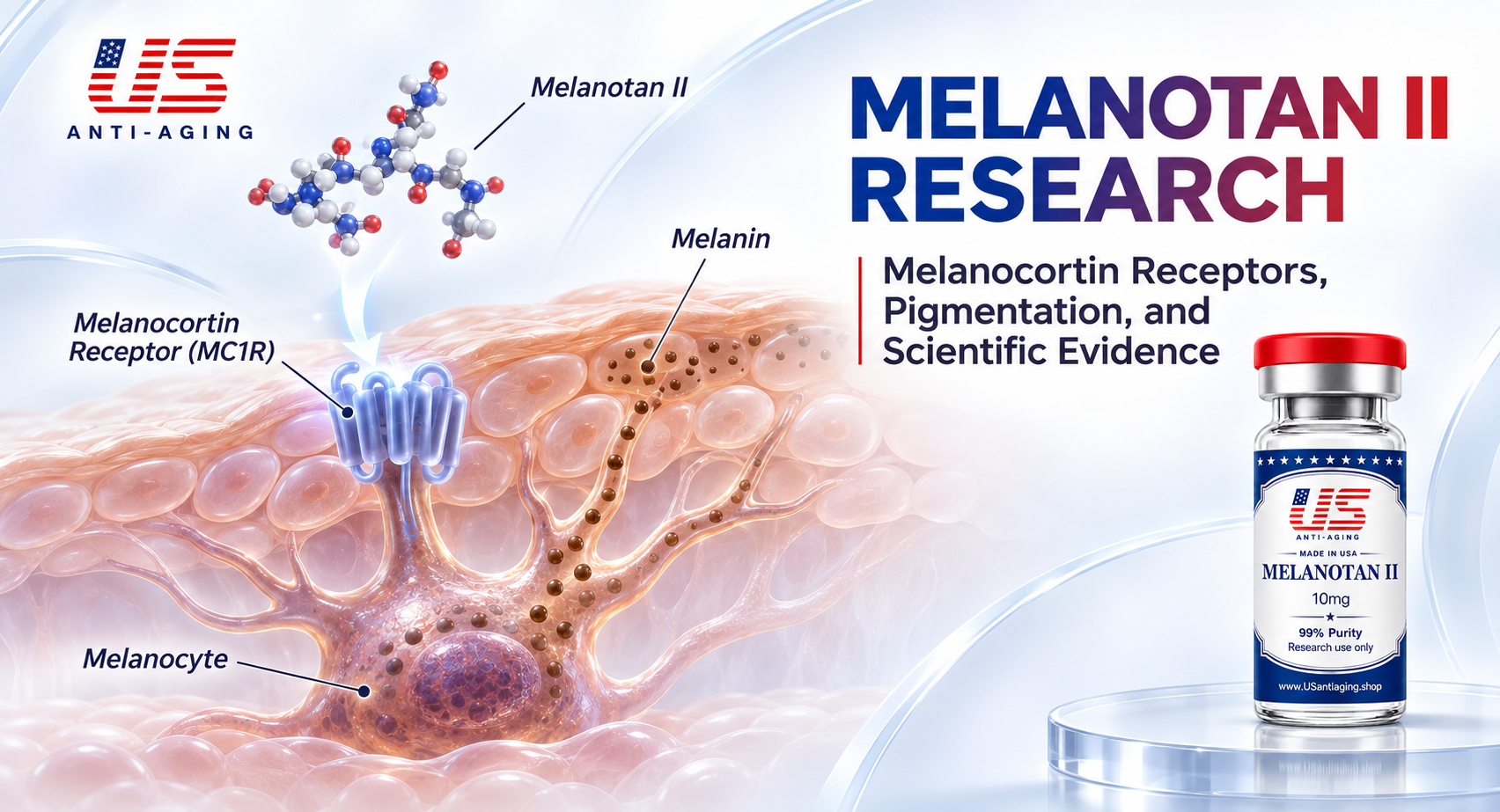


Melanotan II research investigates a synthetic cyclic peptide that interacts with melanocortin receptors involved in pigmentation, energy homeostasis, and other physiological processes. Scientists study Melanotan II, also known as MT-II, to understand receptor activation, intracellular signaling, and melanin production.
Unlike compounds designed to target a single receptor, Melanotan II demonstrates activity across several melanocortin receptor subtypes. Consequently, its biological responses extend beyond pigmentation.
Although laboratory investigations and early human studies have documented biological activity, Melanotan II lacks FDA approval, and significant safety uncertainties remain.
For further educational information about peptide chemistry and receptor biology, explore the scientific resources available at US Anti-Aging
What Is Melanotan II?
Melanotan II is a synthetic cyclic heptapeptide derived from the structure of alpha-melanocyte-stimulating hormone (α-MSH), an endogenous peptide involved in melanocortin signaling.
Researchers developed Melanotan II to investigate how molecular modifications affect receptor activation and melanotropic activity.
Molecular Structure and Characteristics
Unlike the naturally occurring 13-amino-acid α-MSH molecule, Melanotan II contains seven amino acid residues and a cyclic structure formed through a lactam bridge.
| Molecular property | Description |
|---|---|
| Compound name | Melanotan II |
| Alternative name | MT-II |
| Classification | Synthetic cyclic heptapeptide |
| Amino acid residues | 7 |
| Approximate molecular weight | 1,024.2 Da |
| Parent molecule | Alpha-MSH |
| Primary molecular targets | MC1R, MC3R, MC4R, and MC5R |
| Research focus | Receptor pharmacology and pigmentation |
Its molecular architecture incorporates nonstandard amino acid modifications and cyclization, distinguishing it from naturally occurring α-MSH (Dorr et al., 1996).
Importantly, Melanotan II should not be confused with afamelanotide, also known as Melanotan I, which is a structurally different compound with a specific FDA-approved medical indication.
For laboratories investigating melanocortin receptor activity, pigmentation mechanisms, and peptide structure-activity relationships, explore Melanotan II for Research at US Anti-Aging, intended strictly for scientific and laboratory research.
How Does Melanotan II Affect Melanocortin Receptors?
Melanotan II research frequently examines melanocortin receptors, a family of five G protein-coupled receptors (GPCRs) that regulate different physiological functions.
Melanotan II acts as an agonist at several receptor subtypes, meaning it binds to and activates these receptors.
Melanocortin Receptor Subtypes
| Receptor | Primary biological role | Melanotan II activity |
|---|---|---|
| MC1R | Skin and hair pigmentation | Agonist |
| MC2R | Adrenal steroid hormone production | Not a conventional agonist |
| MC3R | Energy balance and metabolic regulation | Agonist |
| MC4R | Appetite and energy homeostasis | Agonist |
| MC5R | Exocrine gland functions and other processes | Agonist |
MC2R differs from the other melanocortin receptors because its activation requires adrenocorticotropic hormone (ACTH). Meanwhile, MC1R, MC3R, MC4R, and MC5R respond to various melanocortin-derived ligands (Cai & Hruby, 2016).
MC1R and Pigmentation Signaling
MC1R plays an important role in melanocytes, the cells responsible for producing melanin.
Following receptor activation, intracellular signaling can influence cyclic adenosine monophosphate (cAMP), protein kinase A (PKA), and transcriptional processes associated with melanogenesis.
A simplified representation of this pathway is:
MC1R activation → cAMP signaling → PKA activation → Regulation of melanogenic gene expression
However, pigmentation represents only one aspect of Melanotan II’s receptor activity. Its interactions with other melanocortin receptor subtypes contribute to additional physiological responses and potential risks.
What Determines Melanotan II Receptor Activity?
Several molecular and biological factors determine how Melanotan II interacts with melanocortin receptors.
Understanding these factors helps researchers distinguish receptor binding from downstream cellular responses.
Peptide Structure and Receptor Recognition
Melanocortin-related peptides share structural features important for receptor recognition, including the conserved His-Phe-Arg-Trp sequence motif in endogenous melanocortins.
Melanotan II incorporates a modified version of this region within its cyclic structure.
However, relatively small changes in amino acid composition can substantially alter receptor affinity, selectivity, and functional activity.
Consequently, Melanotan II research provides a useful context for examining structure-activity relationships among melanocortin receptor ligands.
Binding Affinity, Potency, and Selectivity
Researchers distinguish several pharmacological characteristics:
- Binding affinity: How strongly a molecule interacts with a receptor.
- Potency: The concentration associated with a defined biological response.
- Efficacy: The maximum response a molecule produces within an experimental system.
- Selectivity: The relative preference for one receptor subtype over others.
Importantly, high potency does not establish receptor selectivity or clinical safety.
Cellular Context and Receptor Expression
Receptor density, genetic variation, and intracellular signaling components can influence experimental responses.
For example, two cell populations expressing MC1R may exhibit different downstream responses because of differences in receptor variants or signaling machinery.
Therefore, receptor activity measured in engineered cell lines cannot automatically predict physiological responses in human tissues.
How Is Melanotan II Studied?
Scientists use receptor-based assays, cellular models, and pharmacological investigations to characterize Melanotan II.
Each method addresses a different aspect of molecular activity.
Common Experimental Methods
| Research method | Primary measurement |
|---|---|
| Receptor binding assays | Ligand-receptor affinity |
| cAMP assays | Intracellular signaling activity |
| Melanocyte cultures | Pigmentation-related cellular responses |
| Tyrosinase assays | Melanin synthesis-related enzyme activity |
| Gene expression analysis | Transcriptional responses |
| Animal models | System-level physiological responses |
| Clinical investigations | Human biological responses and adverse events |
Pigmentation and Melanin Research
Researchers distinguish two major forms of melanin: eumelanin and pheomelanin. These pigments differ in their chemical characteristics and interactions with ultraviolet radiation.
MC1R signaling contributes to the regulation of pigment production. However, increased pigmentation alone does not establish protection against ultraviolet-induced DNA damage or skin cancer.
Consequently, Melanotan II research must distinguish measurable pigmentation changes from clinically meaningful protective outcomes.
Early Human Research
A 1996 pilot Phase I investigation examined Melanotan II in three male volunteers.
Two participants demonstrated increased pigmentation. However, researchers also documented nausea, fatigue, sleepiness, yawning, and spontaneous erections (Dorr et al., 1996).
The very small sample and short observation period prevent reliable conclusions about long-term safety or broader clinical effectiveness.
For laboratories investigating melanocortin receptor activity, pigmentation mechanisms, and peptide structure-activity relationships, explore Melanotan II for Research at US Anti-Aging, intended strictly for scientific and laboratory research.
What Are the Known Research Limitations and Risks?
Despite documented receptor activity, Melanotan II research has significant limitations involving human safety, receptor selectivity, and long-term biological responses.
Nonselective Receptor Activity
Because Melanotan II activates multiple melanocortin receptor subtypes, its effects are not limited to melanocytes.
Interactions with receptors in the central nervous system and peripheral tissues can produce physiological responses unrelated to pigmentation.
This broad activity complicates efforts to characterize its overall safety profile.
Documented Adverse Events
Scientific reports have documented serious adverse events following unauthorized Melanotan II use.
For example, a 2021 case report described ischemic priapism requiring surgical intervention after Melanotan II exposure (Mallory et al., 2021).
Although case reports cannot establish the frequency of adverse events, they provide important signals for further safety investigation.
Major Evidence Gaps
Several scientific questions remain unresolved:
- Long-term toxicity and systemic safety.
- Human pharmacokinetics and metabolic clearance.
- Potential effects on existing pigmented skin lesions.
- Variability associated with receptor genetics.
- Impurities and inconsistent formulations.
- Risks associated with prolonged or repeated exposure.
Moreover, Melanotan II is not an FDA-approved tanning product or therapeutic drug in the United States. Existing experimental evidence does not justify recreational or cosmetic self-administration.
To better understand how peptide signaling influences melanocyte activity, skin structure, and other cellular processes, explore our comprehensive guide, Peptides in Skin Research: Biological Mechanisms, Skin Structure, and Scientific Evidence.
FAQs About Melanotan II Research
1. What is Melanotan II research focused on?
Melanotan II research primarily examines melanocortin receptor activation, pigmentation, intracellular signaling, and receptor structure-activity relationships.
2. Which receptors does Melanotan II activate?
Melanotan II demonstrates agonist activity at MC1R, MC3R, MC4R, and MC5R. Its broad receptor activity distinguishes it from receptor-selective compounds.
3. How does Melanotan II relate to melanin production?
Researchers investigate its activation of MC1R and associated cAMP signaling, which can influence melanogenesis. However, pigmentation changes do not establish protection against ultraviolet damage.
4. Is Melanotan II the same as Melanotan I?
No. Melanotan II is a cyclic seven-amino-acid peptide, whereas Melanotan I, or afamelanotide, is a structurally different linear peptide analog. Their pharmacological and regulatory characteristics differ.
5. Is Melanotan II FDA-approved?
No. Melanotan II is not an FDA-approved drug. Its long-term safety remains insufficiently established, and research materials are not intended for human administration.
Conclusion: Understanding Melanotan II Research
Melanotan II research provides insight into melanocortin receptor pharmacology, peptide structure-activity relationships, and pigmentation-related signaling.
Although scientific investigations have demonstrated receptor activation and measurable biological responses, significant uncertainties remain regarding systemic effects, long-term safety, and clinical applications.
Therefore, researchers must distinguish experimental activity from established therapeutic effectiveness.
For further educational information about peptide structures, receptor interactions, and experimental evidence, explore the scientific resources available at US Anti-Aging
Disclaimer: All compounds and information presented in this article are intended strictly for scientific research and educational purposes. These products are not approved for medical use and are not intended for human or veterinary use, diagnosis, treatment, or prevention of any disease.