GHK-Cu Research: Copper Binding, Cellular Mechanisms, and Scientific Evidence

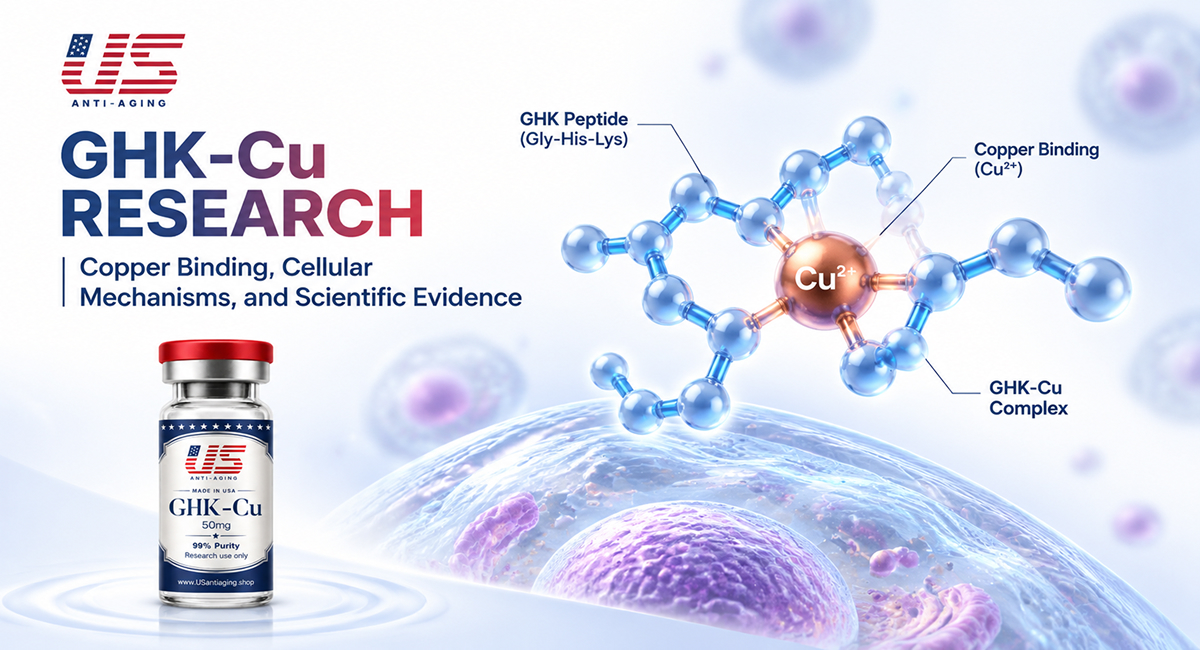


GHK-Cu research investigates a copper-binding tripeptide complex for its molecular interactions, cellular signaling, gene expression, and extracellular matrix regulation. GHK consists of three amino acids: glycine, histidine, and lysine. When it coordinates with copper(II) ions, it forms a complex with distinct chemical and biological properties.
Scientists study GHK-Cu to understand how peptide-metal interactions influence cellular behavior. However, experimental observations do not automatically establish therapeutic effectiveness or long-term human safety.
For laboratories exploring peptide chemistry and molecular biology, US Anti-Aging provides research-focused resources intended for scientific investigation.
This article examines GHK-Cu’s molecular structure, copper-binding mechanisms, experimental applications, and current scientific evidence.
What Is GHK-Cu?
GHK-Cu is a coordination complex formed between glycyl-L-histidyl-L-lysine (GHK) and copper(II) ions. Researchers originally identified GHK in human plasma and subsequently investigated its affinity for copper and its effects on cultured cells.
Unlike conventional synthetic peptides containing only amino acid residues, GHK-Cu incorporates a metal ion that contributes to its chemical characteristics.
Molecular Characteristics of GHK-Cu
| Molecular property | Description |
|---|---|
| Peptide sequence | Gly-His-Lys |
| One-letter sequence | GHK |
| Number of amino acids | 3 |
| Molecular classification | Copper-binding tripeptide complex |
| Coordinated metal ion | Copper(II), Cu²⁺ |
| Typical binding ratio | 1:1 peptide-to-copper complex |
| Primary research areas | Metal coordination, cellular signaling, gene expression |
However, additional coordination species may occur depending on environmental conditions.
GHK vs. GHK-Cu
GHK refers to the tripeptide without specifically coordinated copper. Conversely, GHK-Cu refers to its copper-associated form.
This distinction is essential because copper binding may influence molecular stability and biological activity. Therefore, researchers should identify which molecular form a particular study investigates before applying its conclusions to GHK-Cu research.
For laboratories investigating copper-binding mechanisms, cellular signaling, and extracellular matrix regulation, explore GHK-Cu Peptide for Research at US Anti-Aging, intended strictly for scientific and laboratory research.
How Does GHK-Cu Bind Copper Ions?
GHK binds copper through coordination chemistry, a process in which electron-donating atoms within the peptide interact with a metal ion.
The peptide’s terminal amino group, backbone nitrogen, and histidine imidazole group can participate in copper coordination.
The Influence of pH on Copper Binding
Copper coordination depends partly on the protonation state of the peptide’s functional groups.
Consequently, variations in pH can change binding geometry, stability, and the relative abundance of different molecular species.
Early investigations identified multiple GHK-copper complexes under different solution conditions. Researchers also demonstrated that GHK could compete with albumin for copper binding in experimental systems (Lau & Sarkar, 1981).
These findings establish an important principle: GHK-Cu does not necessarily maintain identical coordination behavior across every biological environment.
Copper Binding and Serum Albumin
Human serum albumin is a major plasma protein involved in transporting various molecules and metal ions.
A 2021 study identified ternary complexes involving GHK, copper, and histidine residues within human serum albumin. The findings suggest possible molecular interactions relevant to the transport of exchangeable copper (Bossak-Ahmad et al., 2021).
However, these chemical observations do not establish the systemic pharmacokinetics of externally administered GHK-Cu.
Which Cellular Pathways Involve GHK-Cu?
GHK-Cu research encompasses several cellular mechanisms involving gene expression, matrix metabolism, and metal-dependent biological activity.
Nevertheless, scientists have not established a single definitive receptor responsible for all reported GHK-Cu responses.
Extracellular Matrix Regulation
Researchers have examined GHK-Cu’s effects on matrix metalloproteinases (MMPs) and tissue inhibitors of metalloproteinases (TIMPs).
A fibroblast study reported increased MMP-2 expression and elevated TIMP-1 and TIMP-2 secretion following GHK-Cu exposure. Interestingly, copper ions reproduced the MMP-2 response, whereas uncomplexed GHK did not (Siméon et al., 2000).
This observation demonstrates why experiments should distinguish peptide-specific activity from copper-dependent effects.
TGF-β-Associated Gene Expression
Transforming growth factor-beta (TGF-β) participates in cellular differentiation, matrix regulation, and tissue remodeling.
A 2012 investigation found that GHK exposure produced gene expression patterns resembling TGF-β-associated responses in cultured human fibroblasts. Researchers also observed changes in integrin expression and cytoskeletal organization (Campbell et al., 2012).
Importantly, this study investigated GHK rather than a separately characterized GHK-Cu preparation. Its findings therefore provide related mechanistic evidence, not direct proof of identical copper-complex activity.
For laboratories investigating copper-binding mechanisms, cellular signaling, and extracellular matrix regulation, explore GHK-Cu Peptide for Research at US Anti-Aging, intended strictly for scientific and laboratory research.
How Do Researchers Study GHK-Cu?
Reliable GHK-Cu research requires both chemical characterization and biological testing. Researchers must determine whether observed responses originate from the peptide, copper ions, or their coordinated complex.
Analytical and Experimental Methods
| Research method | Primary purpose |
|---|---|
| UV-visible spectroscopy | Investigating copper coordination |
| Potentiometric titration | Measuring binding equilibria |
| Electron paramagnetic resonance | Characterizing copper’s electronic environment |
| Mass spectrometry | Identifying peptide-related molecular species |
| Fibroblast cultures | Evaluating cellular responses |
| Gene expression analysis | Measuring transcriptional changes |
| Protein assays | Quantifying selected biological markers |
A comparative investigation of GHK and synthetic analogues demonstrated how spectroscopic and thermodynamic methods can characterize copper-binding behavior and structural differences (Conato et al., 2001).
Why Appropriate Controls Matter
Researchers can strengthen experimental interpretation by comparing:
- Uncomplexed GHK.
- Copper-only controls.
- Characterized GHK-Cu complexes.
- Untreated or vehicle-treated samples.
Furthermore, monitoring cellular viability and molecular stability helps researchers distinguish specific signaling responses from nonspecific experimental effects.
What Does Current GHK-Cu Research Show?
The available evidence includes biochemical investigations, cell culture experiments, and animal models. However, these studies address different scientific questions and should not be treated as equivalent forms of clinical evidence.
Fibroblast and Collagen Research
A foundational 1988 study reported increased collagen synthesis in cultured fibroblasts following exposure to GHK-Cu (Maquart et al., 1988).
Subsequent animal research identified changes in connective tissue accumulation and collagen-associated gene expression within experimental rat wound chambers.
Nevertheless, neither investigation establishes therapeutic effectiveness in humans.
For additional context on collagen turnover and matrix organization, explore the scientific literature concerning peptide-related tissue remodeling.
Evidence and Human Safety Limitations
Despite its established research history, GHK-Cu research has several unresolved questions:
- Molecular behavior across different biological environments.
- Human pharmacokinetics and systemic distribution.
- Long-term exposure and safety.
- Formulation-specific stability and impurities.
- Reproducibility of experimental findings.
The FDA also identifies potential immunogenicity concerns associated with compounded injectable GHK-Cu, particularly regarding aggregation, peptide-related impurities, and insufficient human safety information (FDA, 2026).
Furthermore, findings involving topical cosmetic formulations cannot establish the safety or effectiveness of other formulations or administration routes.
To better understand how GHK-Cu and other peptides interact with skin cells, extracellular matrix components, and collagen-related pathways, explore our comprehensive guide, Peptides in Skin Research: Biological Mechanisms, Skin Structure, and Scientific Evidence.
FAQs About GHK-Cu Research
1. What is GHK-Cu research focused on?
GHK-Cu research examines copper coordination, cellular signaling, gene expression, extracellular matrix regulation, and experimental biological responses.
2. Is GHK-Cu the same as GHK?
No. GHK is a three-amino-acid peptide, whereas GHK-Cu is its copper-associated complex. Copper coordination can influence its chemical and biological characteristics.
3. Why is copper important in GHK-Cu research?
Copper contributes to the complex’s molecular properties and may influence selected cellular responses. Researchers therefore investigate copper-dependent activity separately from the peptide’s independent effects.
4. Which cellular pathways are associated with GHK-Cu?
Researchers have investigated extracellular matrix regulation, MMP/TIMP activity, and gene expression. Related GHK studies also examine TGF-β-associated transcriptional responses.
5. Is GHK-Cu an FDA-approved therapeutic drug?
GHK-Cu is not an FDA-approved therapeutic drug. Research findings and cosmetic applications do not establish regulatory approval for medical use or systemic administration.
Conclusion: Understanding GHK-Cu Research
GHK-Cu research provides valuable insights into peptide-metal coordination, copper-dependent cellular activity, gene expression, and extracellular matrix regulation.
However, distinguishing GHK from GHK-Cu remains essential when evaluating scientific evidence. Researchers must also consider molecular stability, experimental controls, and the limitations of preclinical observations.
Although existing studies provide useful mechanistic information, additional research remains necessary to establish formulation-specific biological behavior and human safety.
For further information about peptide chemistry and molecular research, explore the educational resources available at US Anti-Aging
Disclaimer: All compounds and information presented in this article are intended strictly for scientific research and educational purposes. These products are not approved for medical use and are not intended for human or veterinary use, diagnosis, treatment, or prevention of any disease.