In Vitro vs In Vivo: Key Differences, Research Methods, and Scientific Applications

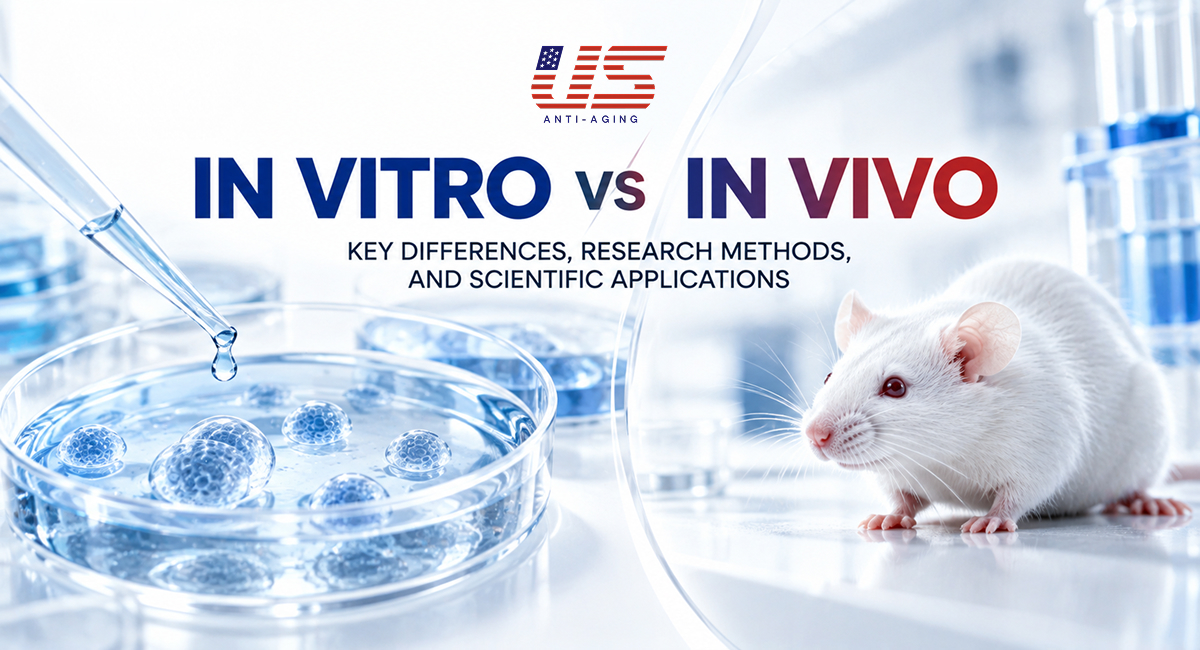


In vitro vs in vivo describes two fundamental approaches to scientific research. In vitro studies investigate biological processes outside living organisms, typically using cultured cells, isolated tissues, or biochemical systems. In contrast, in vivo studies examine biological responses within living organisms, where multiple physiological systems interact.
Both approaches provide valuable scientific information, but they answer different research questions. In vitro experiments offer controlled conditions for studying specific mechanisms, while in vivo models help researchers examine complex biological interactions.
For laboratories investigating peptide-related mechanisms, US Anti-Aging offers research compounds intended for controlled scientific investigation.
This guide explains how both methods work, their applications, major differences, and the limitations researchers must consider when interpreting experimental findings.
What Do In Vitro and In Vivo Mean in Scientific Research?
The terms in vitro and in vivo originate from Latin and describe where scientists conduct an experiment.
In vitro means “in glass,” referring to experiments conducted outside an intact living organism. In vivo means “within the living,” describing investigations involving living organisms.
Understanding In Vitro Research
In vitro research allows scientists to investigate biological processes within controlled experimental environments.
For example, researchers may expose cultured cells to a test compound and measure changes in cellular activity.
These experiments help isolate specific mechanisms without introducing every variable present within a complete organism.
However, simplified laboratory models cannot reproduce all physiological interactions.
Understanding In Vivo Research
In vivo research examines biological processes within living organisms, including experimental animal models and human participants in appropriately designed studies.
Unlike isolated cell experiments, these investigations capture interactions between tissues, organs, circulation, and metabolic systems.
Consequently, researchers can investigate how biological responses change within a more integrated physiological environment.
However, findings from one species do not necessarily predict responses in another.
In vivo research captures interactions between tissues, organs, and physiological systems. However, differences in metabolism, receptor expression, and biological regulation can limit the translation of animal findings to humans. Scientific reviews have highlighted these challenges, particularly when researchers use animal models to predict clinical toxicity (Van Norman, 2019).

How Are In Vitro Studies Conducted in Laboratory Settings?
In vitro studies generally begin with a defined experimental system, such as a cell culture, isolated protein, or tissue preparation.
Researchers then introduce controlled experimental variables and measure the resulting changes.
Because laboratory conditions can be standardized, scientists can investigate specific molecular events with considerable precision.
Common Types of In Vitro Models
Scientists use several experimental systems depending on their research objectives:
- Two-dimensional cell cultures: Cells grow on laboratory surfaces under controlled conditions.
- Three-dimensional cell cultures: Cells organize into structures that better reproduce selected tissue characteristics.
- Organoids: Self-organizing cellular models that reproduce certain architectural and functional features of organs.
- Biochemical assays: Isolated molecular systems used to investigate specific reactions or interactions.
- Ex vivo tissue preparations: Freshly isolated tissues studied outside the organism while retaining some native characteristics.
Ex vivo studies overlap with the broader category of laboratory-based experimentation but are often distinguished from conventional cell culture because they preserve aspects of original tissue organization.
What Can Researchers Measure?
In vitro experiments can investigate measurable biological endpoints, including:
- Cell viability and proliferation.
- Receptor binding and molecular interactions.
- Enzyme activity and biochemical reactions.
- Changes in gene expression.
- Cellular responses under defined experimental conditions.
For example, a peptide-related investigation might examine whether a compound changes receptor-associated signaling in cultured cells.
However, a measurable cellular response does not automatically establish activity within an intact organism.
Advances in Three-Dimensional Laboratory Models
Modern laboratory systems increasingly use organoids and other three-dimensional models to investigate tissue organization.
These approaches can reproduce selected interactions that conventional flat cell cultures cannot capture.
Three-dimensional cell cultures and organoid technologies allow researchers to reproduce selected features of tissue architecture and cellular organization. These models have expanded opportunities to investigate developmental biology and disease mechanisms, although they cannot fully replicate whole-organism physiology (Lancaster & Knoblich, 2014).
Nevertheless, organoids still face limitations involving vascularization, immune interactions, and whole-body physiology.
How Do In Vivo Studies Examine Biological Responses in Living Organisms?
In vivo investigations examine biological processes within intact living systems.
These studies can provide information about how different tissues and regulatory mechanisms interact during an experimental response.
However, the research design must account for biological variability, ethical considerations, and the limitations of the selected model.
How In Vivo Research Models Work
Researchers select an organism or study population appropriate to the scientific question.
Depending on the experiment, investigators may examine physiological measurements, tissue responses, molecular biomarkers, or other predefined outcomes.
For example, researchers studying an experimental peptide may investigate how its distribution and degradation affect observations within an organism.
Such findings can provide information that isolated receptor-binding assays cannot establish.
Biological Factors That Influence Results
Several interacting processes affect in vivo observations:
- Absorption: Entry of a substance into systemic circulation when applicable.
- Distribution: Movement between blood, tissues, and biological compartments.
- Metabolism: Chemical transformation through biological processes.
- Excretion: Removal of substances or metabolites.
- Physiological regulation: Interactions involving hormones, organ systems, and feedback mechanisms.
Together, these factors can influence the concentration of a compound reaching its experimental target.
Consequently, effects observed in cell cultures may differ from those measured within living organisms.
Why Species Differences Matter
Animal models can provide useful mechanistic information, but biological differences may influence experimental outcomes.
For example, species can differ in metabolic enzyme activity, receptor distribution, and physiological regulation.
Therefore, researchers must consider whether the selected model adequately represents the biological question.
Although animal models provide valuable information about integrated biological responses, species-specific differences can influence experimental outcomes. Research examining preclinical toxicity studies has identified substantial challenges in predicting human safety from animal findings alone (Van Norman, 2019).
What Are the Main Differences Between In Vitro and In Vivo Research?
The central difference in in vitro vs in vivo research concerns experimental context.
In vitro studies isolate selected biological processes, whereas in vivo studies investigate responses within living systems.
Neither approach automatically provides stronger evidence for every scientific question.
In Vitro vs In Vivo Comparison Table
| Research factor | In vitro | In vivo |
|---|---|---|
| Experimental setting | Outside an intact organism | Within a living organism |
| Typical models | Cell cultures, tissues, biochemical assays | Animal models, human studies |
| Biological complexity | Usually limited or selectively reproduced | Integrated physiological systems |
| Experimental control | Often high | More biological variables |
| Molecular mechanisms | Well suited to targeted investigation | Studied within broader physiological context |
| Metabolism and distribution | Requires specialized models | Can examine integrated processes |
| Cost and resources | Often lower, depending on model | Often higher |
| Ethical considerations | Depends on cell and tissue sources | Additional animal or human research oversight |
| Main limitation | Incomplete physiological representation | Biological variability and translation challenges |
How Researchers Choose an Appropriate Method
The experimental question should determine which model researchers select.
For example, a receptor-binding study may require an isolated molecular system rather than a whole organism.
However, investigating systemic distribution may require more complex experimental models.
Additionally, researchers increasingly combine methods to strengthen scientific interpretation.
This approach helps identify whether a molecular observation remains relevant under more complex biological conditions.
What Are the Strengths and Limitations of Each Research Method?
A balanced in vitro vs in vivo comparison must consider experimental control, biological complexity, reproducibility, and research relevance.
Each approach provides distinct advantages, but neither eliminates uncertainty.
Strengths and Limitations of In Vitro Research
In vitro experiments offer several important advantages.
Researchers can control specific variables, compare experimental conditions, and investigate cellular mechanisms without exposing an entire organism to a test substance.
Additionally, many laboratory assays support repeated measurements and relatively efficient screening.
However, these models may lack interactions involving circulation, metabolism, immune regulation, and multiple organs.
Therefore, findings from isolated systems require careful interpretation.
In vitro approaches can support controlled, mechanism-focused experiments and reduce reliance on certain animal-based testing procedures. However, researchers must validate these methods for their intended applications before drawing broader biological conclusions. Scientific discussions of modern toxicology emphasize the development of more predictive, mechanism-based testing strategies (Hartung, 2009).
Strengths and Limitations of In Vivo Research
In vivo studies capture interactions between multiple physiological systems.
Consequently, they can provide information about integrated responses, tissue distribution, and organism-level regulation.
However, biological complexity introduces additional experimental variability.
Animal studies also require appropriate ethical review, welfare safeguards, and justification. Furthermore, species differences can limit their relevance to human biology.
Why Combining Research Methods Matters
Scientists increasingly recognize the value of integrating complementary experimental models.
For example, an investigation might begin with biochemical characterization, progress to cultured-cell assays, and use additional validated models when necessary.
This approach allows researchers to distinguish direct molecular interactions from broader biological responses.
Combining laboratory assays, computational techniques, and appropriately validated biological models can help researchers investigate complex scientific questions. Alternative preclinical methods, including organ-on-chip systems and computational modeling, have attracted growing research interest, although their applicability depends on the specific experimental purpose (Van Norman, 2020).
Ultimately, reliable interpretation depends on model suitability, experimental controls, independent replication, and the strength of available evidence.
To better understand how peptide structure influences biological activity, explore our comprehensive guide, How Do Peptides Work?, covering receptor interactions, cellular signaling pathways, and the molecular mechanisms involved in peptide research.

FAQs About In Vitro vs In Vivo Research
1. What is the main difference between in vitro and in vivo research?
In vitro experiments investigate biological processes outside intact living organisms, while in vivo studies examine responses within living organisms.
The primary difference involves experimental setting and the degree of physiological complexity.
2. Is in vitro research more accurate than in vivo research?
Neither method is universally more accurate.
In vitro studies may provide greater control over specific mechanisms, while in vivo models capture more complex biological interactions. Accuracy depends on the research question and model validation.
3. Can in vitro results predict in vivo outcomes?
In vitro findings can help generate hypotheses about organism-level responses, but they do not guarantee similar outcomes.
Factors such as metabolism, tissue distribution, and physiological regulation may change experimental results.
4. Why do scientists use both research methods?
Scientists combine methods to investigate molecular mechanisms and broader biological responses.
Using complementary models can improve interpretation and identify limitations that individual experiments might overlook.
5. Are in vivo studies always conducted on animals?
No. In vivo research includes studies involving living organisms, including humans.
However, animal models remain one category of preclinical research, subject to ethical and regulatory requirements.
Conclusion: Understanding In Vitro vs In Vivo Research Methods
Understanding in vitro vs in vivo research helps scientists evaluate how experimental design influences the interpretation of biological findings.
In vitro methods offer controlled environments for investigating specific molecular and cellular processes. Meanwhile, in vivo studies examine complex physiological interactions within living systems.
Although both approaches contribute valuable information, neither independently establishes the full biological significance of an experimental result.
For laboratories exploring peptide-related mechanisms and research methodology, US Anti-Aging provides research compounds intended for controlled scientific investigation.
Disclaimer: All compounds and information presented in this article are intended strictly for scientific research and educational purposes. These products are not approved for medical use and are not intended for human or veterinary use, diagnosis, treatment, or prevention of any disease.