BPC-157 Research: Molecular Mechanisms, Preclinical Studies, and Scientific Evidence

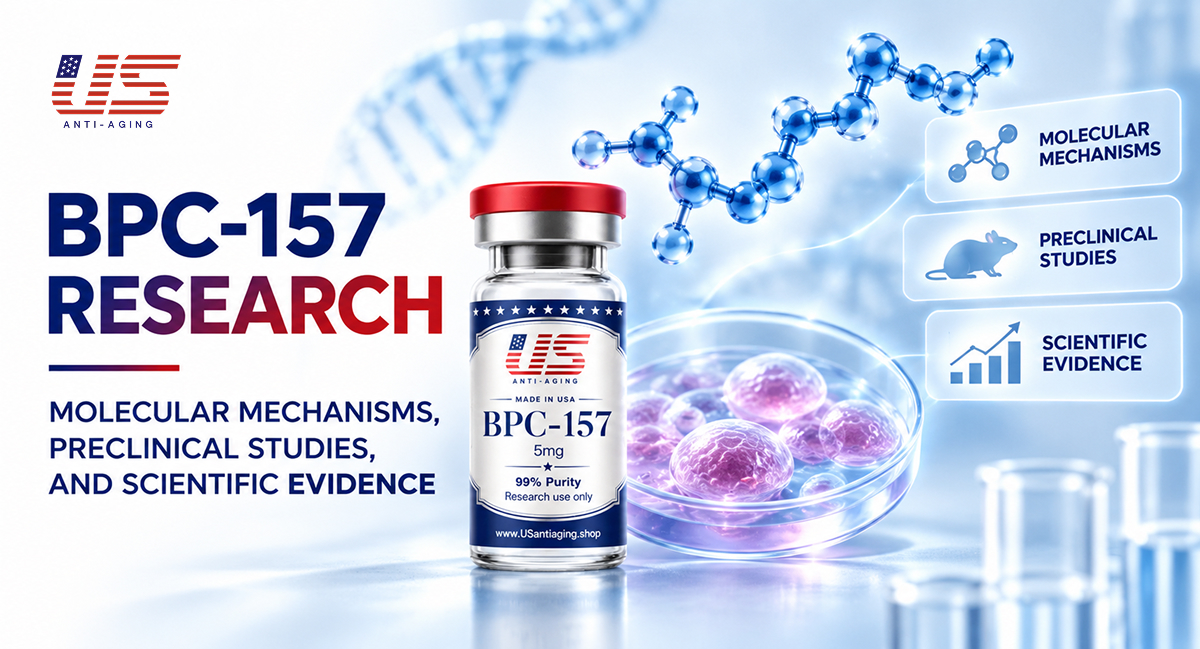


BPC-157 research investigates a synthetic 15-amino-acid peptide for its interactions with cellular signaling pathways, vascular responses, and tissue-related biological processes. Laboratory and animal studies have examined its effects on cell migration, angiogenesis, and experimental musculoskeletal injuries. However, its precise molecular targets remain incompletely understood, and controlled human evidence is insufficient to establish clinical effectiveness or long-term safety.
Current investigations focus primarily on molecular mechanisms and preclinical observations rather than established medical applications.
For laboratories exploring experimental peptide biology, US Anti-Aging provides research-focused compounds intended for scientific investigation.
This article examines BPC-157’s molecular characteristics, proposed signaling mechanisms, experimental models, and the limitations of available scientific evidence.
What Is BPC-157?
BPC-157, commonly called Body Protection Compound-157, is a synthetic pentadecapeptide associated with research into biological responses to tissue injury.
The compound originates from investigations involving peptide sequences associated with gastric protein fractions. However, the synthetic molecule used in laboratory studies should not be confused with a clinically approved pharmaceutical treatment.
Why Is BPC-157 Studied?
Researchers have investigated BPC-157 in experimental models involving gastrointestinal tissues, tendons, ligaments, skeletal muscle, and vascular systems.
The primary scientific questions concern whether the peptide influences cellular migration, tissue organization, and responses to experimental injury.
A comprehensive literature review describes its wide range of preclinical investigations while emphasizing the absence of sufficient clinical evidence supporting medical applications (Józwiak et al., 2025).
What Makes the Evidence Preliminary?
Most published findings involve cultured cells or animal experiments.
Although these systems help identify potential mechanisms, they cannot fully reproduce human physiology.
Furthermore, BPC-157 lacks FDA approval as a therapeutic drug in the United States. Therefore, experimental observations should not be presented as established human health benefits.
For laboratories investigating BPC-157 molecular mechanisms, cellular signaling, and preclinical evidence, explore BPC-157 Peptide for Research at US Anti-Aging, intended strictly for scientific and laboratory research.
What Is the Molecular Structure of BPC-157?
BPC-157 consists of 15 amino acid residues connected through peptide bonds. Its defined amino acid sequence provides the foundation for investigating its chemical characteristics and biological interactions.
Amino Acid Sequence and Molecular Properties
The peptide’s amino acid sequence is:
Gly-Glu-Pro-Pro-Pro-Gly-Lys-Pro-Ala-Asp-Asp-Ala-Gly-Leu-Val
Its one-letter representation is GEPPPGKPADDAGLV.
| Molecular characteristic | Description |
|---|---|
| Compound | BPC-157 |
| Classification | Synthetic pentadecapeptide |
| Number of amino acids | 15 |
| Molecular formula | C62H98N16O22 |
| Approximate molecular weight | 1,419.5 g/mol |
| Main research areas | Cellular signaling, vascular biology, tissue injury models |
These molecular details are documented in the NCBI PubChem compound database.
How Does Structure Affect Experimental Behavior?
BPC-157 contains several proline residues that influence backbone geometry and conformational flexibility.
Additionally, charged amino acid side chains contribute to its chemical characteristics and interactions with surrounding molecules.
However, identifying the peptide sequence does not establish which cellular receptors it recognizes.
Researchers must use molecular characterization and functional assays to distinguish chemical identity from biological activity.
Which Signaling Pathways Are Studied With BPC-157?
BPC-157 research has examined several signaling mechanisms associated with vascular regulation, cellular migration, and experimental injury responses.
However, most proposed mechanisms come from cell-based experiments and animal models. Researchers have not established a single definitive human receptor responsible for its reported biological effects.
VEGFR2 and Angiogenesis-Related Signaling
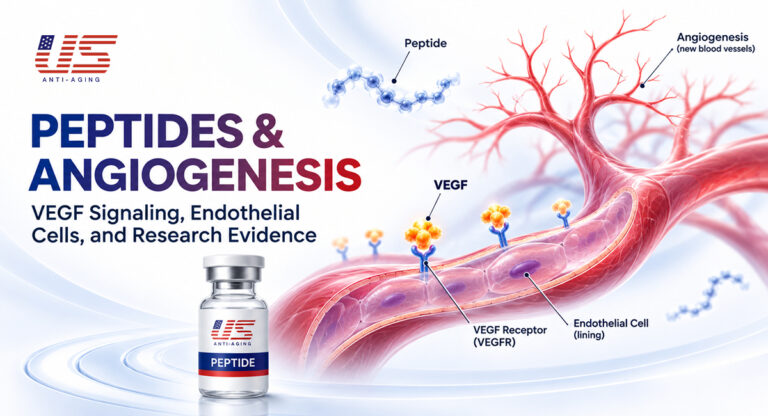
One frequently investigated mechanism involves vascular endothelial growth factor receptor 2 (VEGFR2).
VEGFR2 participates in vascular signaling, including endothelial cell responses associated with blood vessel formation.
Experimental research reported changes in VEGFR2 expression and activation following BPC-157 exposure, alongside angiogenesis-related observations.
However, these findings do not prove that BPC-157 directly binds VEGFR2 or produces the same responses in humans (Hsieh et al., 2017).
FAK–Paxillin and Cellular Migration
Focal adhesion kinase (FAK) and paxillin participate in molecular processes that regulate cellular attachment and movement.
In cultured rat tendon fibroblasts, researchers observed increased migration and changes in FAK and paxillin phosphorylation following BPC-157 exposure.
The investigators also reported improved fibroblast survival under experimentally induced oxidative stress.
These findings suggest a relationship between BPC-157 exposure and adhesion-associated signaling, although the upstream molecular target remains uncertain (Chang et al., 2011).
Nitric Oxide and Other Proposed Pathways
Researchers have also investigated potential interactions involving nitric oxide regulation, Akt/eNOS signaling, and inflammatory responses.
Nitric oxide participates in vascular regulation and cellular communication. However, its effects depend on concentration, tissue type, and biological conditions.
Consequently, changes in nitric oxide-associated markers should not automatically be interpreted as improved tissue repair.
Current mechanistic reviews describe these pathways as experimental associations requiring further confirmation (McGuire et al., 2025).
How Is BPC-157 Investigated in Preclinical Models?
Scientists use several complementary approaches to investigate BPC-157’s biological characteristics.
These models allow researchers to measure specific responses, but their findings vary according to the experimental system.
Cell-Based and Molecular Experiments
In vitro investigations commonly examine tendon fibroblasts, endothelial cells, and other selected cell populations.
Researchers measure endpoints such as:
- Cell migration and adhesion.
- Protein phosphorylation.
- Gene expression changes.
- Cell survival under experimental stress.
- Vascular signaling-related responses.
For example, fibroblast migration assays can identify changes in cellular movement.
However, faster movement in a laboratory assay does not independently demonstrate improved tissue function within a living organism.
Animal Models of Experimental Injury
Animal investigations have examined BPC-157 in models involving tendon injuries, ligament damage, skeletal muscle injury, and bone repair.
Researchers evaluate structural and functional endpoints using histology, biomechanical testing, and other experimental measurements.
A systematic review published in 2025 identified numerous preclinical studies reporting favorable outcomes across musculoskeletal injury models (Emerging Use of BPC-157, 2025).
Nevertheless, methodological differences, small experimental groups, and limited independent validation complicate interpretation.
How Researchers Evaluate Experimental Outcomes
| Experimental model | Common measurement | Main limitation |
|---|---|---|
| Tendon fibroblast cultures | Cell migration and signaling | No whole-tissue physiology |
| Endothelial cell assays | Vascular signaling responses | Cannot confirm functional vascular outcomes |
| Rodent tendon injury | Histology and mechanical strength | Species differences |
| Muscle injury models | Tissue organization and functional markers | Limited human applicability |
| Molecular assays | Protein and gene expression | Indirect evidence of biological function |
Importantly, these outcomes represent different levels of evidence.
For laboratories investigating BPC-157 molecular mechanisms, cellular signaling, and preclinical evidence, explore BPC-157 Peptide for Research at US Anti-Aging, intended strictly for scientific and laboratory research.
What Are the Evidence and Safety Limitations?
The central limitation of BPC-157 research is the gap between experimental findings and reliable human clinical evidence.
Although multiple animal studies have investigated the compound, controlled trials demonstrating clinical effectiveness remain unavailable.
What Does Current Human Evidence Show?
A systematic review published in October 2026 identified three small human investigations involving a combined total of 30 participants.
These included retrospective studies examining knee pain and interstitial cystitis, plus a two-participant intravenous safety pilot.
However, all three studies had substantial methodological limitations, including inadequate controls and small samples.
The review rated the overall certainty of evidence as very low. Therefore, these findings cannot establish effectiveness or safety for routine clinical use (Poolton et al., 2026).
What Safety Questions Remain Unanswered?
Researchers still lack adequate information about several important areas:
- Long-term human safety and adverse events.
- Immunogenicity and immune-related reactions.
- Reliable exposure-response relationships.
- Standardized pharmaceutical formulations.
- Potential effects across different populations.
- Risks associated with impurities and inconsistent manufacturing.
Additionally, the FDA has identified potential safety concerns involving immunogenicity, peptide-related impurities, and insufficient safety information for proposed administration routes.
These concerns reinforce the distinction between research materials and approved pharmaceutical products.
Why Further Research Is Necessary
Future investigations would need validated analytical methods, reproducible experimental findings, and appropriately designed human studies.
Furthermore, researchers must distinguish direct molecular effects from downstream changes that occur indirectly.
Without stronger clinical evidence, claims about injury recovery, tissue regeneration, or established human safety remain unsupported.
To explore how peptides interact with cellular processes involved in tissue repair, read our comprehensive guide, Peptides in Tissue Repair Research: Biological Mechanisms and Current Evidence, covering molecular mechanisms, experimental models, and the current state of scientific evidence.
FAQs About BPC-157 Research
1. What is BPC-157 research focused on?
BPC-157 research primarily examines molecular signaling, cellular migration, vascular responses, and experimental tissue injury models.
Most findings come from laboratory and animal studies rather than controlled human clinical trials.
2. What is the molecular structure of BPC-157?
BPC-157 is a synthetic peptide containing 15 amino acids.
Its sequence is GEPPPGKPADDAGLV, with an approximate molecular weight of 1,419.5 g/mol.
3. Which pathways have been investigated with BPC-157?
Researchers have examined VEGFR2, FAK–paxillin, Akt/eNOS, and nitric oxide-associated signaling.
However, these findings do not establish a definitive receptor mechanism in humans.
4. Has BPC-157 demonstrated effectiveness in humans?
Current human evidence is extremely limited.
Small uncontrolled investigations cannot establish reliable clinical effectiveness, and appropriately designed randomized trials remain necessary.
5. Is BPC-157 approved by the FDA?
No. BPC-157 is not an FDA-approved therapeutic drug.
Research-use-only materials should not be represented as approved treatments or considered clinically validated for human administration.
Conclusion: Understanding the Current State of BPC-157 Research
BPC-157 research has generated experimental findings involving cellular migration, vascular signaling, and responses to tissue injury.
However, the available evidence remains predominantly preclinical. While laboratory studies provide insight into possible molecular mechanisms, they cannot establish therapeutic effectiveness or long-term safety in humans.
Consequently, future investigations require rigorous experimental design, independent replication, and reliable clinical evidence.
For laboratories examining peptide chemistry and molecular biology, US Anti-Aging offers research-focused compounds intended for scientific investigation.
Disclaimer: All compounds and information presented in this article are intended strictly for scientific research and educational purposes. These products are not approved for medical use and are not intended for human or veterinary use, diagnosis, treatment, or prevention of any disease.