
Peptides and Tissue Remodeling: Extracellular Matrix, Collagen, and Cellular Research

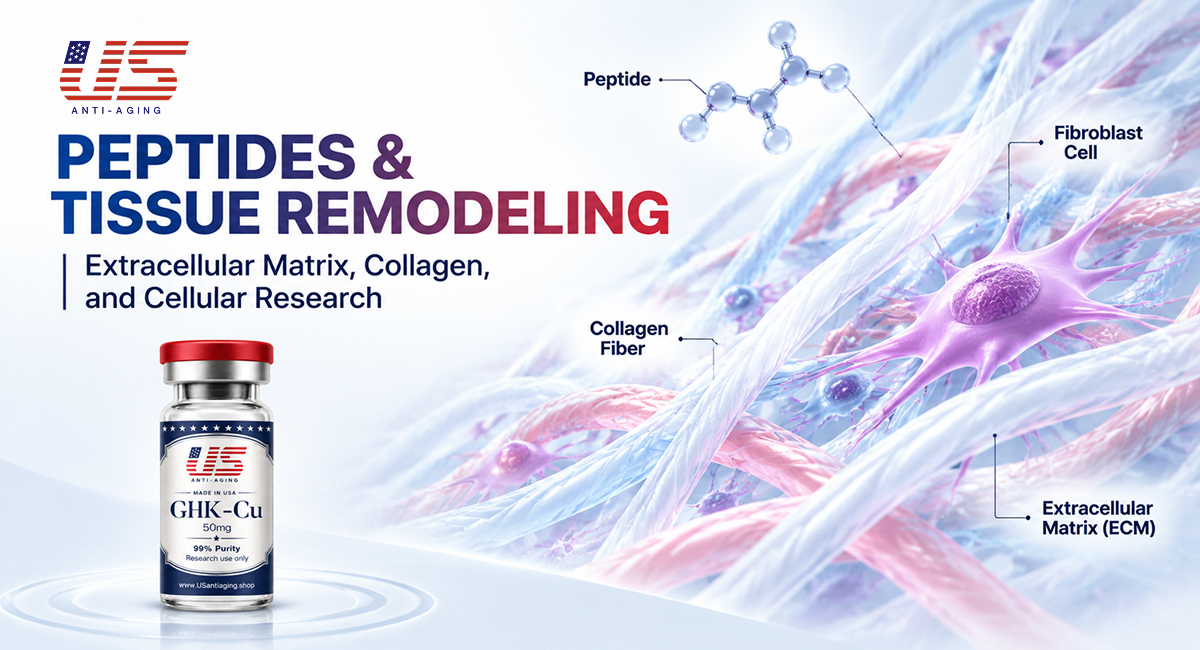


Peptides and tissue remodeling represent an area of biological research examining how peptide molecules interact with fibroblasts, collagen metabolism, extracellular matrix (ECM) organization, and cellular signaling. Scientists investigate whether specific peptides influence matrix synthesis, protein degradation, cellular adhesion, and the structural properties of experimental tissues.
However, tissue remodeling requires a balance between matrix production and degradation. Increased collagen synthesis alone does not necessarily indicate improved tissue organization or function.
For laboratories investigating peptide chemistry and cellular biology, US Anti-Aging provides research-focused resources intended for scientific exploration.
This article examines the cellular mechanisms, experimental models, and scientific evidence connecting peptides with tissue remodeling.
What Is Tissue Remodeling?
Tissue remodeling is a dynamic biological process involving changes in tissue composition, structural organization, and mechanical properties. It occurs during normal development, physiological adaptation, and responses to tissue injury.
Unlike tissue repair, which focuses broadly on restoring tissue integrity, remodeling emphasizes the continuous reorganization of existing and newly formed structures.
Major Biological Processes in Tissue Remodeling
Researchers commonly investigate several interconnected processes:
- Matrix synthesis: Production of collagen, fibronectin, and other extracellular components.
- Matrix degradation: Enzymatic breakdown of existing structural proteins.
- Cellular reorganization: Changes in cellular distribution and attachment.
- Protein cross-linking: Formation of molecular connections that influence tissue stiffness.
- Mechanical adaptation: Structural responses to physical forces.
The extracellular matrix provides both structural support and biochemical signals that regulate cellular behavior. Consequently, changes in matrix composition can influence tissue development and cellular function (Bonnans et al., 2014).
Within peptides and tissue remodeling research, scientists examine these processes individually and collectively.
How Do Fibroblasts Influence Tissue Remodeling?
Fibroblasts are connective tissue cells that produce, organize, and maintain extracellular matrix components. They respond to biochemical signals, mechanical forces, and changes in their surrounding environment.
However, fibroblasts are not a uniform cell population. Their characteristics and functions vary across skin, tendons, lungs, and other tissues.
Fibroblast Activation and Matrix Production
Following tissue injury, selected fibroblasts adopt an activated phenotype characterized by changes in matrix production and cellular behavior.
Researchers frequently measure collagen expression and fibronectin production to investigate these responses.
Additionally, transforming growth factor-beta (TGF-β) signaling plays an important role in regulating fibroblast activation and matrix-related gene expression.
Myofibroblasts and Tissue Contraction
Under particular biological conditions, fibroblasts can differentiate into contractile cells known as myofibroblasts.
These cells generate mechanical tension and contribute to matrix organization. Nevertheless, prolonged or excessive myofibroblast activity can promote fibrosis and disrupt normal tissue function (Hinz, 2016).
Therefore, researchers studying peptides and tissue remodeling must distinguish temporary cellular activation from persistent fibrotic responses.
What Roles Do Collagen and the ECM Play?
The extracellular matrix consists of proteins, polysaccharides, and associated molecules that support tissue architecture and regulate cellular communication.
Collagen is among its most abundant structural proteins. However, other ECM constituents also contribute to tissue stability, elasticity, and biochemical signaling.
Major Extracellular Matrix Components
| ECM component | Primary biological role |
|---|---|
| Type I collagen | Provides tensile strength |
| Type III collagen | Supports flexible connective tissue networks |
| Elastin | Contributes to elasticity and recoil |
| Fibronectin | Supports cellular adhesion and matrix assembly |
| Proteoglycans | Regulate hydration and molecular interactions |
| Glycosaminoglycans | Influence matrix organization and water retention |
The relative abundance and organization of these components vary between tissues.
Consequently, measuring collagen concentration alone provides only a partial understanding of matrix remodeling.
MMPs and TIMPs in Matrix Regulation
Matrix metalloproteinases (MMPs) are enzymes that degrade selected extracellular matrix components.
Meanwhile, tissue inhibitors of metalloproteinases (TIMPs) regulate MMP activity and help maintain controlled matrix turnover.
An imbalance between these processes can contribute to excessive matrix degradation or accumulation.
Matrikines: Peptides Generated From the ECM
During matrix degradation, structural proteins can release biologically active fragments known as matrikines.
These fragments may influence surrounding cells and generate additional signaling responses. Furthermore, their activities can vary according to sequence, molecular target, and tissue context.
Research into matrikines highlights how matrix-derived peptides can participate in both physiological and pathological remodeling (Jariwala et al., 2022).
How Are Peptides Studied in Tissue Remodeling Models?
Scientists investigating peptides and tissue remodeling use experimental methods that measure matrix composition, cellular behavior, and mechanical characteristics.
Different models provide complementary information about how peptide exposure influences selected biological processes.
Common Experimental Models and Measurements
| Research method | Primary measurement | Scientific limitation |
|---|---|---|
| Fibroblast cultures | Matrix-related cellular activity | Limited tissue complexity |
| qPCR | Collagen and ECM-associated gene expression | Does not directly measure protein abundance |
| Western blot | Protein expression and signaling | Limited structural information |
| Gelatin zymography | Gelatin-degrading enzyme activity | Does not represent complete ECM turnover |
| Three-dimensional collagen models | Matrix contraction and cellular organization | Simplified tissue environment |
| Histological analysis | Collagen distribution and tissue architecture | May not establish mechanical function |
| Biomechanical testing | Tissue stiffness and tensile strength | Does not identify specific molecular mechanisms |
Why Multiple Endpoints Matter
Suppose a peptide increases collagen-associated gene expression in cultured fibroblasts.
Although this observation suggests altered cellular activity, it does not establish increased collagen deposition, appropriate fiber alignment, or improved mechanical strength.
Consequently, reliable peptides and tissue remodeling research combines molecular, structural, and functional measurements rather than relying on a single biomarker.
What Does Current Scientific Evidence Show?
Current research includes copper-binding peptides, matrix-derived fragments, and synthetic peptides investigated in connective tissue models.
However, each compound has a distinct evidence base.
GHK-Cu and Collagen Synthesis
GHK-Cu is a copper-binding complex associated with the tripeptide glycyl-histidyl-lysine.
An early fibroblast study reported increased collagen synthesis following GHK-Cu exposure, independently of changes in cell number.
Subsequent research using a rat wound chamber model identified increased collagen and glycosaminoglycan accumulation, alongside changes in type I and type III collagen gene expression (Maquart et al., 1993).
Nevertheless, these findings do not establish human clinical effectiveness.
GHK-Cu and Matrix Degradation
Interestingly, GHK-Cu research extends beyond collagen production.
A separate fibroblast study reported increased MMP-2 expression alongside increased secretion of TIMP-1 and TIMP-2. Copper ions alone reproduced the MMP-2 response, while the uncomplexed tripeptide did not (PubMed-indexed study, 2000).
This finding illustrates why researchers must distinguish the activity of a peptide from that of its associated metal ions.
It also highlights the importance of investigating matrix synthesis and degradation together.
BPC-157 and Tendon Fibroblast Research
BPC-157 is a synthetic 15-amino-acid peptide investigated in experimental connective tissue models.
A study involving rat tendon explants and cultured fibroblasts reported changes in cellular outgrowth, migration, and adhesion-associated signaling following BPC-157 exposure (Chang et al., 2011).
However, altered fibroblast migration does not independently demonstrate improved collagen organization or functional tissue remodeling in humans.
Current Evidence Limitations
Several uncertainties remain across peptides and tissue remodeling research:
- Limited direct evidence from controlled human studies of investigational compounds.
- Differences between experimental tissues and human physiology.
- Incomplete characterization of long-term matrix responses.
- Variability in molecular formulations and analytical methods.
- Insufficient evidence connecting cellular changes with functional outcomes.
To explore how peptides interact with cellular processes involved in tissue repair, read our comprehensive guide, Peptides in Tissue Repair Research: Biological Mechanisms and Current Evidence, covering molecular mechanisms, experimental models, and the current state of scientific evidence.
FAQs About Peptides and Tissue Remodeling
1. What is the relationship between peptides and tissue remodeling?
Researchers investigate how specific peptides influence fibroblast activity, collagen metabolism, matrix turnover, and cellular signaling. These responses depend on molecular identity and experimental conditions.
2. Which peptides are studied in extracellular matrix research?
GHK-Cu, BPC-157, and several matrix-derived peptides appear in experimental literature. However, their molecular mechanisms and supporting evidence differ considerably.
3. Does increased collagen production indicate improved tissue remodeling?
Not necessarily. Effective remodeling also depends on collagen organization, degradation, cross-linking, and mechanical properties. Excessive collagen accumulation may contribute to fibrosis.
4. What role do MMPs play in tissue remodeling?
Matrix metalloproteinases participate in extracellular matrix degradation. Their activity helps regulate structural reorganization and interacts with natural inhibitors known as TIMPs.
5. Can preclinical peptide research establish human tissue remodeling benefits?
No. Cellular and animal studies provide mechanistic information, but controlled human investigations are necessary to establish clinical effectiveness and safety.
Conclusion: Understanding Peptides and Tissue Remodeling
Peptides and tissue remodeling research provides insight into fibroblast regulation, collagen metabolism, extracellular matrix turnover, and cellular communication.
Although experimental studies involving GHK-Cu and BPC-157 demonstrate changes in selected matrix-associated processes, these observations cannot independently establish therapeutic benefits.
Consequently, meaningful scientific interpretation requires complementary experimental methods, verified molecular identities, and careful evaluation of structural and functional outcomes.
For further information about peptide chemistry and cellular research, explore the educational resources available at US Anti-Aging
Disclaimer: All compounds and information presented in this article are intended strictly for scientific research and educational purposes. These products are not approved for medical use and are not intended for human or veterinary use, diagnosis, treatment, or prevention of any disease.