TB-500 Research: Molecular Structure, Thymosin Beta-4, and Preclinical Evidence

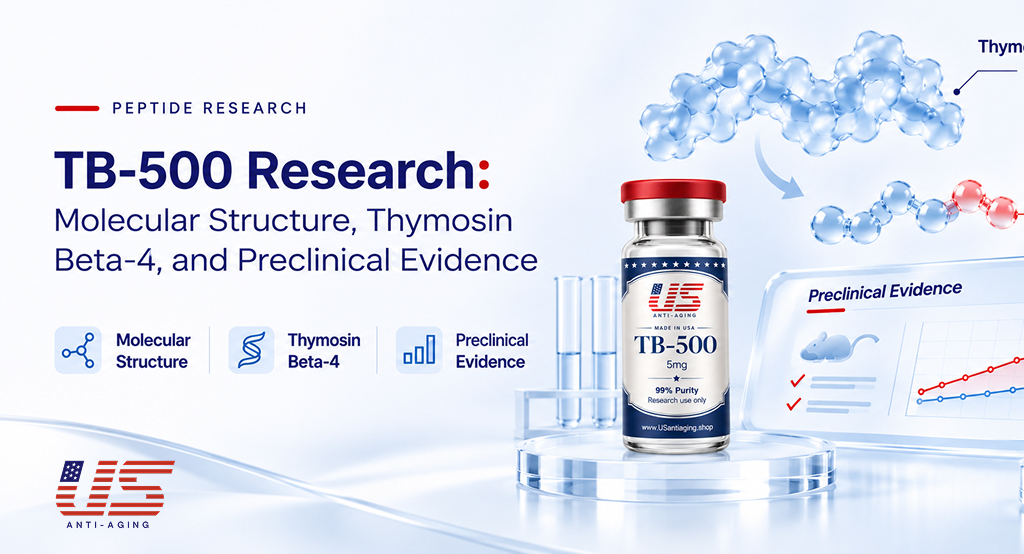


TB-500 research investigates a synthetic peptide fragment derived from thymosin beta-4, a naturally occurring protein involved in actin regulation and cellular movement. Researchers have studied TB-500-related sequences for their molecular characteristics, metabolism, and potential interactions with processes associated with tissue repair.
However, an important distinction exists: TB-500 and full-length thymosin beta-4 are not necessarily the same compound. Most published biological studies involve thymosin beta-4 or related fragments rather than the specifically acetylated peptide identified as TB-500.
Furthermore, direct human evidence remains insufficient to establish clinical effectiveness or long-term safety.
For laboratories exploring peptide biology, US Anti-Aging provides research-focused compounds intended for scientific investigation.
This article examines TB-500’s molecular identity, differences from thymosin beta-4, direct experimental findings, and current evidence limitations.
What Is TB-500?
TB-500 commonly refers to a synthetic peptide containing the acetylated amino acid sequence Ac-LKKTETQ, corresponding to residues 17–23 of thymosin beta-4.
This seven-amino-acid region forms part of the parent peptide’s actin-binding domain, which has attracted scientific interest because of its involvement in cellular organization and movement.
However, commercial naming conventions are inconsistent, and some products labeled TB-500 may contain different peptide forms.
Why Is TB-500 Investigated?
Researchers study TB-500-related molecules to investigate:
- Molecular interactions involving actin-associated structures.
- Peptide degradation and metabolic stability.
- Cellular migration under laboratory conditions.
- Angiogenesis-related experimental responses.
- Analytical identification of peptide fragments and metabolites.
Nevertheless, these research areas do not establish that TB-500 produces clinically meaningful tissue repair.
A 2012 analytical study identified the acetylated 17–23 fragment of thymosin beta-4 in a preparation marketed as TB-500, providing important evidence about its chemical identity (Esposito et al., 2012).
Why Chemical Identity Matters
A commercial name does not necessarily establish a compound’s exact amino acid sequence, terminal modifications, or purity.
Therefore, researchers must verify molecular identity before comparing results across studies.
This distinction is particularly important because studies involving different thymosin beta-4 derivatives cannot automatically support identical biological conclusions.
For laboratories investigating TB-500 molecular structure, peptide metabolism, and preclinical research, explore TB-500 Peptide for Research at US Anti-Aging, intended strictly for scientific and laboratory research.
How Does TB-500 Differ From Thymosin Beta-4?
The central distinction in TB-500 research concerns the relationship between a short synthetic fragment and its full-length parent molecule.
Thymosin beta-4 is a naturally occurring peptide containing 43 amino acids. In contrast, the commonly identified TB-500 fragment contains seven amino acids with an additional N-terminal acetyl group.
Comparing TB-500 and Thymosin Beta-4
| Characteristic | TB-500 | Thymosin Beta-4 |
|---|---|---|
| Molecular classification | Synthetic peptide fragment | Naturally occurring peptide |
| Amino acid length | 7 residues | 43 residues |
| Typical sequence | Ac-LKKTETQ | Full-length thymosin beta-4 sequence |
| Approximate molecular weight | 889 Da | 4,963 Da |
| Main research emphasis | Molecular identification, metabolism, fragment activity | Actin regulation, cellular migration, experimental tissue repair |
| Human clinical evidence | No established controlled human trials of the defined fragment | Selected early human investigations |
| Clinical equivalence | Not established | Cannot be inferred for TB-500 |
Why Thymosin Beta-4 Findings Cannot Automatically Apply to TB-500
Thymosin beta-4 contains multiple functional regions that may contribute to its biological activity.
For example, researchers have investigated its interactions with actin, endothelial cells, and repair-associated processes.
A laboratory study demonstrated that the actin-binding region plays an important role in angiogenesis-related responses (Philp et al., 2003).
However, the study’s fragment findings do not automatically establish equivalent activity for every chemically modified version of that sequence.
Consequently, researchers must distinguish evidence concerning the parent molecule, unmodified fragments, and acetylated TB-500.
What Molecular Properties Define TB-500?
Understanding TB-500’s molecular properties requires examining its amino acid composition, terminal modifications, and susceptibility to degradation.
The commonly identified fragment contains the sequence Ac-Leu-Lys-Lys-Thr-Glu-Thr-Gln, abbreviated Ac-LKKTETQ.
Its N-terminal acetyl group represents a chemical modification that distinguishes it from the corresponding unacetylated sequence.
The Role of the Actin-Binding Region
Actin is a structural protein involved in cellular shape, movement, and cytoskeletal organization.
The central LKKTETQ region contributes to thymosin beta-4’s interaction with actin-associated biological processes.
Therefore, researchers investigate whether isolated fragments retain selected characteristics associated with the parent molecule.
However, the presence of this sequence alone does not prove that acetylated TB-500 reproduces every function of full-length thymosin beta-4.
How Molecular Modifications Affect Experimental Behavior
Chemical modifications can influence peptide properties such as:
- Enzymatic stability: Susceptibility to proteolytic degradation.
- Molecular recognition: Interactions with biological targets.
- Solubility: Behavior within particular experimental solutions.
- Metabolic processing: Formation of smaller peptide fragments.
- Analytical identification: Detection and differentiation using mass spectrometry.
Importantly, structural modification may change biological behavior rather than simply improving it.
Researchers must therefore characterize the specific peptide used in each experiment.
For laboratories investigating TB-500 molecular structure, peptide metabolism, and preclinical research, explore TB-500 Peptide for Research at US Anti-Aging, intended strictly for scientific and laboratory research.
What Studies Have Directly Investigated TB-500?
Published TB-500 research includes analytical identification, animal metabolism studies, and selected experiments examining cellular responses.
However, a substantial portion of the literature commonly associated with TB-500 actually investigates full-length thymosin beta-4 or unacetylated peptide fragments.
Analytical Characterization of TB-500
One early study used high-resolution mass spectrometry to identify Ac-LKKTETQ in TB-500 preparations.
Researchers also synthesized the fragment and developed analytical methods relevant to its detection in biological samples.
The investigation primarily established chemical identity and detection approaches rather than biological effectiveness (Esposito et al., 2012).
Metabolism and Cellular Activity Studies
A 2024 investigation directly examined acetylated TB-500 and several metabolites using human serum, experimental enzyme systems, and rat samples.
Researchers identified multiple degradation products, including Ac-LK and Ac-LKK.
Additionally, fibroblast experiments evaluated wound-closure-related activity.
Interestingly, the metabolite Ac-LKKTE demonstrated a statistically significant response in the reported assay, whereas the parent TB-500 compound did not.
These findings suggest that metabolic products may contribute to certain experimental observations (Rahaman et al., 2024).
However, cell-based results cannot establish improved tissue repair in humans.
Research Involving Related Peptide Fragments
Separate experiments investigated the unacetylated LKKTETQ sequence associated with thymosin beta-4.
In an animal wound model, researchers reported repair-associated responses after administering a synthetic peptide containing this actin-binding region (Philp et al., 2003).
Nevertheless, the unacetylated sequence should not be considered chemically identical to acetylated TB-500.
Comparing the Experimental Evidence
| Study | Compound investigated | Main finding |
|---|---|---|
| Esposito et al., 2012 | Acetylated TB-500 fragment | Chemical identification and analytical detection |
| Philp et al., 2003 | Thymosin beta-4 and unacetylated fragment | Experimental angiogenesis and wound-associated responses |
| Rahaman et al., 2024 | TB-500 and metabolites | Metabolic characterization and fibroblast assay findings |
| McGuire et al., 2026 | Thymosin beta-4 and TB-500 literature | Identified substantial evidence gaps and limited direct TB-500 research |
A 2026 scoping review confirmed that most available experimental literature focuses on thymosin beta-4 rather than the specifically defined TB-500 fragment (McGuire et al., 2026).
What Are the Evidence and Safety Limitations?
The main limitation of TB-500 research is the shortage of direct, high-quality evidence involving the defined acetylated fragment.
Although related thymosin beta-4 investigations provide biological context, they cannot establish equivalent efficacy or safety.
Limited Human Clinical Evidence
Published human research involving thymosin beta-4 has examined selected applications, including wound and ocular surface conditions.
However, these investigations used specific full-length peptide formulations rather than the commonly identified TB-500 fragment.
Furthermore, controlled human studies have not established the clinical effectiveness of acetylated TB-500.
Therefore, findings involving thymosin beta-4 should not be presented as direct clinical validation of TB-500.
Unanswered Safety Questions
Several uncertainties remain:
- Long-term toxicity and adverse effects.
- Human pharmacokinetics and metabolic behavior.
- Immunogenicity and immune-related responses.
- Consistency of compound identity and purity.
- Potential risks involving uncharacterized impurities.
- Differences between experimental formulations.
Additionally, the FDA’s 2026 scientific evaluation identified concerns involving the inconsistent identity and characterization of substances marketed as TB-500.
These uncertainties reinforce the importance of distinguishing laboratory research materials from approved medicines.
What Further Research Is Needed?
Future investigations require clearly identified molecular preparations, validated analytical methods, and reproducible biological experiments.
Researchers must also determine whether effects observed with related fragments persist with acetylated TB-500.
Ultimately, appropriately designed clinical studies would be necessary before establishing human safety or therapeutic effectiveness.
To explore how peptides interact with cellular processes involved in tissue repair, read our comprehensive guide, Peptides in Tissue Repair Research: Biological Mechanisms and Current Evidence, covering molecular mechanisms, experimental models, and the current state of scientific evidence.
FAQs About TB-500 Research
1. What is TB-500 research focused on?
TB-500 research examines peptide identity, metabolism, actin-associated molecular interactions, and experimental cellular responses.
However, direct evidence remains limited compared with the research available for thymosin beta-4.
2. Is TB-500 the same as thymosin beta-4?
No. TB-500 commonly refers to an acetylated seven-amino-acid fragment, while thymosin beta-4 contains 43 amino acids.
Commercial naming may vary, so molecular identity requires confirmation.
3. What is the amino acid sequence of TB-500?
The commonly identified TB-500 fragment has the sequence Ac-LKKTETQ.
The Ac prefix indicates an N-terminal acetyl modification.
4. Have human clinical trials established TB-500 effectiveness?
No. Controlled human clinical evidence has not established effectiveness for the defined TB-500 fragment.
Studies involving full-length thymosin beta-4 cannot automatically support claims about TB-500.
5. Is TB-500 approved by the FDA?
No. TB-500 is not an FDA-approved therapeutic drug.
Research-use-only materials should not be presented as approved medical treatments.
Conclusion: Understanding the Current State of TB-500 Research
TB-500 research provides useful information about a synthetic thymosin beta-4 fragment, particularly its molecular identification, degradation, and selected laboratory responses.
However, the scientific evidence remains limited and should not be confused with the broader research involving full-length thymosin beta-4.
Consequently, reliable interpretation requires precise compound identification, appropriate experimental controls, and careful separation of direct findings from related biological observations.
For laboratories exploring peptide chemistry and molecular biology, US Anti-Aging offers research-focused compounds intended for scientific investigation.
Disclaimer: All compounds and information presented in this article are intended strictly for scientific research and educational purposes. These products are not approved for medical use and are not intended for human or veterinary use, diagnosis, treatment, or prevention of any disease.