Top 4 Peptides for Recovery Research: Mechanisms and Scientific Evidence

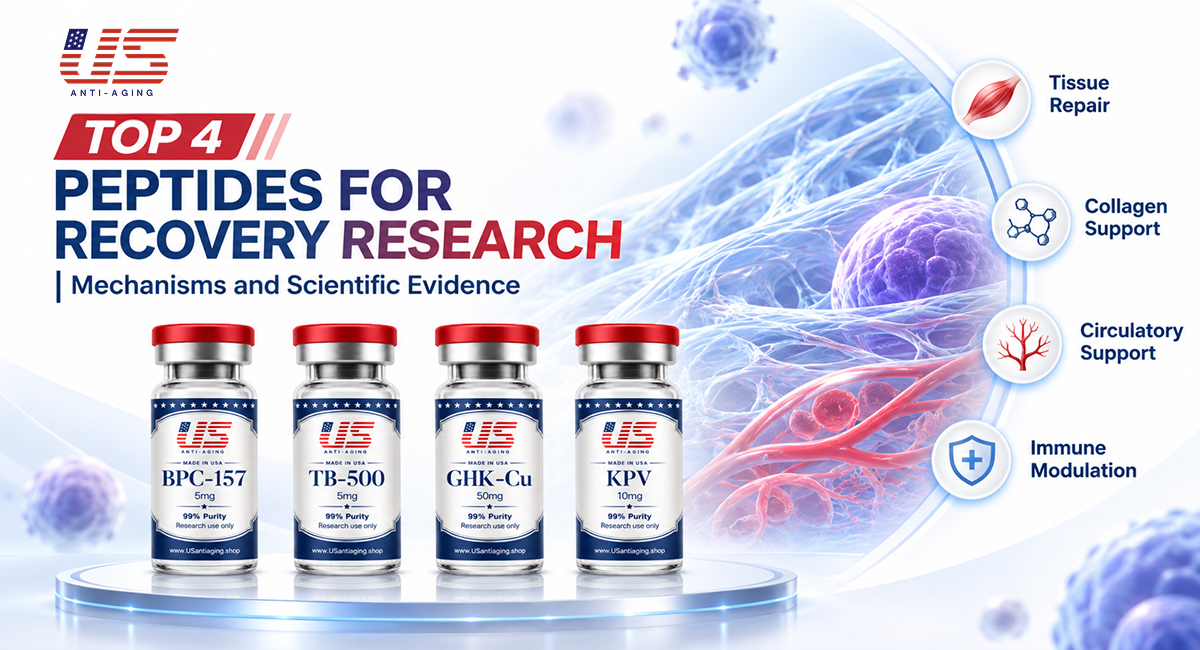


The top peptides for recovery research featured in this article are BPC-157, TB-500, KPV, and the GLOW peptide blend. Scientists investigate these compounds in connection with cellular migration, inflammatory signaling, vascular responses, and extracellular matrix remodeling.
However, each compound has a different molecular structure, experimental purpose, and level of scientific evidence. While BPC-157 has a substantial preclinical research history, direct TB-500 studies remain limited. Meanwhile, KPV research primarily focuses on inflammation, and GLOW introduces the complexities of multi-peptide formulations.
The selection below reflects research relevance rather than a ranking of clinical effectiveness.
For additional educational information about peptide biology and experimental methods, explore the scientific resources available at US Anti-Aging
What Are Peptides for Recovery Research?
Peptides for recovery research are molecules that scientists investigate to understand biological responses associated with tissue injury, cellular stress, inflammation, and structural reorganization.
Recovery is not a single molecular process. Instead, it involves interconnected biological mechanisms that vary according to tissue type and experimental conditions.
Major Biological Processes in Recovery Research
Researchers commonly examine:
- Cellular migration: Movement of cells toward experimentally damaged regions.
- Angiogenesis: Formation of new blood vessels from existing vascular networks.
- Inflammatory regulation: Changes in cytokine production and immune signaling.
- Extracellular matrix remodeling: Reorganization of collagen and other structural components.
- Mechanical recovery: Changes in tissue strength and functional properties.
Consequently, evaluating the top peptides for recovery research requires more than examining whether a compound influences one biological marker.
Scientists must also determine whether molecular observations correspond to meaningful structural or functional changes.
Which 4 Peptides and Formulations Are Featured?
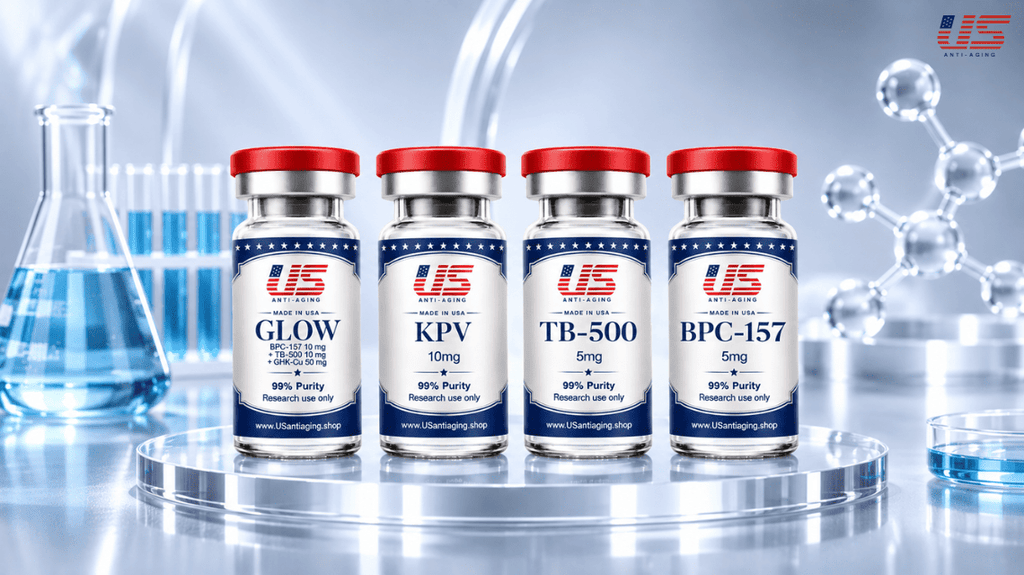
The following four research compounds represent different approaches to investigating recovery-associated biological processes.
1. BPC-157
BPC-157 is a synthetic pentadecapeptide containing 15 amino acids.
Researchers have investigated its relationship with fibroblast migration, vascular signaling, and experimental musculoskeletal injuries. Its research history includes tendon, ligament, skeletal muscle, and bone injury models.
However, most supporting evidence remains preclinical.
For further investigation into peptide molecular mechanisms, cellular migration, and experimental tissue repair, explore BPC-157 Peptide for Research at US Anti-Aging, intended strictly for scientific and laboratory research.
2. TB-500
TB-500 commonly refers to a synthetic, acetylated seven-amino-acid fragment of thymosin beta-4.
Its molecular sequence, Ac-LKKTETQ, corresponds to part of the parent peptide’s actin-binding region. However, TB-500 and full-length thymosin beta-4 are distinct molecules.
Analytical research has confirmed the presence of this acetylated fragment in a preparation marketed as TB-500 ( Esposito et al., 2012 ).
For laboratories investigating actin-associated cellular processes, peptide metabolism, and vascular signaling, explore TB-500 Peptide for Research at US Anti-Aging, intended strictly for scientific and laboratory research.
3. KPV
KPV is a tripeptide consisting of lysine, proline, and valine. It corresponds to the C-terminal amino acid sequence of alpha-melanocyte-stimulating hormone (α-MSH).
Unlike compounds primarily investigated in musculoskeletal injury models, KPV has a research background centered on inflammatory signaling and intestinal epithelial responses.
For laboratories investigating inflammatory pathways, cytokine regulation, and cellular peptide transport, explore KPV Peptide for Research at US Anti-Aging, intended strictly for scientific and laboratory research.
4. GLOW Peptide Blend
GLOW commonly refers to a multi-component formulation containing GHK-Cu, BPC-157, and TB-500.
Rather than representing one molecular entity, GLOW combines compounds with different chemical characteristics and research histories.
Therefore, its inclusion among the top peptides for recovery research reflects its relevance to combination research, not established superiority over individual peptides.
For laboratories investigating multi-peptide interactions, molecular compatibility, and formulation stability, explore the GLOW Peptide Blend at US Anti-Aging, combining BPC-157, TB-500, and GHK-Cu for scientific research purposes only.
What Does BPC-157 and TB-500 Research Show?
BPC-157 and TB-500 frequently appear in discussions about experimental tissue repair. Nevertheless, their direct scientific evidence differs substantially.
BPC-157: Experimental Musculoskeletal Research
A 2025 systematic review examined 36 studies involving BPC-157, including 35 preclinical investigations and one clinical study.
The review identified favorable structural, functional, and biomechanical observations in several animal injury models. Researchers also examined pathways associated with cellular growth, angiogenesis, and inflammatory regulation ( Vasireddi et al., 2025 ).
However, animal findings do not establish equivalent recovery outcomes in humans.
TB-500: Distinguishing Fragment and Parent Peptide Evidence
Thymosin beta-4 research provides biological context for investigating actin-associated cellular movement.
Nevertheless, much of the literature commonly attributed to TB-500 actually concerns full-length thymosin beta-4.
Researchers must therefore distinguish studies examining the parent molecule from those directly investigating its acetylated fragment.
Without confirmed molecular equivalence, findings involving thymosin beta-4 cannot establish TB-500’s biological effectiveness.
Why Functional Measurements Matter
When comparing the top peptides for recovery research, scientists distinguish molecular activity from functional recovery.
For example, increased fibroblast migration may indicate a cellular response. However, it does not independently establish improved tendon strength, appropriate collagen alignment, or restored mobility.
Consequently, structural observations and biomechanical measurements provide essential complementary evidence.
How Are KPV and GLOW Studied?
KPV and Inflammatory Signaling
Researchers have investigated KPV through intestinal epithelial cell cultures, immune cell models, and experimental colitis studies.
A foundational study identified peptide transporter 1 (PepT1)-mediated KPV uptake alongside changes in NF-κB and MAPK signaling and inflammatory cytokine production ( Dalmasso et al., 2008 ).
Importantly, this research primarily concerns intestinal inflammation rather than athletic recovery or musculoskeletal regeneration.
Therefore, evidence from these models cannot establish comparable effects in injured tendons or skeletal muscles.
GLOW and Multi-Peptide Research
Research involving GLOW introduces questions about chemical compatibility, compound stability, and combined biological activity.
Its GHK-Cu component provides a copper-binding research context, while BPC-157 and TB-500 contribute separate experimental backgrounds.
However, individual component studies cannot establish the properties of the complete formulation. Researchers must directly evaluate the mixture before drawing conclusions about additive or synergistic activity.
No well-established controlled human evidence demonstrates the effectiveness or safety of the complete GLOW blend for recovery.
How Do These Research Compounds Compare?
Comparing the top peptides for recovery research requires evaluating molecular identity, experimental models, and the strength of available evidence.
Scientific Comparison Table
| Research compound | Molecular classification | Primary research focus | Main evidence limitation |
|---|---|---|---|
| BPC-157 | 15-amino-acid peptide | Experimental tissue injury and vascular signaling | Predominantly preclinical evidence |
| TB-500 | Thymosin beta-4-related fragment | Molecular characterization and peptide metabolism | Limited direct fragment-specific evidence |
| KPV | Three-amino-acid peptide | Inflammatory signaling and intestinal models | Insufficient human clinical evidence |
| GLOW | Multi-component formulation | Peptide interactions and combination research | Limited direct evidence for the complete blend |
What Does Human Evidence Show?
A 2026 systematic review of BPC-157 identified three human investigations involving 30 participants. However, methodological weaknesses, inadequate controls, and small sample sizes resulted in very low certainty of evidence ( Poolton et al., 2026 ).
Furthermore, the FDA identifies insufficient human safety information for BPC-157, KPV, thymosin beta-4 fragments, and injectable GHK-Cu. Potential concerns include immunogenicity, peptide-related impurities, and inadequate product characterization ( FDA, 2026 ).
None of these four research compounds has FDA approval for recovery-related therapeutic applications.
Why No Universal Research Ranking Exists
Each compound addresses different scientific questions. Therefore, the most relevant experimental evidence depends on the biological process under investigation.
To explore how peptides interact with cellular processes involved in tissue repair, read our comprehensive guide, Peptides in Tissue Repair Research: Biological Mechanisms and Current Evidence, covering molecular mechanisms, experimental models, and the current state of scientific evidence.
FAQs About Peptides for Recovery Research
1. What are the top peptides for recovery research?
BPC-157, TB-500, KPV, and GLOW are four examples relevant to experimental injury responses, inflammatory signaling, and combination research. This selection does not constitute a clinical effectiveness ranking.
2. Are BPC-157 and TB-500 the same type of peptide?
No. BPC-157 contains 15 amino acids, while TB-500 commonly refers to a seven-amino-acid fragment of thymosin beta-4. Their molecular structures and research histories differ.
3. Is KPV primarily studied for musculoskeletal recovery?
No. KPV research primarily examines inflammatory signaling, intestinal inflammation, and cellular peptide transport. Its relevance to musculoskeletal recovery remains insufficiently established.
4. Does GLOW have stronger evidence than individual peptides?
No established evidence demonstrates that GLOW produces superior outcomes compared with its individual components. Combination-specific effects require direct experimental validation.
5. Are these research peptides approved for human recovery?
No. None of the featured compounds has FDA approval for therapeutic recovery applications. Available evidence does not establish their safety or effectiveness for human administration.
Conclusion: Understanding the Top Peptides for Recovery Research
The top peptides for recovery research discussed here illustrate distinct scientific approaches to tissue injury, inflammatory regulation, and molecular interactions.
Although existing studies provide useful information about selected biological mechanisms, substantial evidence gaps remain. Consequently, reliable interpretation requires verified molecular identities, appropriate experimental controls, and careful separation of preclinical findings from clinical evidence.
For additional educational information about peptide chemistry and experimental research, explore the scientific resources available at US Anti-Aging
Disclaimer: All compounds and information presented in this article are intended strictly for scientific research and educational purposes. These products are not approved for medical use and are not intended for human or veterinary use, diagnosis, treatment, or prevention of any disease.