Peptides and Inflammation Research: Cytokine Signaling and Preclinical Evidence




Peptides and inflammation research examines how peptide molecules interact with immune signaling, cytokine production, and cellular processes associated with inflammatory responses. Scientists investigate whether specific peptides influence pathways such as nuclear factor kappa B (NF-κB), mitogen-activated protein kinases (MAPKs), and receptor-mediated immune communication.
However, peptides do not share a universal inflammatory mechanism. Their activities depend on molecular structure, cellular targets, and experimental conditions.
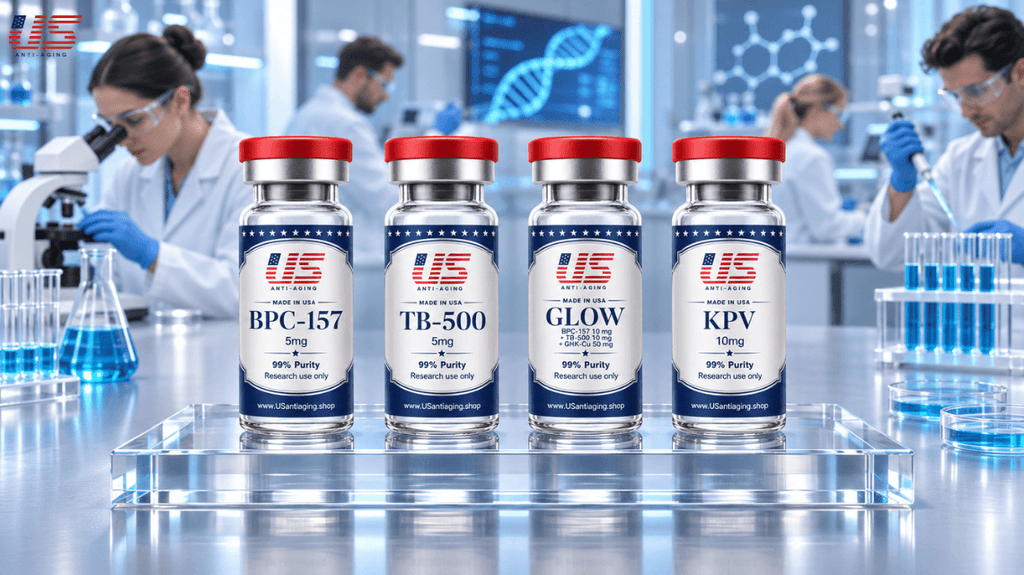
For laboratories investigating molecular signaling and immune biology, US Anti-Aging provides research-focused information and compounds intended for scientific investigation.
This article explores inflammatory mechanisms, peptide-associated signaling, experimental methods, and the limitations of current preclinical evidence.
What Is Inflammation in Biological Research?
Inflammation is a coordinated biological response to infection, tissue injury, cellular stress, or other disturbances in physiological homeostasis.
It involves immune cells, signaling molecules, vascular changes, and interactions between affected tissues.
Although inflammation serves essential protective functions, persistent or poorly regulated responses can contribute to tissue damage.
Acute and Chronic Inflammation
Researchers generally distinguish between two major inflammatory patterns:
| Characteristic | Acute Inflammation | Chronic Inflammation |
|---|---|---|
| Duration | Short-term | Persistent or prolonged |
| Major cellular participants | Neutrophils and macrophages | Macrophages, lymphocytes, and other immune cells |
| Biological context | Immediate response to injury or infection | Sustained immune activation |
| Research endpoints | Cytokine release and immune cell recruitment | Persistent signaling and tissue remodeling |
Importantly, inflammation is not inherently harmful. It contributes to host defense, adaptation, and tissue repair under appropriate biological conditions (Medzhitov, 2008).
Consequently, peptides and inflammation research focuses on understanding immune regulation rather than simply suppressing every inflammatory response.
How Do Peptides Interact With Inflammatory Pathways?
Peptides can influence inflammatory processes through several molecular mechanisms. Depending on their sequence and structure, they may interact with cellular receptors, membrane transporters, or extracellular signaling molecules.
However, individual peptides can produce different responses even when researchers examine similar inflammatory endpoints.
Receptor-Mediated Signaling
Certain peptides interact with receptors that regulate immune cell behavior.
For example, researchers investigate melanocortin-related peptides and annexin A1-derived fragments to understand receptor-associated inflammatory regulation.
These interactions may influence intracellular signaling, immune cell migration, and inflammatory mediator production.
Nevertheless, researchers must distinguish direct receptor activation from indirect downstream effects.
Intracellular Peptide Transport
Some short peptides enter cells through specialized transport proteins.
KPV, a tripeptide consisting of lysine, proline, and valine, provides an example of transporter-associated research.
Scientists have investigated its cellular uptake through peptide transporter 1 (PepT1) and subsequent changes in inflammatory signaling.
Inflammation Resolution
Another area of peptides and inflammation research involves the active resolution of inflammation.
Unlike general immune suppression, resolution involves coordinated biological processes that terminate inflammatory responses and restore tissue homeostasis.
Therefore, scientists examine whether specific peptide signals influence immune cell clearance, inflammatory mediator production, or the transition toward normal cellular function.
What Roles Do Cytokines and NF-κB Play?
Cytokines and NF-κB represent important molecular targets in inflammatory research because they coordinate communication between immune cells and surrounding tissues.
However, changes in these markers require careful biological interpretation.
Cytokines as Inflammatory Signaling Molecules
Cytokines are signaling proteins that regulate immune responses, cellular communication, and inflammatory activity.
Frequently investigated cytokines include:
- TNF-α: Participates in inflammatory activation and immune communication.
- IL-1β: Contributes to inflammatory signaling and cellular responses.
- IL-6: Influences acute-phase responses and immune regulation.
- IL-10: Participates in limiting selected inflammatory responses.
Importantly, cytokine functions depend on their biological environment. A reduction in one inflammatory marker does not necessarily demonstrate improved overall immune function.
NF-κB and Gene Expression
NF-κB represents a family of transcription factors that regulate numerous genes involved in inflammation, immunity, and cell survival.
Following appropriate cellular stimulation, NF-κB can enter the nucleus and influence gene transcription.
Nevertheless, NF-κB also participates in processes that help resolve inflammation. Its biological role therefore extends beyond simply promoting inflammatory activity (Lawrence, 2009).
Within peptides and inflammation research, scientists must consider signaling intensity, timing, and cellular context when evaluating NF-κB activity.
How Is Peptide-Related Inflammation Studied?
Researchers use complementary experimental approaches to investigate peptide-associated inflammatory responses.
These methods help distinguish molecular activity from broader physiological outcomes.
Common Experimental Models
| Research method | Primary measurement | Main limitation |
|---|---|---|
| Immune cell cultures | Cytokine production | Limited tissue complexity |
| NF-κB reporter assays | Transcriptional activity | Indirect measure of inflammation |
| ELISA | Cytokine concentrations | Limited to selected proteins |
| qPCR | Inflammatory gene expression | Does not directly measure protein activity |
| Animal inflammation models | Histology and immune responses | Species-dependent differences |
Why Experimental Controls Matter
Reliable peptides and inflammation research requires appropriate control groups to distinguish peptide-associated effects from normal biological variability.
For example, reduced cytokine concentrations could reflect altered signaling, fewer viable cells, or interference with the analytical method.
Consequently, researchers should evaluate cellular viability alongside inflammatory measurements.
Furthermore, combining gene expression, protein measurements, and functional observations strengthens experimental interpretation.
A single biomarker rarely provides sufficient evidence to characterize an entire inflammatory response.
What Does Current Preclinical Evidence Show?
Current peptides and inflammation research includes investigations involving short synthetic peptides, endogenous host-defense peptides, and fragments derived from regulatory proteins.
These compounds illustrate different experimental mechanisms rather than a single shared biological effect.
KPV and Intestinal Inflammatory Signaling
KPV has attracted research interest because of its relationship with alpha-melanocyte-stimulating hormone (α-MSH) and intestinal inflammatory pathways.
A study involving intestinal epithelial cells, immune cells, and mouse colitis models identified PepT1-mediated KPV uptake alongside reduced NF-κB and MAPK activation. Researchers also observed changes in inflammatory cytokine expression (Dalmasso et al., 2008).
However, these findings do not establish therapeutic effectiveness in humans.
LL-37 and Innate Immune Responses
LL-37 is an endogenous host-defense peptide involved in antimicrobial activity and immune communication.
Laboratory investigations found that LL-37 altered cytokine release in human immune cells exposed to selected toll-like receptor stimuli. However, its effects depended on the type of inflammatory stimulus (Mookherjee et al., 2006).
This finding demonstrates why peptide-associated inflammatory activity cannot be generalized across different experimental conditions.
Annexin A1-Derived Peptides and Inflammation Resolution
Ac2-26 is an N-terminal peptide derived from annexin A1, a protein associated with inflammatory regulation.
In an experimental acute inflammation model, researchers observed that Ac2-26 promoted neutrophil apoptosis and accelerated inflammatory resolution (Vago et al., 2012).
These observations illustrate the distinction between reducing inflammatory signals and actively supporting resolution mechanisms within experimental systems.
Limitations of Current Scientific Evidence
Despite these findings, several limitations affect peptides and inflammation research:
- Differences between experimental models and human physiology.
- Incomplete understanding of direct molecular targets.
- Limited pharmacokinetic and long-term safety information.
- Variability in experimental conditions and peptide formulations.
- Insufficient clinical validation for many investigational compounds.
Therefore, preclinical observations cannot independently establish human safety or medical effectiveness.
To explore how peptides interact with cellular processes involved in tissue repair, read our comprehensive guide, Peptides in Tissue Repair Research: Biological Mechanisms and Current Evidence, covering molecular mechanisms, experimental models, and the current state of scientific evidence.
FAQs About Peptides and Inflammation Research
1. What is peptides and inflammation research?
It examines how peptide molecules influence immune communication, cytokine production, inflammatory pathways, and resolution mechanisms within experimental biological systems.
2. Which peptides are studied in inflammatory research?
Researchers have investigated KPV, LL-37, alpha-MSH-related peptides, and annexin A1-derived fragments. However, their molecular mechanisms and supporting evidence differ.
3. How does NF-κB relate to peptide research?
NF-κB regulates genes associated with inflammation and immune activity. Researchers measure its responses to investigate how particular peptides influence intracellular signaling.
4. Does reduced cytokine production prove anti-inflammatory effectiveness?
No. Reduced cytokine production represents one experimental observation. Researchers need additional cellular, functional, and safety measurements to establish its biological significance.
5. Can preclinical peptide studies establish human effectiveness?
No. Laboratory and animal experiments provide mechanistic evidence, but appropriately designed human clinical studies are necessary to establish therapeutic effectiveness and safety.
Conclusion: Understanding Peptides and Inflammation Research
Peptides and inflammation research provides valuable insights into cytokine regulation, intracellular signaling, immune cell behavior, and inflammatory resolution.
Although experimental studies involving KPV, LL-37, and annexin A1-derived peptides demonstrate distinct biological responses, these findings remain dependent on compound identity and experimental conditions.
Consequently, reliable interpretation requires validated analytical methods, appropriate controls, and careful differentiation between preclinical findings and clinical evidence.
For additional information about peptide chemistry and experimental research, explore the scientific resources available at US Anti-Aging.
Disclaimer: All compounds and information presented in this article are intended strictly for scientific research and educational purposes. These products are not approved for medical use and are not intended for human or veterinary use, diagnosis, treatment, or prevention of any disease.