Peptides and Angiogenesis: VEGF Signaling, Endothelial Cells, and Research Evidence

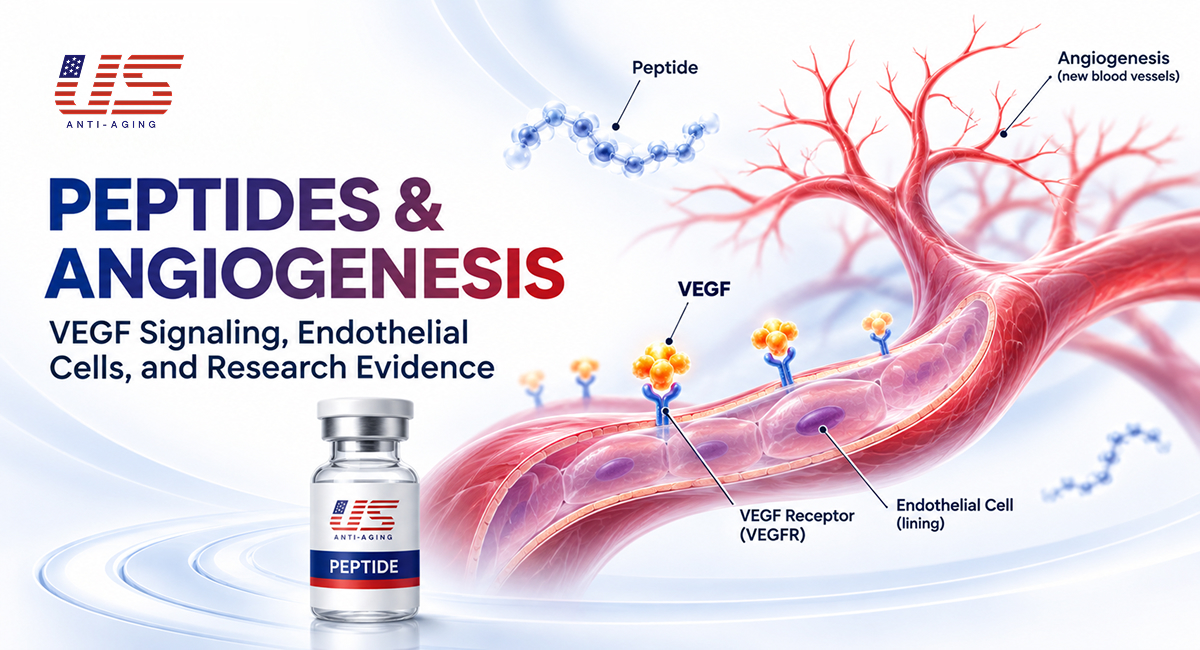


Peptides and angiogenesis represent an important area of biological research examining how peptide molecules influence blood vessel formation, endothelial cell behavior, and vascular signaling. Scientists investigate these interactions through pathways involving vascular endothelial growth factor (VEGF), cellular migration, proliferation, and extracellular matrix remodeling.
However, peptides do not universally stimulate angiogenesis. Depending on their molecular structure and biological targets, some peptides may promote vascular formation, while others demonstrate inhibitory activity under experimental conditions.
For laboratories investigating vascular biology and molecular signaling, US Anti-Aging provides research-focused resources for scientific exploration.
This article examines angiogenesis mechanisms, VEGF signaling, endothelial cell interactions, experimental methods, and the limitations of current scientific evidence.
What Is Angiogenesis?
Angiogenesis is the biological process through which new blood vessels develop from existing vascular networks. It contributes to embryonic development, tissue repair, and physiological adaptation to changing oxygen and nutrient requirements.
However, dysregulated angiogenesis can also contribute to pathological conditions, including tumor progression and abnormal retinal vascularization.
The Major Stages of Angiogenesis
Researchers generally describe sprouting angiogenesis through several interconnected events:
- Endothelial activation: Cells respond to molecular signals within their surrounding environment.
- Matrix remodeling: Enzymatic activity allows endothelial cells to move through surrounding tissue.
- Cell migration and proliferation: Endothelial cells extend and develop vascular sprouts.
- Lumen formation: Developing structures establish internal channels.
- Vessel maturation: Supporting cells and extracellular matrix components contribute to vascular stability.
Importantly, successful angiogenesis requires more than increased endothelial cell proliferation. Newly formed vessels must develop appropriate structural organization and functional connections to existing circulation (Carmeliet & Jain, 2011).
Therefore, researchers studying peptides and angiogenesis examine both molecular responses and vascular functionality.
How Does VEGF Signaling Regulate Angiogenesis?
Vascular endothelial growth factor is a family of signaling proteins that regulates blood vessel development, endothelial cell activity, and vascular permeability.
Among its members, VEGF-A plays a central role in sprouting angiogenesis through interactions with vascular endothelial growth factor receptors.
VEGFR2 and Intracellular Signaling
Vascular endothelial growth factor receptor 2 (VEGFR2) is a receptor tyrosine kinase that mediates many endothelial responses to VEGF-A.
Following receptor activation, intracellular signaling networks coordinate cellular migration, survival, proliferation, and permeability.
| Signaling pathway | Primary research relevance |
|---|---|
| PI3K/Akt | Endothelial cell survival |
| MAPK/ERK | Cellular proliferation |
| PLCγ | Intracellular signal transmission |
| Akt/eNOS | Nitric oxide regulation and vascular responses |
| Src-associated signaling | Endothelial permeability and junction regulation |
These pathways interact with additional receptors and regulatory proteins, creating a complex signaling network (Koch & Claesson-Welsh, 2012).
Why VEGF Expression Alone Is Insufficient
Increased VEGF expression does not automatically demonstrate successful blood vessel formation.
For example, endothelial cells may exhibit stronger molecular signaling without developing stable vascular structures. Consequently, peptides and angiogenesis research must distinguish growth factor expression from receptor activation and functional vascular development.
How Do Peptides Interact With Endothelial Cells?
Endothelial cells form the inner lining of blood vessels and regulate vascular permeability, molecular exchange, and interactions between blood and surrounding tissues.
Researchers investigate peptide-associated endothelial responses through several distinct mechanisms.
Receptor-Associated Molecular Signaling
Certain peptides may influence receptor expression, intracellular phosphorylation, or signaling-related protein activity.
However, observing changes in VEGFR2 signaling does not necessarily establish that a peptide binds directly to VEGFR2.
Scientists therefore distinguish direct molecular interactions from indirect changes in downstream pathways.
Cytoskeletal Organization and Cellular Migration
Endothelial migration depends partly on actin, a structural protein involved in cellular movement and shape regulation.
Thymosin beta-4 provides an example of a peptide investigated for its relationship with actin-associated processes and vascular formation.
Experimental research identified its seven-amino-acid actin-binding region as an important contributor to endothelial migration and vascular sprouting responses (Philp et al., 2003).
Nevertheless, findings involving thymosin beta-4 cannot automatically establish identical activity for chemically modified fragments marketed as TB-500.
Pro-Angiogenic and Anti-Angiogenic Activity
Peptides and angiogenesis research encompasses both vascular stimulation and inhibition.
While some compounds demonstrate increased endothelial migration or vascular sprouting, others interfere with endothelial survival or vessel formation.
Accordingly, the biological significance of peptide activity depends on the specific research model and physiological context.
How Is Peptide-Related Angiogenesis Studied?
Scientists use complementary laboratory methods to evaluate different stages of angiogenesis. Human umbilical vein endothelial cells (HUVECs) are among the commonly used cellular models in vascular research.
However, isolated endothelial cells cannot reproduce every characteristic of a functioning vascular network.
Common Angiogenesis Research Methods
| Experimental method | Primary measurement | Key limitation |
|---|---|---|
| Endothelial migration assay | Cellular movement | Does not establish vessel formation |
| Tube formation assay | Network-like cellular structures | Does not confirm functional blood flow |
| Aortic ring assay | Vascular sprouting | Limited systemic physiological context |
| Western blot | Signaling protein expression and phosphorylation | Does not directly measure vascular function |
| Animal angiogenesis models | Vessel development and tissue responses | Species-dependent differences |
| Laser Doppler imaging | Relative tissue perfusion | Cannot independently identify newly formed vessels |
Scientific consensus guidelines emphasize that individual angiogenesis assays evaluate different biological events and possess distinct limitations (Nowak-Sliwinska et al., 2018).
Why Multiple Measurements Matter
Reliable peptides and angiogenesis research requires evidence beyond a single laboratory endpoint.
For example, increased branching in a tube formation assay may indicate altered endothelial organization. However, it does not demonstrate that those structures can transport blood or remain stable over time.
Combining molecular measurements, structural observations, and functional assessments provides a more informative understanding of vascular responses.
What Does Current Scientific Evidence Show?
Current peptides and angiogenesis research includes investigations involving synthetic peptides, naturally occurring regulatory molecules, and protein-derived fragments.
The following examples demonstrate how different compounds influence vascular processes under specific experimental conditions.
BPC-157 and VEGFR2-Associated Signaling
BPC-157 is a synthetic pentadecapeptide investigated in experimental vascular and tissue injury models.
A 2017 study reported increased VEGFR2 expression and changes in Akt/eNOS signaling following BPC-157 exposure in endothelial cells. Researchers also observed increased vascular density and blood flow recovery in a rat hindlimb ischemia model.
Interestingly, the investigators identified increased VEGFR2 expression without a corresponding increase in VEGF-A expression in cultured endothelial cells (Hsieh et al., 2017).
These findings provide mechanistic evidence but do not establish clinical vascular benefits in humans.
Thymosin Beta-4 and Vascular Sprouting
Thymosin beta-4 contains 43 amino acids and participates in actin regulation.
Laboratory investigations involving full-length thymosin beta-4 and its actin-binding sequence have reported endothelial migration and vascular sprouting responses.
However, molecular identity remains essential when interpreting these findings. Evidence involving full-length thymosin beta-4 or unmodified fragments cannot independently validate acetylated TB-500.
ABT-510 and Angiogenesis Inhibition
ABT-510 is a synthetic peptide derivative inspired by thrombospondin-1, an endogenous regulator of angiogenesis.
In an experimental glioma model, researchers reported reduced microvessel density and increased endothelial cell apoptosis following ABT-510 exposure (Anderson et al., 2007).
This example illustrates that peptide-associated vascular activity can involve inhibition rather than stimulation.
Evidence and Safety Limitations
Several uncertainties continue to affect research interpretation:
- Limited clinical validation for investigational peptides.
- Incomplete understanding of direct molecular targets.
- Differences between cellular models and human vascular systems.
- Insufficient long-term safety information.
- Variability in peptide identity and experimental conditions.
Furthermore, stimulating angiogenesis is not inherently beneficial because abnormal vascular development can contribute to pathological processes.
To explore how peptides interact with cellular processes involved in tissue repair, read our comprehensive guide, Peptides in Tissue Repair Research: Biological Mechanisms and Current Evidence, covering molecular mechanisms, experimental models, and the current state of scientific evidence.
FAQs About Peptides and Angiogenesis
1. What is the relationship between peptides and angiogenesis?
Researchers investigate how specific peptides influence endothelial signaling, cellular migration, vascular sprouting, and blood vessel formation. Depending on the compound, experimental responses may involve angiogenesis promotion or inhibition.
2. What role does VEGF play in angiogenesis?
VEGF regulates endothelial cell behavior through receptor-mediated signaling. VEGFR2 is particularly important for coordinating vascular growth, cellular migration, proliferation, and survival.
3. Which peptides are studied in angiogenesis research?
Researchers have investigated BPC-157, thymosin beta-4, and synthetic derivatives such as ABT-510. These compounds have different molecular mechanisms and supporting evidence.
4. Is angiogenesis always biologically beneficial?
No. Angiogenesis contributes to normal tissue development and repair, but abnormal vascular growth can also support disease progression. Its significance depends on biological context.
5. Can endothelial cell studies establish clinical effectiveness?
No. Endothelial assays provide information about specific cellular responses. Appropriately designed clinical investigations are necessary to establish human safety and therapeutic effectiveness.
Conclusion: Understanding Peptides and Angiogenesis
Peptides and angiogenesis research provides valuable insights into VEGF signaling, endothelial cell behavior, vascular sprouting, and molecular regulation.
Although experimental findings involving BPC-157, thymosin beta-4, and other peptides demonstrate distinct biological responses, these observations cannot establish universal vascular effects or human clinical benefits.
Consequently, reliable scientific interpretation requires verified molecular identities, complementary experimental methods, and careful evaluation of evidence limitations.
For further information about peptide biology and molecular research, explore the educational resources available at US Anti-Aging
Disclaimer: All compounds and information presented in this article are intended strictly for scientific research and educational purposes. These products are not approved for medical use and are not intended for human or veterinary use, diagnosis, treatment, or prevention of any disease.