KPV Peptide Research: Molecular Structure, Inflammatory Signaling, and Preclinical Evidence

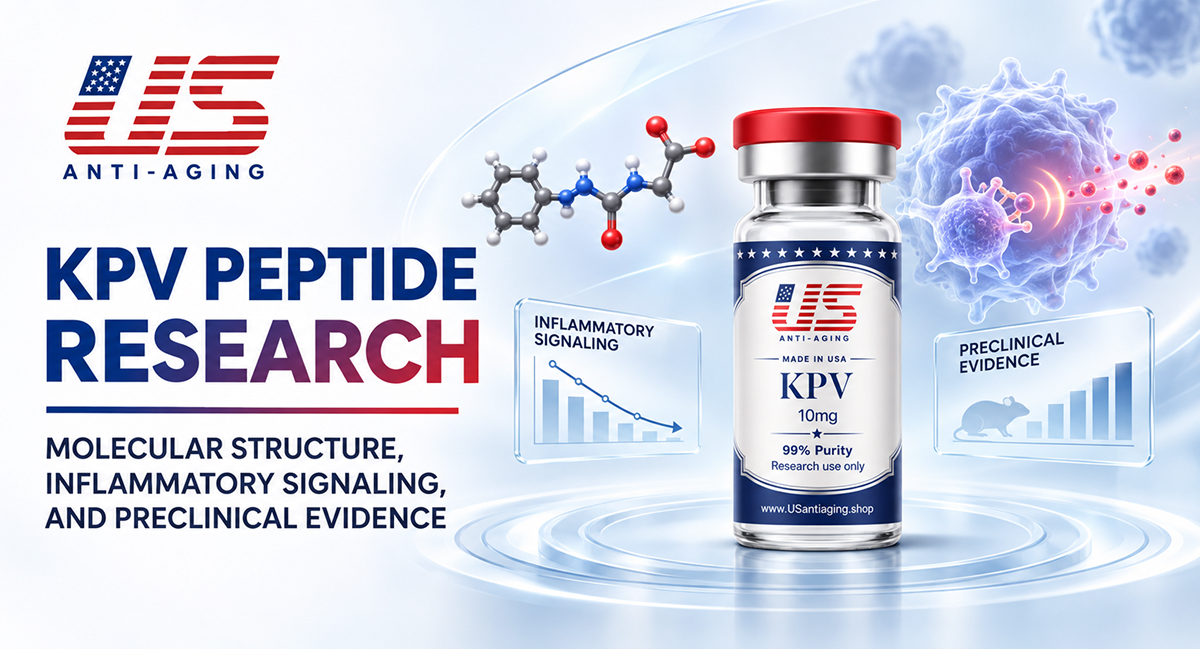


KPV Peptide Research investigates a three-amino-acid peptide derived from alpha-melanocyte-stimulating hormone (α-MSH). Scientists study KPV, or lysine-proline-valine, for its effects on inflammatory signaling, intestinal epithelial cells, and experimental models of tissue inflammation. Laboratory findings suggest that KPV can influence NF-κB and MAPK signaling, although its precise molecular targets remain incompletely understood.
Importantly, existing evidence comes primarily from cell cultures and animal experiments. No published human clinical trials have established KPV’s safety or therapeutic effectiveness.
For laboratories investigating peptide biology and molecular signaling, US Anti-Aging offers research-focused compounds intended for scientific investigation.
This article examines KPV’s molecular characteristics, relationship with α-MSH, experimental mechanisms, and current evidence limitations.
What Is KPV Peptide?
KPV is a naturally occurring tripeptide sequence consisting of lysine (K), proline (P), and valine (V). It corresponds to the three amino acids at the carboxyl terminus of α-MSH, a peptide hormone involved in melanocortin signaling.
Researchers have investigated KPV because certain laboratory models demonstrate changes in inflammatory responses following exposure to this short peptide.
Molecular Structure and Characteristics of KPV
KPV contains three amino acids connected through two peptide bonds. Its relatively small molecular size makes it an interesting subject for investigating peptide transport and cellular interactions.
| Molecular property | Description |
|---|---|
| Compound name | KPV |
| Full amino acid sequence | Lys-Pro-Val |
| One-letter sequence | KPV |
| Peptide classification | Tripeptide |
| Molecular formula | C16H30N4O4 |
| Approximate molecular weight | 342.44 g/mol |
| Parent peptide | Alpha-melanocyte-stimulating hormone |
| Primary research focus | Inflammatory signaling and intestinal models |
These characteristics describe the unmodified KPV peptide. Different salt forms or chemical modifications may have different molecular properties.
Why Researchers Study KPV
Scientists investigate KPV in several experimental settings:
- Intestinal epithelial inflammation.
- NF-κB and MAPK signaling.
- Cellular peptide transport.
- Experimental colitis models.
- Keratinocyte responses.
- Peptide delivery and molecular stability.
However, these investigations do not establish clinical benefits for inflammatory conditions.
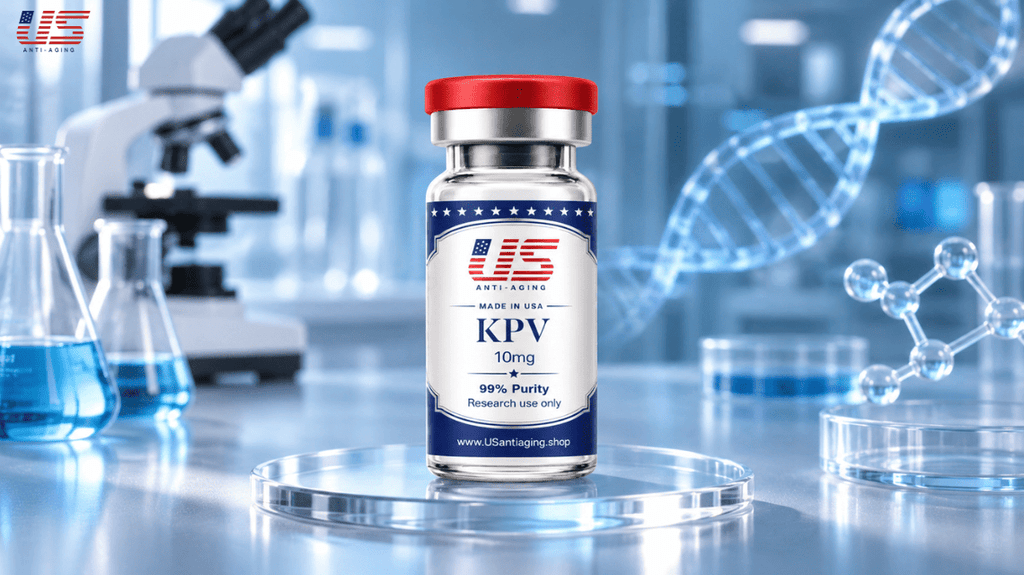
For laboratories investigating inflammatory signaling and peptide biology, explore KPV Peptide for Research at US Anti-Aging, intended strictly for controlled scientific and laboratory research.
How Is KPV Related to Alpha-MSH?
Alpha-melanocyte-stimulating hormone is a 13-amino-acid peptide derived from the proopiomelanocortin (POMC) precursor.
It participates in melanocortin receptor signaling and has attracted research interest for its effects on pigmentation, immune regulation, and inflammatory responses.
KPV represents the final three amino acids of α-MSH, corresponding to residues 11–13.
Alpha-MSH and Its C-Terminal Fragment
Although KPV shares a sequence with α-MSH, the two molecules are structurally different.
Full-length α-MSH contains additional amino acids involved in classical melanocortin receptor recognition.
In contrast, KPV lacks much of the sequence associated with conventional melanocortin receptor activation.
Nevertheless, experimental studies have reported anti-inflammatory activity associated with the shorter fragment, suggesting that some effects may involve alternative signaling mechanisms (Brzoska et al., 2011).
Does KPV Activate Melanocortin Receptors?
The relationship between KPV and melanocortin receptor signaling remains complex.
In human keratinocyte experiments, researchers observed intracellular calcium responses associated with α-MSH-related peptides, including KPV, under specific experimental conditions.
However, these observations did not establish that KPV reproduces the complete receptor activity of α-MSH (Elliott et al., 2004).
Consequently, scientists should distinguish KPV’s observed cellular responses from the established functions of its parent hormone.
How Is KPV Studied in Inflammatory Signaling?
KPV Peptide Research frequently examines intracellular pathways associated with inflammatory communication.
These investigations focus on how cells respond to inflammatory stimuli and whether KPV exposure changes measurable signaling activity.
NF-κB Signaling and Inflammatory Responses
Nuclear factor kappa B (NF-κB) is a transcription factor involved in regulating inflammatory and immune-related gene expression.
Under certain experimental conditions, inflammatory stimuli activate NF-κB and influence the production of signaling molecules such as cytokines.
Researchers have investigated whether KPV alters these responses in intestinal epithelial and immune cell models.
A study using human-derived cell lines reported reduced NF-κB activation and pro-inflammatory cytokine expression following KPV exposure (Dalmasso et al., 2008).
However, these results do not demonstrate equivalent effects in human patients.
MAPK Signaling and Cellular Regulation
Mitogen-activated protein kinase (MAPK) pathways participate in cellular responses to environmental and inflammatory signals.
Researchers have examined changes in MAPK-associated activity after exposing experimental cells to KPV.
The findings suggest that KPV can influence selected intracellular signaling responses under controlled conditions.
Nevertheless, identifying changes in pathway activity does not establish a complete molecular mechanism.
The Role of the PepT1 Transporter
One particularly important area of KPV research involves peptide transporter 1 (PepT1).
PepT1 transports certain dipeptides and tripeptides across cellular membranes. It normally plays a major role in intestinal nutrient absorption and may appear in additional cell populations under inflammatory conditions.
Experimental research demonstrated PepT1-mediated KPV uptake in intestinal epithelial and immune cell systems.
Furthermore, the investigators connected this transport mechanism with changes in inflammatory signaling.
However, transporter-mediated uptake does not independently establish systemic bioavailability or clinical effectiveness.
What Do Preclinical KPV Studies Show?
Researchers have investigated KPV in several laboratory and animal models, particularly those involving intestinal inflammation.
The findings provide mechanistic information but remain insufficient to establish clinical applications.
KPV in Experimental Colitis Models
Colitis models allow researchers to examine inflammatory changes in intestinal tissues.
Scientists commonly use dextran sodium sulfate (DSS) or other experimental methods to produce measurable intestinal inflammation in animals.
A 2008 investigation reported reduced inflammatory infiltration and improved selected disease-related measurements in mouse colitis models following KPV exposure.
Importantly, the investigators also examined animals with nonfunctional melanocortin-1 receptors, providing evidence that certain responses may occur independently of conventional MC1R signaling (Kannengiesser et al., 2008).
Investigating KPV Delivery Systems
Peptide stability and delivery present additional challenges in experimental research.
Therefore, scientists have investigated nanoparticle formulations designed to deliver KPV to intestinal tissues.
A 2010 study used KPV-loaded nanoparticles within a polysaccharide hydrogel and reported improvements in selected inflammatory and histological measurements in a mouse colitis model (Laroui et al., 2010).
Subsequently, another investigation examined hyaluronic acid-functionalized nanoparticles and reported changes in intestinal inflammation and mucosal injury measurements in experimental models.
However, findings from specialized formulations cannot automatically be generalized to unmodified KPV.
Summary of Preclinical Evidence
| Research model | Main investigation | Evidence limitation |
|---|---|---|
| Intestinal epithelial cells | NF-κB and MAPK signaling | Does not establish human clinical outcomes |
| Immune cell cultures | Cytokine-related responses | Limited physiological complexity |
| Mouse colitis models | Inflammatory and histological measurements | Species differences |
| Keratinocyte cultures | Intracellular signaling | Limited to specific cellular conditions |
| Nanoparticle delivery models | Targeted intestinal delivery | Formulation-specific results |
These findings demonstrate why researchers must consider both experimental models and molecular formulations when interpreting results.
For laboratories investigating inflammatory signaling and peptide biology, explore KPV Peptide for Research at US Anti-Aging, intended strictly for controlled scientific and laboratory research.
What Are the Current Evidence and Safety Gaps?
The central limitation of KPV Peptide Research is the absence of reliable human clinical evidence.
Although laboratory findings suggest potentially interesting biological activities, researchers have not established whether these observations translate into meaningful outcomes in humans.
Lack of Human Clinical Trials
As of the FDA’s 2026 scientific evaluation, the agency had not identified clinical studies or documented human exposure data for KPV.
Consequently, researchers lack established information about human pharmacokinetics, appropriate clinical exposure, and long-term safety.
The FDA also highlighted insufficient evidence regarding potential immunogenicity and other safety concerns (FDA, 2026).
Major Scientific Limitations
Several questions remain unresolved:
- Which molecular targets directly mediate KPV’s observed effects?
- How does formulation influence peptide stability and distribution?
- Are experimental findings reproducible across independent laboratories?
- What are the consequences of repeated or prolonged exposure?
- Can observations from animal models translate to human biology?
Additionally, limited clinical data prevent reliable conclusions about adverse-event frequency.
Therefore, the absence of documented safety problems should not be interpreted as proof of safety.
To explore how peptides interact with cellular processes involved in tissue repair, read our comprehensive guide, Peptides in Tissue Repair Research: Biological Mechanisms and Current Evidence, covering molecular mechanisms, experimental models, and the current state of scientific evidence.
FAQs About KPV Peptide Research
1. What is KPV peptide research focused on?
KPV peptide research primarily examines inflammatory signaling, cellular peptide transport, and responses in experimental intestinal inflammation models.
Most published findings come from cell cultures and animal studies.
2. Is KPV the same as alpha-MSH?
No. KPV is the three-amino-acid C-terminal fragment of alpha-MSH.
Although they share a sequence region, their molecular structures and signaling characteristics differ.
3. Which signaling pathways are associated with KPV?
Researchers have investigated NF-κB, MAPK, and melanocortin-related signaling.
Additionally, PepT1-mediated cellular uptake represents an important experimental mechanism.
4. Have human clinical trials established KPV effectiveness?
No. Published human clinical evidence has not established KPV’s effectiveness or long-term safety.
Preclinical findings cannot independently support therapeutic claims.
5. Is KPV approved by the FDA?
No. KPV is not an FDA-approved therapeutic drug.
Research-use-only materials should not be represented as approved medical treatments.
Conclusion: Understanding the Current State of KPV Peptide Research
KPV Peptide Research provides valuable information about the relationship between short peptide sequences, cellular transport, and inflammatory signaling.
Laboratory studies have identified changes in NF-κB, MAPK, and intestinal inflammatory responses. However, these observations remain predominantly preclinical, and the mechanisms require further independent investigation.
Consequently, reliable conclusions depend on validated experimental models, molecular characterization, and appropriately designed human studies.
For laboratories exploring peptide chemistry and inflammatory signaling, US Anti-Aging offers research-focused compounds intended for scientific investigation.
Disclaimer: All compounds and information presented in this article are intended strictly for scientific research and educational purposes. These products are not approved for medical use and are not intended for human or veterinary use, diagnosis, treatment, or prevention of any disease.