GLOW Peptide Blend Research: Composition, Molecular Characteristics, and Evidence Limitations

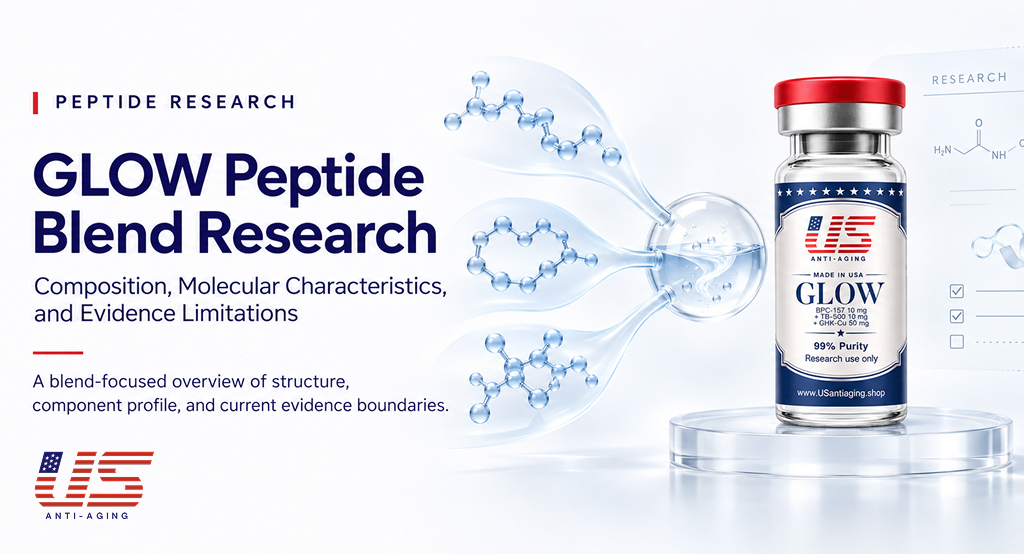


GLOW Peptide Blend Research examines multi-peptide formulations commonly combining GHK-Cu, BPC-157, and TB-500. These compounds have distinct molecular structures and experimental research backgrounds involving extracellular matrix activity, cellular signaling, and peptide metabolism.
However, GLOW is a formulation name rather than a standardized scientific compound. Its ingredients and concentrations can vary, and evidence involving individual peptides cannot establish the biological effects of their combination.
Importantly, no established clinical evidence demonstrates that the complete GLOW formulation produces therapeutic benefits or has a validated human safety profile.
For laboratories investigating peptide chemistry, US Anti-Aging offers research-focused compounds, including multi-peptide formulations intended for controlled scientific investigation.
This article explores GLOW composition, laboratory testing methods, analytical challenges, and the limitations of current evidence.
What Is the GLOW Peptide Blend?
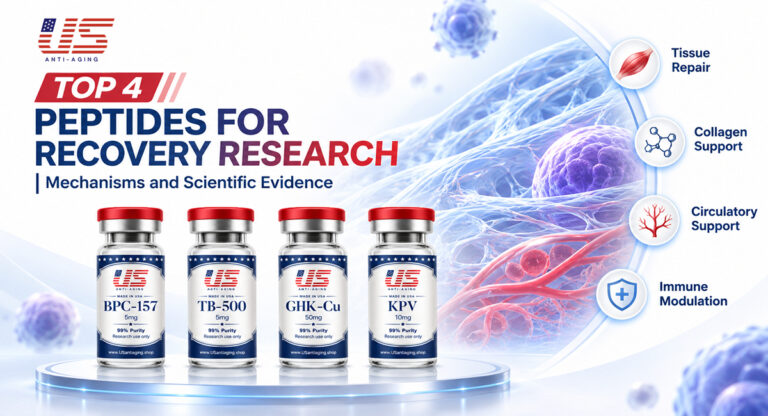
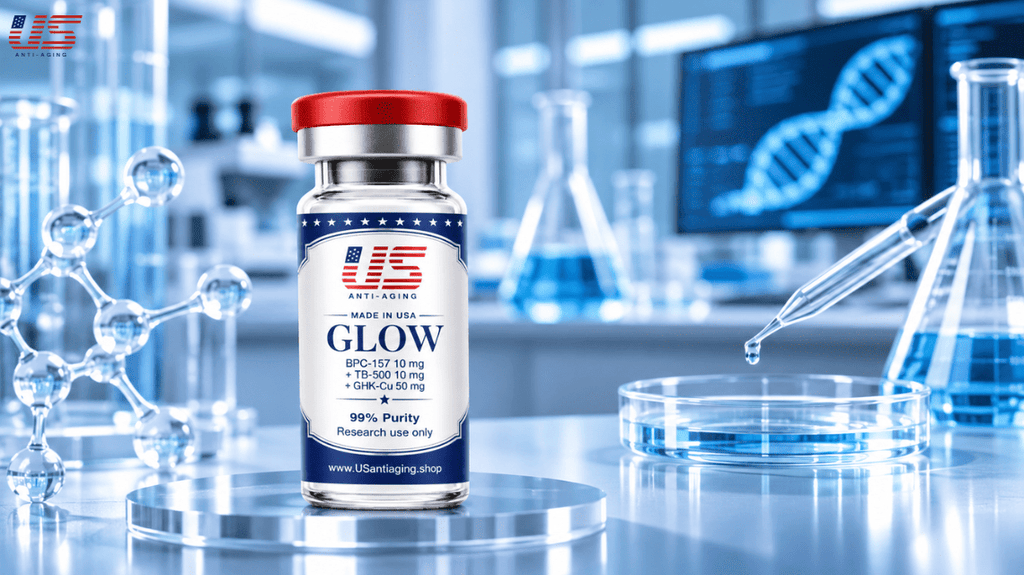
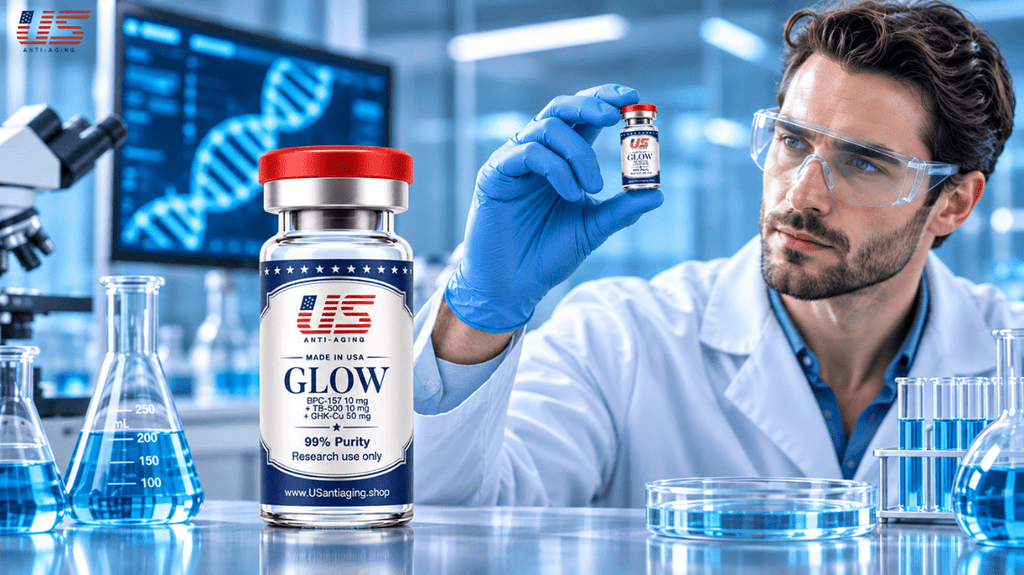
GLOW is a research-market name for a formulation that typically combines three peptide-related compounds: GHK-Cu, BPC-157, and TB-500.
Unlike a single peptide with a defined amino acid sequence, GLOW contains multiple molecular species with different chemical properties.
Consequently, researchers must evaluate the identity, quantity, and stability of each component separately.
Understanding the GLOW Formulation
A commonly marketed GLOW formulation contains 70 mg of combined peptide material:
- GHK-Cu: 50 mg
- BPC-157: 10 mg
- TB-500: 10 mg
This represents a nominal mass ratio of 5:1:1.
However, this composition is not universal. Researchers should verify the specific formulation through its product specifications and batch-level analytical documentation.
Why Study Multi-Peptide Formulations?
Multi-peptide research explores how distinct compounds behave within shared experimental environments.
Scientists investigate whether combining molecules changes their stability, solubility, analytical recovery, or measurable biological responses.
Importantly, combining compounds with individually observed activities does not guarantee additive or synergistic effects.
Therefore, GLOW Peptide Blend Research requires evidence about the complete formulation rather than assumptions based on its individual ingredients.
Explore GLOW Peptide Blend for laboratory research involving BPC-157, TB-500, and GHK-Cu in multi-peptide signaling and tissue-response studies.
Which Compounds Are Included in GLOW?
The three commonly included GLOW components differ in amino acid composition, molecular organization, and research history.
Understanding these differences helps scientists identify appropriate analytical methods and interpret existing publications.
GHK-Cu: A Copper-Binding Tripeptide
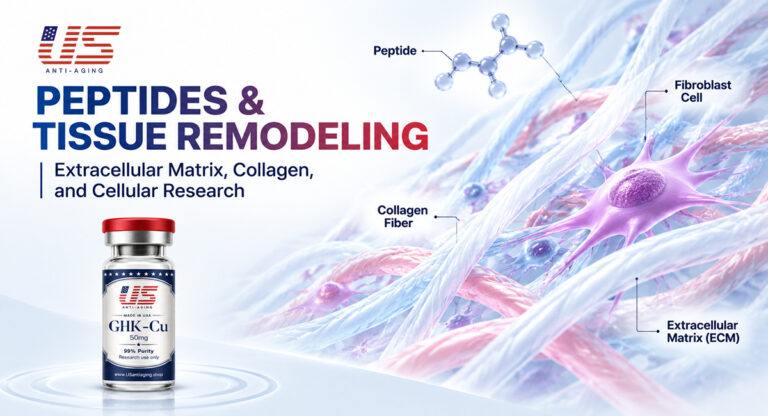
GHK-Cu consists of the tripeptide glycyl-L-histidyl-L-lysine associated with copper(II).
Researchers have investigated this complex in fibroblast cultures and extracellular matrix-related experiments.
An early laboratory study reported increased collagen synthesis in fibroblast cultures following GHK-Cu exposure (Maquart et al., 1988).
However, those findings concern the isolated copper complex and cannot establish the behavior of GLOW as a combined formulation.
BPC-157: A Synthetic Pentadecapeptide
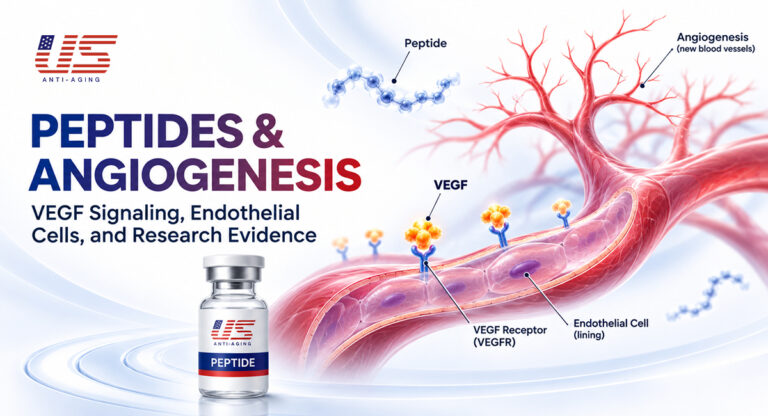
BPC-157 contains 15 amino acids and has been investigated in experimental tissue injury and vascular signaling models.
Although preclinical findings have generated scientific interest, robust human clinical evidence remains limited.
A 2026 systematic review identified only three small human investigations totaling 30 participants, with very low overall certainty of evidence (Poolton et al., 2026).
Consequently, individual BPC-157 findings cannot establish the safety or effectiveness of mixtures containing it.
TB-500: A Thymosin Beta-4-Related Fragment
TB-500 commonly refers to an N-terminally acetylated seven-amino-acid fragment of thymosin beta-4.
Its sequence is Ac-LKKTETQ, although commercial naming practices are inconsistent.
Analytical research identified this fragment through high-resolution mass spectrometry, distinguishing it from full-length thymosin beta-4 (Esposito et al., 2012).
Therefore, scientific evaluation requires confirmation of the exact TB-500 species present in a particular formulation.
Comparing the Molecular Components
| Compound | Molecular classification | Primary research context |
|---|---|---|
| GHK-Cu | Copper-binding tripeptide complex | Fibroblast activity and extracellular matrix studies |
| BPC-157 | Synthetic 15-amino-acid peptide | Cellular signaling and experimental injury models |
| TB-500 | Thymosin beta-4-related peptide fragment | Molecular characterization and preclinical research |
These characteristics demonstrate why GLOW should not be treated as a single molecular entity.
How Are Multi-Peptide Formulations Studied?
GLOW Peptide Blend Research requires analytical and experimental approaches that account for multiple compounds within the same sample.
Researchers generally investigate molecular identity, component concentration, stability, and possible interactions.
High-Performance Liquid Chromatography
High-performance liquid chromatography (HPLC) separates compounds according to their interactions with chromatographic materials and mobile phases.
For peptide mixtures, researchers develop methods that distinguish individual components from impurities and degradation products.
However, overlapping chromatographic peaks can complicate interpretation.
Therefore, a single overall purity measurement may not adequately characterize every constituent.
Liquid Chromatography–Mass Spectrometry
Liquid chromatography–mass spectrometry (LC-MS) combines molecular separation with mass-based identification.
Scientists use this technique to investigate peptide identity, molecular modifications, and degradation products.
A study involving multi-peptide vaccine preparations demonstrated that HPLC and mass spectrometry could characterize complex peptide mixtures and monitor their stability under defined conditions (Chianese-Bullock et al., 2009).
Nevertheless, those findings concern different formulations and do not establish GLOW’s stability.
Measuring Biological Responses
After confirming chemical identity, researchers may investigate individual compounds and mixtures in controlled experimental systems.
For example, studies can compare responses involving cellular migration, protein expression, and extracellular matrix organization.
Appropriate controls help determine whether observed differences reflect genuine compound-associated effects or experimental variability.
What Challenges Affect Peptide Blend Testing?
Evaluating several peptides simultaneously creates challenges that may not arise when investigating isolated compounds.
These challenges involve chemical compatibility, analytical specificity, and interpretation of experimental outcomes.
Chemical Stability and Molecular Interactions
Peptides may undergo oxidation, hydrolysis, aggregation, or enzymatic degradation under different conditions.
Furthermore, interactions between components can influence the properties of a mixture.
GHK-Cu introduces an additional consideration because its copper-binding characteristics differ from those of the other commonly included peptides.
However, copper-related interactions within a specific GLOW formulation require direct experimental confirmation.
Analytical Accuracy and Component Identification
Researchers must distinguish the intended components from degradation fragments, impurities, and unexpected molecular species.
A reliable analytical strategy may include:
- Identity confirmation for each component.
- Component-specific concentration measurements.
- Stability-indicating chromatographic methods.
- Detection of degradation products.
- Batch-to-batch comparison.
- Assessment of potential analytical interference.
These measurements are especially important when formulations contain compounds with substantially different molecular structures.
Why Combined Effects Are Difficult to Interpret
Suppose an experiment produces a stronger cellular response with a peptide blend than with an untreated control.
That finding alone cannot identify which ingredient contributed to the response.
A more informative experimental design compares each component individually with the complete mixture.
Researchers can also examine whether the response differs from what would be expected from independently measured component effects.
However, evidence of synergy requires an appropriate quantitative model, not simply a larger response in the combination group.
Explore GLOW Peptide Blend for laboratory research involving BPC-157, TB-500, and GHK-Cu in multi-peptide signaling and tissue-response studies.
What Scientific Evidence Exists for GLOW?
Current GLOW Peptide Blend Research remains limited by the absence of well-established studies evaluating the complete three-component formulation.
Most relevant publications investigate GHK-Cu, BPC-157, or thymosin beta-4-related peptides separately.
Consequently, the distinction between component evidence and combination evidence is essential.
Evidence From Individual Compounds
Laboratory experiments involving GHK-Cu have examined collagen synthesis and fibroblast behavior.
Meanwhile, BPC-157 studies have investigated experimental injury responses in animal models.
Thymosin beta-4 research has also explored actin-associated processes and cellular migration.
However, these findings involve different molecules, study designs, and experimental conditions. They cannot establish equivalent outcomes for a combined GLOW preparation.
What Do Combination Studies Show?
A 2026 rat Achilles tendon study investigated BPC-157, a preparation described as TB-500, and their combination.
Although several experimental measurements differed between treatment and control groups, the combined treatment did not provide additional benefits compared with either compound individually (Biçer et al., 2026).
Importantly, this experiment did not include GHK-Cu and therefore did not evaluate the complete GLOW formulation.
It also cannot establish how a commercially marketed GLOW mixture would behave.
Major Evidence Limitations
Current scientific uncertainties include:
- No established controlled human trials of the complete GLOW formulation.
- Insufficient characterization of formulation-specific stability.
- Limited direct evidence concerning interactions among all three components.
- Inconsistent commercial definitions of TB-500.
- Inadequate human pharmacokinetic and long-term safety information.
Therefore, claims of superior effects from combining these peptides remain unsupported without direct comparative evidence.
To explore how peptides interact with cellular processes involved in tissue repair, read our comprehensive guide, Peptides in Tissue Repair Research: Biological Mechanisms and Current Evidence, covering molecular mechanisms, experimental models, and the current state of scientific evidence.
FAQs About GLOW Peptide Blend Research
1. What is GLOW Peptide Blend Research?
GLOW Peptide Blend Research examines the composition, molecular properties, analytical characterization, and experimental behavior of formulations commonly containing GHK-Cu, BPC-157, and TB-500.
Its primary scientific focus is understanding the mixture rather than assuming that individual component findings apply to the combination.
2. What peptides are commonly included in GLOW?
GLOW commonly contains GHK-Cu, BPC-157, and TB-500.
However, formulations may differ, so researchers must verify the identity and quantity of each ingredient.
3. Is GLOW a single peptide?
No. GLOW is a multi-component formulation rather than one peptide with a unique amino acid sequence.
Its constituents have different molecular structures and chemical characteristics.
4. Does combining peptides improve experimental outcomes?
Not necessarily. Combining peptides can alter experimental responses, but improvements or synergistic effects require direct comparative testing.
Individual component studies cannot establish combination effectiveness.
5. Has the GLOW peptide blend been clinically validated?
No. Established human clinical evidence does not demonstrate the safety or therapeutic effectiveness of the complete GLOW formulation.
Its components also have important evidence and regulatory limitations.
Conclusion: Understanding GLOW Peptide Blend Research
GLOW Peptide Blend Research highlights the scientific challenges associated with studying formulations containing multiple peptide compounds.
Although GHK-Cu, BPC-157, and TB-500 have distinct research backgrounds, evidence concerning individual molecules does not establish the behavior of the combined formulation.
Therefore, meaningful investigations require verified molecular identities, validated analytical methods, controlled comparisons, and reproducible experimental findings.
For laboratories interested in multi-peptide formulation research, explore US Anti-Aging for research-focused compounds intended strictly for scientific investigation.
Disclaimer: All compounds and information presented in this article are intended strictly for scientific research and educational purposes. These products are not approved for medical use and are not intended for human or veterinary use, diagnosis, treatment, or prevention of any disease.