BPC-157 vs TB-500: Molecular Differences, Research Mechanisms, and Scientific Evidence

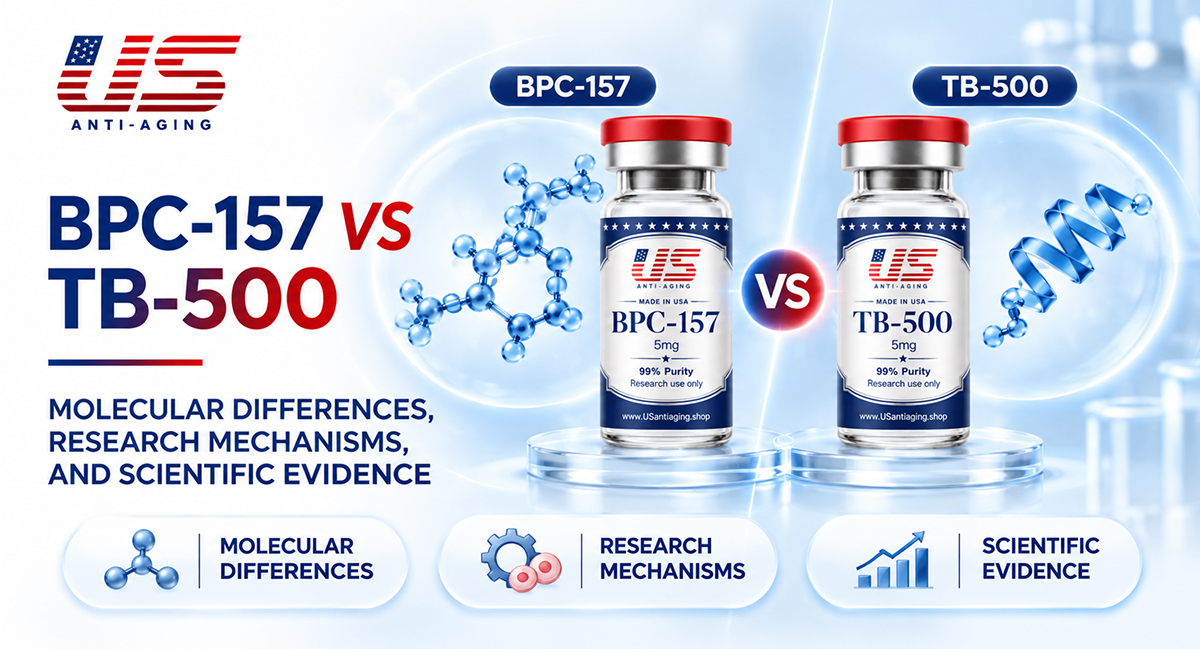


BPC-157 vs TB-500 is a comparison of two investigational peptides with different molecular origins, structures, and research mechanisms. BPC-157 is a synthetic 15-amino-acid peptide studied primarily in experimental injury and cellular signaling models. TB-500 commonly refers to a seven-amino-acid fragment of thymosin beta-4, although researchers and commercial suppliers sometimes use the name for different molecular forms.
Both have attracted interest in tissue repair research, but their biological effects are not interchangeable. Importantly, neither compound has sufficient controlled human evidence to establish therapeutic effectiveness or long-term safety.
For laboratories exploring peptide chemistry, US Anti-Aging provides research-focused compounds for scientific investigation.
This comparison examines molecular identity, signaling mechanisms, preclinical findings, and evidence limitations.
What Are BPC-157 and TB-500?
BPC-157 and TB-500 are peptide compounds investigated for different biological characteristics associated with cellular activity and experimental tissue repair.
However, their research histories, molecular identities, and supporting evidence differ substantially.
Understanding BPC-157
BPC-157, or Body Protection Compound-157, is a synthetic pentadecapeptide associated with research originating from gastric protein-related investigations.
Scientists have explored its activity in tendon fibroblasts, vascular cells, and animal injury models.
Experimental findings have suggested relationships with cellular migration, adhesion-associated signaling, and vascular responses. Nevertheless, these observations remain predominantly preclinical.
Understanding TB-500
TB-500 commonly refers to an N-terminally acetylated fragment corresponding to residues 17–23 of thymosin beta-4.
Thymosin beta-4 is a naturally occurring 43-amino-acid peptide involved in actin regulation and cellular movement.
However, the name TB-500 is not consistently applied across all research and commercial materials.
Analytical investigators identified the seven-amino-acid fragment Ac-LKKTETQ in a product marketed as TB-500 (Esposito et al., 2012).
Therefore, researchers must verify the precise compound before comparing experimental results.
How Do Their Molecular Structures Differ?
The clearest distinction in BPC-157 and TB-500 involves amino acid sequence, molecular size, and biological origin.
These differences can influence molecular recognition, enzymatic degradation, and interactions with experimental systems.
Molecular Comparison
| Characteristic | BPC-157 | TB-500 |
|---|---|---|
| Classification | Synthetic pentadecapeptide | Synthetic thymosin beta-4-related fragment |
| Amino acid length | 15 | Commonly 7 |
| Sequence | GEPPPGKPADDAGLV | Ac-LKKTETQ |
| Approximate molecular weight | 1,419.5 Da | 889 Da |
| Molecular origin | Gastric protein-related research | Thymosin beta-4 sequence |
| Principal research areas | Cellular migration, vascular signaling, injury models | Peptide metabolism, actin-related biology, cellular assays |
The TB-500 characteristics above refer to the acetylated seven-residue fragment, not full-length thymosin beta-4.
Why Sequence Differences Matter
A peptide’s amino acid sequence influences its physical characteristics and interactions with biological molecules.
BPC-157 contains several proline residues and charged amino acids that contribute to its molecular properties.
In contrast, TB-500 contains a short region associated with the actin-binding functions of thymosin beta-4.
However, the presence of this sequence does not establish that TB-500 reproduces every function of the full-length parent peptide.
Chemical Identity and Experimental Consistency
Researchers commonly use mass spectrometry and chromatography to verify peptide identity and purity.
This is particularly important for TB-500 because the same commercial name may refer to different molecular preparations.
Consequently, meaningful comparisons require confirmed sequences, chemical modifications, and analytical specifications.
How Do Their Research Mechanisms Compare?
Researchers have investigated different molecular pathways associated with BPC-157 and thymosin beta-4-related peptides.
However, proposed mechanisms should be distinguished from established receptor interactions or demonstrated human effects.
BPC-157: FAK–Paxillin and VEGFR2 Signaling
BPC-157 investigations have examined focal adhesion kinase (FAK), paxillin, and vascular endothelial growth factor receptor 2 (VEGFR2).
FAK and paxillin participate in cellular adhesion and migration, while VEGFR2 contributes to vascular signaling.
In cultured rat tendon fibroblasts, BPC-157 exposure increased migration and FAK–paxillin phosphorylation (Chang et al., 2011).
Separate experiments reported VEGFR2-associated changes during angiogenesis-related investigations (Hsieh et al., 2017).
However, these findings do not establish a definitive direct receptor target or prove corresponding effects in humans.
For laboratories investigating BPC-157 molecular mechanisms, cellular signaling, and preclinical evidence, explore BPC-157 Peptide for Research at US Anti-Aging, intended strictly for scientific and laboratory research.
TB-500: Actin-Associated Biology
Research involving thymosin beta-4 focuses heavily on actin regulation.
Actin participates in cytoskeletal organization, cell migration, and cellular shape changes.
Experimental investigations demonstrated that a seven-amino-acid actin-binding region of thymosin beta-4 contributes to selected angiogenesis-related responses (Philp et al., 2003).
Nevertheless, those results should not automatically be attributed to acetylated TB-500 without confirming molecular equivalence.
For laboratories investigating TB-500 molecular structure, peptide metabolism, and preclinical research, explore TB-500 Peptide for Research at US Anti-Aging, intended strictly for scientific and laboratory research.
Mechanistic Differences at a Glance
The principal research distinctions involve:
- BPC-157: FAK–paxillin activity, VEGFR2-related responses, and experimental cellular migration.
- TB-500-related sequences: Actin-associated interactions, peptide metabolism, and selected cell migration responses.
- Shared experimental interests: Vascular processes, extracellular matrix organization, and tissue-related biological measurements.
Importantly, overlapping experimental outcomes do not prove identical mechanisms.
What Do Their Preclinical Studies Reveal?
Preclinical investigations provide the strongest available evidence for comparing BPC-157 vs TB-500.
However, different experimental models and molecular preparations complicate direct comparisons.
BPC-157 in Experimental Injury Models
Researchers have investigated BPC-157 in rodent tendon, ligament, and muscle injury models.
Common measurements include cellular migration, histological organization, and biomechanical properties.
Although some studies have reported favorable outcomes, animal findings cannot independently demonstrate human clinical effectiveness.
TB-500 and Thymosin Beta-4 Research
A 2026 scoping review examined 80 studies involving thymosin beta-4, TB-500, and related derivatives.
Most investigations involved full-length thymosin beta-4 rather than the specifically defined TB-500 fragment.
Furthermore, evidence concerning direct musculoskeletal applications remained comparatively limited (McGuire et al., 2026).
This distinction limits the conclusions researchers can draw about TB-500 itself.
What Does a Direct Comparison Study Show?
A 2026 study investigated BPC-157, a preparation described as synthetic thymosin beta-4 (TB-500), and their combination in a rat Achilles tendon injury model.
Researchers divided 32 rats into four groups and examined tendon structure and mechanical properties after four weeks.
The TB-500 group demonstrated statistically significant improvements in selected histological measurements and maximum load to failure compared with controls.
However, the combined treatment did not produce additional benefits compared with either compound alone (Biçer et al., 2026).
Importantly, the authors described their material as synthetic thymosin beta-4, so these findings should not automatically be assigned to the seven-residue acetylated TB-500 fragment.
Interpreting the Results
The experiment provides preliminary comparative information, not evidence that one peptide is clinically superior.
Its limitations include a small animal sample, a single injury model, and a relatively short observation period.
Additionally, formulation identity remains essential when comparing its findings with other TB-500 investigations.
How Do Their Evidence and Safety Gaps Differ?
The central question in BPC-157 and TB-500 is not which compound has stronger marketing claims, but which findings directly support each molecular preparation.
Both substances have substantial evidence limitations.
BPC-157: Limited Human Investigations
A 2026 systematic review identified three small human studies involving 30 participants.
The investigations had important methodological weaknesses, including small samples and inadequate controls.
Consequently, the reviewers rated the overall certainty of evidence as very low (Poolton et al., 2026).
For laboratories investigating BPC-157 molecular mechanisms, cellular signaling, and preclinical evidence, explore BPC-157 Peptide for Research at US Anti-Aging, intended strictly for scientific and laboratory research.
TB-500: Greater Molecular Identity Uncertainty
The evidence gap for TB-500 is particularly complicated by inconsistent naming.
Although full-length thymosin beta-4 has undergone selected human investigations, those results cannot establish the clinical properties of the acetylated fragment.
Furthermore, direct human exposure and safety data for the defined TB-500 fragment remain insufficient.
For laboratories investigating TB-500 molecular structure, peptide metabolism, and preclinical research, explore TB-500 Peptide for Research at US Anti-Aging, intended strictly for scientific and laboratory research.
Shared Safety Concerns
Important unanswered questions include:
- Long-term toxicity and immunogenicity.
- Human pharmacokinetics and metabolism.
- Peptide-related impurities and product characterization.
- Reproducibility across independent laboratories.
- Clinical effectiveness in controlled human trials.
The FDA identifies potential safety concerns involving both BPC-157 and thymosin beta-4 fragments, including immunogenicity and inadequate human safety information.
Neither peptide has FDA approval as a therapeutic drug.
To explore how peptides interact with cellular processes involved in tissue repair, read our comprehensive guide, Peptides in Tissue Repair Research: Biological Mechanisms and Current Evidence, covering molecular mechanisms, experimental models, and the current state of scientific evidence.
FAQs About BPC-157 vs TB-500
1. What is the main difference between BPC-157 and TB-500?
BPC-157 is a synthetic 15-amino-acid peptide, while TB-500 commonly refers to a seven-amino-acid thymosin beta-4 fragment.
They have different molecular structures and research histories.
2. Do BPC-157 and TB-500 work through the same mechanisms?
Not necessarily. Researchers have investigated BPC-157-related FAK–paxillin and VEGFR2 signaling, while thymosin beta-4 research emphasizes actin-associated cellular processes.
Their precise mechanisms require further investigation.
3. Which peptide has stronger scientific evidence?
BPC-157 has more directly relevant musculoskeletal preclinical research, whereas full-length thymosin beta-4 has a broader research history across several tissue systems.
Neither evidence base establishes the clinical effectiveness of the defined TB-500 fragment or BPC-157.
4. Have researchers studied BPC-157 and TB-500 together?
Yes. A 2026 rat Achilles tendon study examined both compounds and their combination.
However, combined treatment did not demonstrate additional benefits, and the molecular form described as TB-500 requires careful interpretation.
5. Are BPC-157 and TB-500 FDA-approved?
No. Neither BPC-157 nor TB-500 is an FDA-approved therapeutic drug.
Their research findings should not be interpreted as established medical benefits.
Conclusion: Interpreting BPC-157 vs TB-500 Research
The scientific comparison of BPC-157 vs TB-500 highlights differences in molecular structure, experimental mechanisms, and available evidence.
BPC-157 research has focused on cellular migration, vascular signaling, and preclinical injury models. Meanwhile, TB-500 research requires careful differentiation between the acetylated fragment and full-length thymosin beta-4.
Although some experimental findings are promising, neither compound has sufficient evidence to establish human clinical effectiveness or long-term safety.
For laboratories investigating their molecular characteristics, explore BPC-157 and TB-500 at US Anti-Aging, intended strictly for scientific research.
Disclaimer: All compounds and information presented in this article are intended strictly for scientific research and educational purposes. These products are not approved for medical use and are not intended for human or veterinary use, diagnosis, treatment, or prevention of any disease.